Central Library of the University of Augsburg
CastleHarburg
Harburg Castle
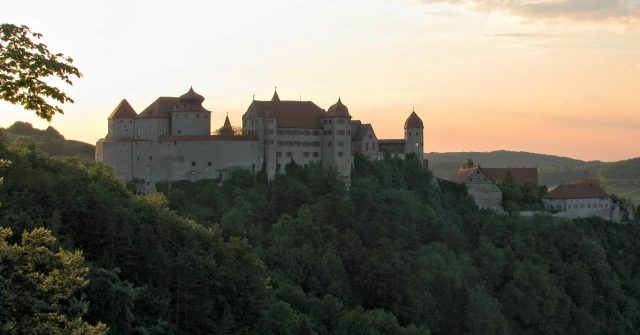
Above the town of Harburg (Swabia) stands the castle of the same name, Harburg Castle, an extensive medieval complex from the 11th/12th century. The condition from the 18th century is largely preserved. The hilltop castle at 480 m above sea level, like the castles of Wallerstein and Baldern, belongs to the princely house of Oettingen-Wallerstein.
The first written mention of Harburg dates back to 1150 AD. At that time, the 13-year-old Staufer Heinrich (VI.), son and co-king of King Konrad III, wrote a letter to Constantinople to his aunt, Empress Irene of Byzantium, and her husband Manuel Komnenos, in which he reported on the Battle of Flochberg. He mentioned that he was staying at Harburg at the time. In 1299, the castle was pledged by King Albrecht I from the House of Habsburg to the Counts of Oettingen. After the extinction of the line, it passed to the House of Oettingen-Wallerstein in 1731.
In 1530, Hieronymus Wolf was a scribe at Harburg.
The Castle's Defenses
The core castle is enclosed by a ring wall with six towers, which is among the oldest parts of the building. It includes the bailiwick, the two keeps, the palas (princely building), the Kastenhaus, the draw well, the castle church, and the crypt chapel. Slightly lower lies the outer bailey with the farm buildings, which include the Red Stable. It is said to have been sketched by Carl Spitzweg during a visit (1858).
The Well
Harburg Castle has a well that once had a depth of 129 meters. One had to operate the adjacent treadwheel for over half an hour to get a bucket of water. Today it is only about 50 meters deep, as the tunnel of federal highway 25 runs directly beneath the castle.
Battlements and Zwinger
The covered battlement, built in the 15th century, served to defend the castle. The side of the castle facing the plateau was most vulnerable to attacks. Here the walls were particularly strong. In addition, the castle was protected at this point by a zwinger with semicircular wall towers.
In the defensive wall there are loopholes, murder holes, and ball loopholes. A recoil timber for hanging arquebuses is attached to the loopholes. Through the murder holes, which point downwards, quicklime or pitch could be poured. The ball loopholes are movable wooden balls with a hole, which were built into the wall. They are also called wooden eyes.
The Keeps
Harburg Castle had two keeps, the Diebsturm (Thief's Tower) and the Faulturm (Lazy Tower). They are among the oldest buildings at Harburg and date from the 12th century. Originally, the keep was intended as the last refuge for the inhabitants of the attacked castle, if enemies had already penetrated the castle.
The older, western keep, the Diebsturm, is for this reason very high and very thick. Its walls have a thickness of three meters at the bottom. The large stones required for this were brought to the site with ox carts via a ramp. The entrance to the Diebsturm was formerly five meters above the ground on the first floor. The Harburg residents entered the keep with a ladder. However, the keep was not only used for defense; through a hole on the first floor, supplies were lowered nine meters into the Diebsturm with a winch. This cellar was an important storage room, as it was always cool inside the three-meter-thick walls. Later it was used as a prison. There were two torture chambers in the Diebsturm. In one torture chamber it could be made very hot, but in the other it was very dark and cold in winter. The old storage cellar became a dungeon into which prisoners were lowered, and was therefore also called the "Angstloch" (fear hole).
The eastern keep, the Faulturm, was converted into a staircase for the hall building in the 18th century. The roof, the snail-shaped cap, also dates from this period.
Further Buildings
Bailiwick, Kastenhaus and Pfisterbau
In 1562, the bailiwick was built as a half-timbered building, inhabited by the castle bailiff. Today it houses an inn and the castle hotel. The Kastenhaus was also built in the 16th century. It originally served as a granary, later it was used as a stable and armory. Directly next to the castle church is the Pfisterei, the former bakery, where flour was processed into bread. Today it houses the castle shop.
Hall Building
The hall building originally served as accommodation for the castle garrison. Between 1717 and 1721, Prince Ernst Albrecht added another floor and a large, representative hall. Since then, the Faulturm has served as its staircase. The ceiling paintings were brought to Harburg from the demolished Tiergarten Castle near Schrattenhofen. They depict scenes from Greek mythology.
Princely Building
The Princely Building, which contains remnants of the palas, served as a residence for the comital family in the 16th century. Later, the building was used as quarters for hunting parties and, at the beginning of the 19th century, as a granary.
In 1948/49, Prince Eugen had the Oettingen-Wallerstein Library and art collection housed here. The library was sold to the Free State of Bavaria in 1980 for 40 million DM and is now housed in the Central Library of the University of Augsburg.
St. Michael's Castle Church
The single-nave castle church, now characterized by Baroque style, is Harburg's oldest church. It originated in the 18th century from the Romanesque castle chapel. Three larger-than-life figures adorn the church. They depict Count Gottfried and his two wives. Further statues depict Louis XVI and his two wives Salome and Elisabeth. The entrance to the crypt chapel of the Protestant Oettingen-Oettingen line is guarded by two warrior statues. In addition, late Gothic carvings depicting a Madonna and the Archangel Michael can be seen.
Harburg Castle Festival
From 1996 to 2010, the multi-day Harburg Castle Festival was held in the summer on the castle grounds. All proceeds went to charitable causes. The organizer was the Kiwanis Club Donauwörth.
Take Mobile History with you
You are reading this text for free. Premium adds what matters on the road: descriptions read aloud, sites found through your camera, whole regions taken offline.
- Every description, including the ~17,700 Premium sites
- Audio guide: have descriptions read to you on location
- AR finder: see sites through your camera, with distance and bearing
- Unlimited saved sites
14 days free, then from €2.99 a month. Cancel anytime.
Location: 48.7850, 10.6870