Restaurant
CastleLauf an der Pegnitz-Nuschelberg
Haller Castle
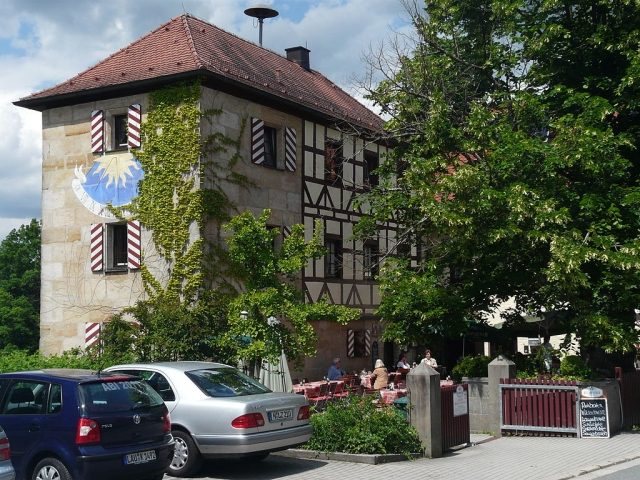
Of the three Nuschelberg farms, mentioned in 1275 and 1326, one was owned by the Breitenstein family as an imperial fief in 1398. However, they also acquired the other two, apparently as free property, and granted them as fiefs themselves. In 1530, Christoph, Joachim, and Hans von Breitenstein renounced their feudal rights and sold the two farms to the widow Anna Gartner. Only a few months later, Anna sold the two estates to the Nuremberg citizen Endres Pegnitzer, who in 1534 resold them to Sebastian Cammerer for 1,010 guilders. In the following years until 1541, Cammerer "built a seat on one of the farmsteads," which, however, was damaged only a few years later in the Second Margrave War in 1553. It is still unclear whether any remains of Cammerer's old building have been preserved in the square sandstone tower of the "Hallerschlösschen." The damage incurred in 1553 was evidently repaired when Wolf Cammerer sold the seat to Caspar Benninger and Georg Beer in 1587. The two Laufer citizens initially used the manor house together but then divided the seat. It is possible that the half-timbered extension to the tower, and thus its current characteristic appearance, originated in these years.
In 1607, Seyfried Pfinzing – who already owned several manor houses – acquired one half, and in 1617, he was able to unite the entire property in his hand. In the same year, he died as the last of his family branch, not without having previously transformed the Nuschelberg property into the core of a charitable foundation for needy men.
The foundation administrators were the Pfinzing family until their extinction in 1764/66, and thereafter until the dissolution of the foundation in 1811, their universal heirs, the Haller von Hallerstein, which is why the small castle still bears their name today. The modest furnishings of the seat are evident from an 1815 description and make a longer stay of the Hallers at the castle rather unlikely: the ground floor and the second upper floor were undeveloped, the first upper floor was rented to a day laborer family. On-site administration had been entrusted to a Vogt since the 17th century, who lived in the opposite Voitenhaus (Nuschelberger Hauptstraße 4). The current single-story building with a mansard roof and dormers dates from the 18th century.
The estate was broken up, and the manor house was sold in 1815 for the modest sum of 600 guilders to Johann Kießkalt. The new owner set up a tavern in the castle, which developed into a popular excursion destination under the following families and was fundamentally renovated in 1934. The extension with half-timbering and stone plinth, completely destroyed by a bomb hit in World War II, was rebuilt to approximately its old condition as early as 1948. The castle still serves as an inn today.
Take Mobile History with you
You are reading this text for free. Premium adds what matters on the road: descriptions read aloud, sites found through your camera, whole regions taken offline.
- Every description, including the ~17,700 Premium sites
- Audio guide: have descriptions read to you on location
- AR finder: see sites through your camera, with distance and bearing
- Unlimited saved sites
14 days free, then from €2.99 a month. Cancel anytime.
Source: Wikipedia · Licence: CC BY-SA 4.0 · Image: http://de.wikipedia.org/wiki/Datei:Nuschelberg.jpg
This description draws on the facts documented in the linked Wikipedia article; Wikipedia content is licensed under CC BY-SA 4.0. Wording and editing: Mobile History.
Location: 49.5377, 11.2336