Restaurant
ManorMunich-Harlaching
Menterschwaige Manor
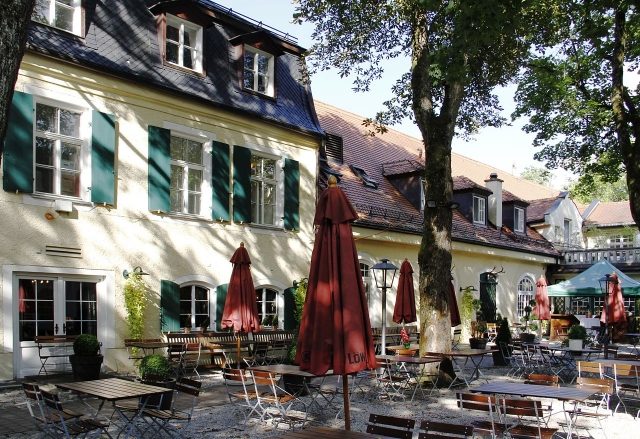
The Menterschwaige manor is a listed, three-winged building in Munich directly on the high bank of the Isar, separated from the edge of the slope only by a public pedestrian and cycle path and old forest. It is located in the Munich district of Harlaching, and the surrounding quarter is named after it as Menterschwaige. Today, the manor houses an inn with a beer garden.
The Menterschwaige dates back to a dairy farm called Harthausen, first mentioned in a deed of ownership around the year 1012. The name comes from the word Hardt for a high-lying forest. Since 1189, a church, built south of the farm on the clearing at the edge of the Perlacher Forst, also belonged to the dairy farm. In the 15th century, the farm, like Grünwald, located about five kilometers to the south, came into the possession of the Dukes of Bavaria. Duke Johann IV retreated from Munich to the secluded Harthausen dairy farm in the plague year of 1463 but was nevertheless infected and died there.
In 1504, the manor burned down, and the rebuilt farm was destroyed by the Swedes in 1632 during the Thirty Years' War. In 1660, Elector Ferdinand Maria gifted the property to his Lord High Steward Maximilian Graf von Kurz, who rebuilt a farm with livestock there. After his death, the ducal family reacquired the dairy farm, and it remained in the possession of the Wittelsbachs until 1793.
Excursion Destination in the 19th Century
Subsequently, the farm was sold several times in quick succession. The first buyer was the Imperial Count Marquart von Kreith, from whom the Nockher banking family, known for the Nockherberg, acquired the Menterschwaige. In 1803, Nockher opened an inn for the first time in the former manor. The next owner was the Swiss David Edvard. In 1807, Peter Johann Gaibl acquired the farm. He already operated the Menter brewery and restaurant in Munich's old town, so he was referred to as Menterbräu, and since then, the inn and the Harthausen estate became known as Menterschwaige.
Due to its charming location on the high bank with views of the river and the Alps, the inn became a popular destination for country excursions from the city, and longer stays for summer retreats were also popular. It is described as "a solitary inn, [...] where the magnificent mountains for the first time allow us a confidential glimpse into their bosom" and the Menterschwaige "is one of the most popular places to visit, especially on Sundays and holidays and on May 1st, where thousands of people gather here." Travel reports from visitors to Munich around the mid-19th century almost always mention an excursion to the Menterschwaige.
Of particular importance were the annual artists' festivals hosted by King Ludwig I at the Menterschwaige. Originally scheduled for May 1st, they were often postponed due to the weather, sometimes well into June. These were joint festivals of all Munich artists' and singers' associations, who marched as a promenade with "music, flags, women, drinking horns, and parasols" from the city along the Isar for about an hour and a half to the inn. There, a festival ground with various stages and backdrops had been set up, where "knight, ghost, phantom, tragic, and horror comedies" were performed. There were lavish meals and Maibock beer.
According to countless publications, Lola Montez, the king's common-law mistress, is said to have hidden in the Menterschwaige on February 11, 1848, when riots broke out in Munich because of her. These statements are incorrect. Montez spent the first night after her escape from the city on the other side of the Isar in an inn in Großhesselohe, as evidenced by a letter from her hand to the king. The next night she retreated to Blutenburg and then fled via Lindau to Switzerland.
The Renovation of 1899
In 1896, the construction company Heilmann & Littmann bought the inn and the associated 52 hectares of land for 450,000 Marks. Jakob Heilmann developed the region for the villa colony of the same name, Menterschwaige. He sold the actual inn with four hectares of land in 1898 to the public limited company Bürgerliches Bräuhaus München, on whose supervisory board Heilmann sat, for 220,000 Marks. The following year, the brewery demolished agricultural outbuildings and rebuilt the complex. At that time, they constructed approximately the current building stock. It consists of the historic main building under a mansard roof with two guest rooms on the ground floor and two more on the upper floor, as well as an adjoining beer hall with a cross vault in the former cowshed. A connecting wing with a kitchen, cold room, and two more guest rooms connected the large "restaurant hall with stage" in the south wing, arranged parallel to the main building. Of another hall directly on the edge of the slope beyond the public path, only parts of the foundations remain. The opening of the tram line to Grünwald in 1910 with a Menterschwaige stop facilitated access. In 1921, Bürgerbräu merged with Löwenbräu. After the Second World War, the United States confiscated the Menterschwaige inn and the majority of the villas in the surrounding district. A cinema was set up in the hall. In the late 1950s, Löwenbräu received the Menterschwaige back and restored the manor.
Today, the Menterschwaige is a restaurant with around 500 seats in various rooms and a popular Munich beer garden with over 2000 seats. The so-called Lola Montez House can be rented for events.
St. Margaretha Church
In 1189, the associated church, under the patronage of St. Margaretha, was consecrated by Bishop Otto II of Freising. It was subordinate to the Schäftlarn monastery as a filial church. By 1315, it is documented that the church had by then belonged to the Bogenhausen parish. Later, it was assigned as a subsidiary church to the filial church in Giesing, and in 1628, it was subordinated to the newly established parish in Au. Around 1750, the church was expanded and rebuilt through donations from the later owners of the Nockher estate and generously furnished in the Rococo style. After the secularization in 1803, the then owner of the Edvard estate mistakenly considered the church his property, although as a community church it was not subject to secularization, and had it demolished in 1804. He sold the furnishings through an antique dealer. This was only noticed in 1807 when the new owner Gaigl inquired, asking for permission to set up an altar room for house services.
Take Mobile History with you
You are reading this text for free. Premium adds what matters on the road: descriptions read aloud, sites found through your camera, whole regions taken offline.
- Every description, including the ~17,700 Premium sites
- Audio guide: have descriptions read to you on location
- AR finder: see sites through your camera, with distance and bearing
- Unlimited saved sites
14 days free, then from €2.99 a month. Cancel anytime.
Source: Wikipedia · Licence: CC BY-SA 4.0
This description draws on the facts documented in the linked Wikipedia article; Wikipedia content is licensed under CC BY-SA 4.0. Wording and editing: Mobile History.
Location: 48.0816, 11.5452