Holiday homes
ManorPassow-Weisin
Weisin Manor
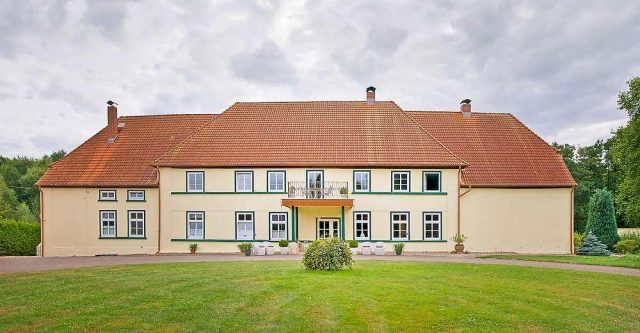
The village of Weisin was first mentioned in a document in 1235, when Bishop Brunward of Schwerin transferred the village to the parish of Kuppentin. A personal name, Johannis de Weisin, was also mentioned. His son Gerhardus appeared as a witness in 1285, as documented by records. The place name Weisin is of Wendish origin and means Vysina (hill), also hill village.
When Weisin was removed from the district of Kuppentin and assigned to the church in Benthen is not known. In addition to the von Lobeck and von Dessin families, the Lords von Weltzien also acquired first revenues and shares of property in Weisin around 1370. From 1509 to 1701, the von Weltzien family resided continuously in Weisin and on the moated castle, which probably burned down in 1687 due to lightning. Since 1490, the von Weltzien family had their residence on the castle protected by water. As early as 1689, a new manor house was built on the estate, which had been laid out further east in 1590. In 1701, Captain Gerd Friedrich von Weltzien mortgaged the estate.
Succession of owners of the estate:
- 1533 Balthasar and Joachim von Weltzien
- 1573 Jaspar and Heinrich von Weltzien
- 1593 Batzer von Weltzien
- 1610 Johann Adeloff Friedrich von Weltzien
- 1701 Captain Gerd Friedrich von Weltzien
- 1702 Sigmund Friedrich von Restorff
- 1733 Johann Bernhard von Stralendorff
- 1753 Captain Hans Christoph von Rieben
- 1782 Major Gerhard von Levetzow
- 1783 Simon Peter and Christian Langfeldt
- 1819 Major General Johann Caspar von Boddien
- 1837 Johann Friedrich Hofschläger
- 1870 Peter Godeffroy
- 1904 Chamberlain Dr. jur. Arnold Woldemar von Frege-Weltzien
- 1917 Alfred and Ehrenfried von Wolffersdorf
From 1838 until the end of the Second World War, there was a main sheep farm in Weisin. Merino sheep imported from Spain were kept, driven to Hamburg, and from there transported by sailing ship to Australia, to the area of Adelaide. In 1925, Weisin received electric lighting through a line to the power station at the Bobzin lock. From 1940, the manor house served as a hospital and accommodation for up to 80 refugees and displaced persons. From 1954, in addition to apartments and a kindergarten in the east wing, a Konsum sales outlet was also housed in the manor house. The manor house with a small park is located directly on the Elde river.
In October 1952, the first LPG was founded, which, as Clara Zetkin, was soon converted from Type I to Type III and merged with the LPG Seefeld Charlottenhof. After the political change of 1989, the Weisin lands are managed by the Passow agricultural cooperative.
Until the 1990s, rental apartments were set up in the manor house. In 1998, H.G. Wolf from Bremen was able to acquire the manor house; he had the house and the entire property extensively renovated. In 2007, there was another change of ownership. The Jakobs family (originally from Hanover) operates a cozy, small holiday guesthouse with several holiday apartments in the house. Two small halls are also available in the house for conferences and events.
Take Mobile History with you
You are reading this text for free. Premium adds what matters on the road: descriptions read aloud, sites found through your camera, whole regions taken offline.
- Every description, including the ~17,700 Premium sites
- Audio guide: have descriptions read to you on location
- AR finder: see sites through your camera, with distance and bearing
- Unlimited saved sites
14 days free, then from €2.99 a month. Cancel anytime.
Source: Wikipedia · Licence: CC BY-SA 4.0 · Image: http://www.werner-conrad.de/gutshaus-weisin.html
This description draws on the facts documented in the linked Wikipedia article; Wikipedia content is licensed under CC BY-SA 4.0. Wording and editing: Mobile History.
Location: 53.4981, 12.0755