Uninhabited
ManorUdars
Udars Manor
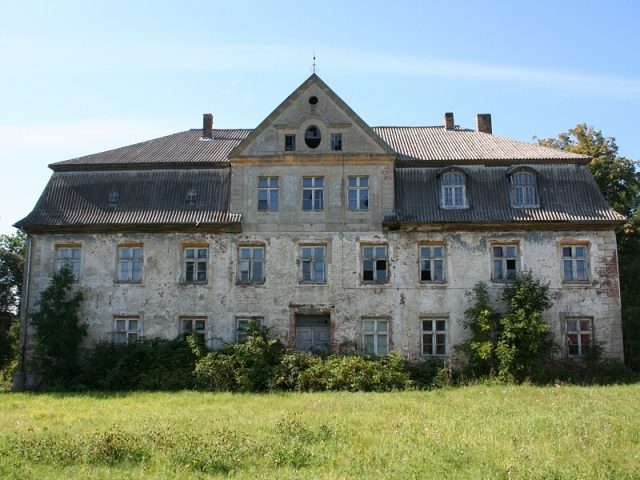
Udars is a district of the municipality of Schaprode in the northwestern part of the island of Rügen. Udars is located south of the country road from Schaprode in the west to Trent in the east, not far from the Udarser Wiek. The name comes from the Slavic language area ("udarzici" = "the men of Udarg") and was probably a Slavic princely seat.
The first documented records date from the early 14th century. Owners included the families von Pentz (before 1408), von Barnekow, and until the Reformation, the Hiddensee Monastery. After that, the place was in manorial possession. The last duke from the Griffin dynasty of Pomerania, Bogislaw XIV, established the estate around 1624 as a widow's seat for his wife Agnes, and united the three existing farmsteads into the manor village of Agnesenhof.
The sister of the last Pomeranian duke, Duchess Anna von Croÿ, received Udars as a gift in 1629. Her son Ernst Bogislaw von Croy sold Udars in 1657 to the Stralsund council family von Wolfrad, who after 1734 transferred it to the von Usedom family of Kartzitz. This family held the estate, with about four hundred hectares on the Udarser Wiek, until about 1901. After this, a bourgeois owner acquired the estate, but soon passed it on.
His successor, Fritz Kroos, built workers' houses at the village entrance after 1920. During the Great Depression, the estate went bankrupt and was divided by the Berliner Siedlerbank and sold to families, predominantly from Holstein, who established smaller farms of 20 to 35 hectares here.
The main building, manor house, the inspectorate, and a smaller area including the manor park and a garden plot to the west of it were taken over by Karl von Schultz-Granskevitz, who had employees living there in the 1930s and set up a nursery garden for his seed breeding company "Norddeutsche Saatzuchtgesellschaft KG von Schultz-Granskevitz". Until and after the end of the war, Udars Manor house rapidly changed hands, serving as a military hospital, a building used by the Red Army after expropriation, and a refugee home. Karl von Schultz from the old Rügen family von Platen-Granskevitz was abducted by the Soviet Military Administration in Germany in 1945 and has been missing ever since.
Udars Manor House+
Udars Manor House is a nine-axis building of approximately 16 × 34 m, erected around 1660 over a much older building. A Gothic cross-vaulted cellar under the south side of the house dates from the original construction. The northern cellar area is walled up and filled with sand. It is presumed that plague victims were hastily buried here before 1650. In early summer 1994, this walled-up area was accessed at three points with larger boreholes for sample collection, but nothing of the sort was found.
The two-story plastered building with lugged plaster fascias on the windows and pronounced corner rustication has a crowned high mansard roof, erected in the 19th century, with dormer gables to the east (courtyard side) and west (field/park side), as well as some dormers dating from that period.
Preserved from the 1660 renovation are the simple staircase with baroque board balusters, the servants' staircase, the baroque entrance door (partially subsequently clad), some interior doors and windows, two open fireplaces in the large hall on the first floor, partially simple stucco mouldings in the old rooms, and sparse remnants of textile wall coverings. In the ground floor side corridor at the southern side entrance, an open smoke vent was uncovered, dating from before 1660.
In the early 1950s, the manor house became part of the "Vereinigung volkseigener Güter, Schwerin" (Association of People's Own Estates, Schwerin). Until 1994, it served as an employee residence for the VEG (Volkseigenes Gut - People's Own Estate) Tierproduktion Granskevitz, whose last director was Eckard Daberkow. After this, Matthias Graf von Krockow acquired the manor house and a small park, but his planned renovation of the house stalled in its early stages.
Various concepts were developed for the use of the building. Udars was intended to become an external branch of the Pomeranian State Museum for temporary exhibitions, and a butterfly park was also planned. Funding for the remaining investment sum did not materialize due to the lack of official permits for renovation, new construction, and change of use. Since 2004, Udars Manor House has been owned by a family from Kempten.
The building was already a protected monument during GDR times and was included in the monument protection list of the Rügen district under number 764 after reunification.
Legend+
Local folklore tells of an underground passage that is said to lead to the manor house in Streu-Schaprode. Furthermore, the ghost of the last Countess Usedom is said to haunt the house; she died in Frankfurt in the early 20th century, far from the island of Rügen. A Puck is also said to reside in Udars, having come from Scandinavia via Holstein four hundred years ago.
Take Mobile History with you
You are reading this text for free. Premium adds what matters on the road: descriptions read aloud, sites found through your camera, whole regions taken offline.
- Every description, including the ~17,700 Premium sites
- Audio guide: have descriptions read to you on location
- AR finder: see sites through your camera, with distance and bearing
- Unlimited saved sites
14 days free, then from €2.99 a month. Cancel anytime.
Source: Wikipedia · Licence: CC BY-SA 4.0
This description draws on the facts documented in the linked Wikipedia article; Wikipedia content is licensed under CC BY-SA 4.0. Wording and editing: Mobile History.
Location: 54.5169, 13.2084