Cultural center
ManorOsterholz - Scharmbeck
Sandbeck Manor
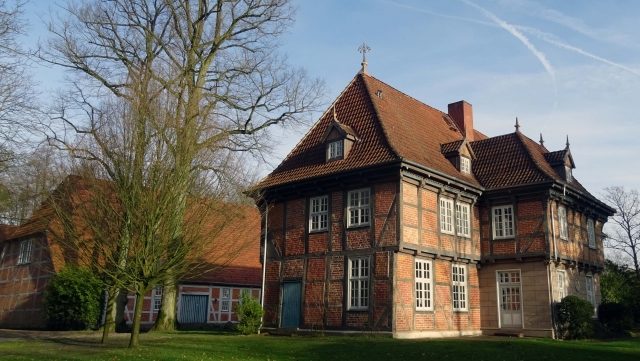
The former knight's seat Gut Sandbeck is located in the district of Osterholz on the Scharmbecker Bach in the district town of Osterholz-Scharmbeck. After extensive restoration, it has served as a cultural center for the city since 1981.
The Börde Scharmbeck probably already existed in 768, but is only mentioned in documents in 1043 as "Scirnbeci". The names Sandbeck and Scharmbeck are ultimately identical and variations of Scirnbeci; the original namesake is the Scharmbecker Bach, which flows south to the Hamme, closing the Hamme bend.
In 1182, the name Westerbeck (Westerbike) was first mentioned; at this time, such names in documents were still often local designations of origin and not always fixed family names.
In 1233, the place Sandbeck was first mentioned by Bertholdus von Westerbike, the ministerialis of the church of St. Petri in Bremen, when he sold his property in Sandbeck for 30 marks to the monastery in Osterholz.
The monastery passed it on in 1331, and thus a family of Sandbeck was first mentioned. This place name, derived from a person's origin (of status), also developed into a fixed part of the name, and since 1343, the letter seal of Heyno von Sandbeck existed: a clear stream (presumably the Scharmbecker Bach) on a blue field and an open helmet with three peacock feathers. On the signet ring, this seal is mirrored, and the crystal-clear stream flows from top left to bottom right; in the seal of the documents themselves, it appears "correctly" from top right to bottom left.
In 1454, Berthold and Heino von Sandbeck entered into an alliance with the city of Bremen, presumably also to gain allies in their disputes with the provosts, who, as patrons of the nunnery in Osterholz, supervised the feudal obligations of the estate.
This alliance was then called upon, and in 1499, Bart(h)old von Sandbeck led 700 men into the Battle of Weddewarden (see History of Hadeln and Wursten), as Archbishop Johann III. Rode von Wale intervened in Wursten, which in turn was allied with Count Johann von Oldenburg.
The feudal burden continued to weigh on the von Sandbecks: 1455 and 1500 were highlights of these disagreements, which led to the intervention of the Archbishop of Bremen.
Therefore, in 1513, the monastery in Osterholz was once again officially enfeoffed with the Sandbecks. On a Sunday (Laetare), Provost Johann Widdenbrügge invited them to the monastery: witnesses included the mayor of Bremen Marten Heyenbroch, the estate owners Warner von der Hude, and the estate owners Brothers Cordt. With this, the Archbishop of Bremen emphasized who exercised secular power in the region; a refusal would have meant the beginning of a feud, and the Sandbecks would probably have lost their fief, which is why Just von Sandbeck (as was customary at the time) tearfully – in front of his entourage – pledged allegiance to the monastery.
Just von Sandbeck died in 1540, but even with that, the conflicts between both sides were not permanently ended.
In 1575, the present manor house was built in the style – now so called – of the Weser Renaissance; due to the two crossings of the Scharmbecker Bach, the original construction as a moated castle remains visible to this day. The builder was Johann von Sandbeck, the master builder was the Bremen council master carpenter Johan Stollink, who had also created the upper floor and roof truss of the Bremen Town Hall in 1609.
On April 17, 1552, the Basdahler knighthood held a Satting (Sate) in Scharmbeck: 328 horses and 3483 foot soldiers were to be provided by the region up to Lesum as military service in case of war. Two horses were allocated to the knight's estate.
The disputes with the monastery escalated in 1613; Herman and Joachim von Sandbeck were accused of having broken into the houses of two monastery tenants with cocked pistols and drawn swords and causing considerable damage there. One monastery tenant was grossly mistreated, another roughly treated and scolded. The reason for this less than glorious behavior was a mocking song composed about the two, which the monastery tenants had sung. The reason for the mocking song was the frequent assaults of the two brothers on the monastery tenants.
In 1705, Jürgen Franz von Sandbeck died in office as royal Swedish district administrator. In 1773, a mill weir was built from heavy hewn stones and a water mill was erected.
The lord of the manor from 1789 to 1840 was Gottlieb Ernst von Sandbeck; under his direction, the estate was known as an "Edelhof" in 1800 and listed 175 position holders, including:
- 46 in Westerbeck
- 20 in Sandbeckerbruch
- 13 in Bargten
During the French period in Bremen from 1812 to 1813, Gottlieb Ernst von Sandbeck was even Maire (mayor) of the Mairie Scharmbeck.
In 1855, the last lord of the manor, Friedrich Christian Heinrich August von Sandbeck, died, and the formerly large estate – it owned more than 10,000 Morgen of land – was so heavily indebted that it had to be sold in the same year for 140,000 Thaler to the banker Carl Hostmann from Celle, who greatly reduced its size through partial sales.
In 1862, it changed hands for 70,000 Thaler to a Mr. Thörnau and in 1875 was still about 250 Morgen in size.
In 1886, the von Hodenberg family acquired it. In terms of area, the estate was still the largest farm in the entire surrounding area. Between 1955 and 1975, the estate changed owners several times before the city of Osterholz-Scharmbeck acquired the remaining area (including the five existing buildings) for 380,000 DM from the IDUNA insurance company on September 23, 1975.
During this eventful period, the more or less suitable living and usable space in the main house, the large barn, and the adjacent buildings was rented out to companies and private individuals.
The city initially restored (until 1979 only in the lower areas, later completely comprehensively) only the main house and developed it into the cultural center Gut Sandbeck. The renovation cost a total of 1.6 million DM and was initially completed with the festive inauguration on June 4, 1981. The original water mill from 1773 had already been demolished in 1971, but the mill weir still exists. In 1984, the restoration of the Large Barn followed, and in 1987, the Small Barn; both have been used culturally ever since.
In September 2011, the manor house and the theater barn were filming locations for the television series Jümmer Justizgeschichten, which was produced by the Hamburg production company miramedia on behalf of NDR.
Take Mobile History with you
You are reading this text for free. Premium adds what matters on the road: descriptions read aloud, sites found through your camera, whole regions taken offline.
- Every description, including the ~17,700 Premium sites
- Audio guide: have descriptions read to you on location
- AR finder: see sites through your camera, with distance and bearing
- Unlimited saved sites
14 days free, then from €2.99 a month. Cancel anytime.
Source: Wikipedia · Licence: CC BY-SA 4.0 · Image: Jörg Heldt
This description draws on the facts documented in the linked Wikipedia article; Wikipedia content is licensed under CC BY-SA 4.0. Wording and editing: Mobile History.
Location: 53.2339, 8.7809