Hotel
ManorDamshagen-Parin
Parin Manor
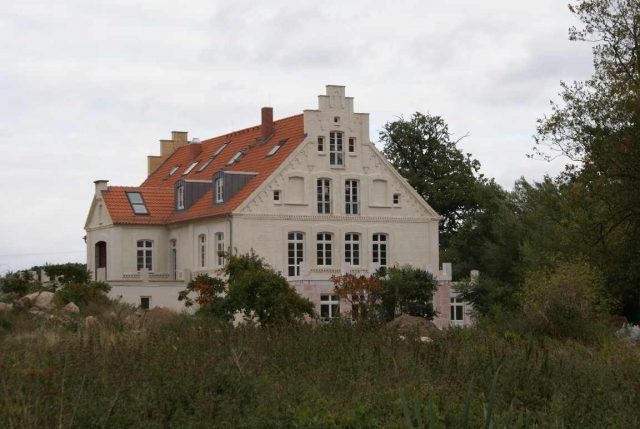
Parin is first mentioned in documents as "Porin" in the Ratzeburg tithe register of 1230. According to this, the tithe from one of the 12 hides was leased to a Theodericus, probably from the de Storm family. The von Plessen noble family, which shaped the Klützer Winkel region, may have owned Parin from the mid-14th century. The mention of a Hinz von Plessen is found for the year 1294, in 1359 "Reymbern von Pleße" is documented as owner, and in 1391 "Helmolt van Pleße zu Poryn". Because the sources only refer to Parin as a "nobleman's seat", there seems to have been no village at this time. The medieval "nobleman's seat" was still known in the area at the beginning of the 20th century under the name "Alter Hof" (Old Farm), and its earthworks were still visible at that time. Pastor Hermann Gustav Adolf Peek reported at the beginning of the 20th century that the fieldstones that had formed the road to this farm were used in 1904 as building material for the former farmworker houses, still inhabited today, on "Unterstraße".
Early Modern Period
The medieval "nobleman's seat" was probably abandoned in the second half of the 17th century and moved to a higher location near the present manor house. Because Volrad von Plessen had served the Winter King Frederick V of the Palatinate, his estates, which included Parin, were expropriated in 1629 and distributed to a follower during the Thirty Years' War (1618-1648) when Albrecht von Wallenstein (1583-1634) was Duke of Mecklenburg. This led to a long legal dispute until Parin returned to the possession of the von Plessens in 1634. On May 19, 1708, Privy Councillor Christian Siegfried von Plessen sold Parin, Rolofshagen, Kussow, and Gutow for 40,000 Thalers to Master of the Horse Hartwig von Bülow. The Parin estate was managed by a scribe in Rolofshagen for the landlords. From 1750, the landlords of Parin were finally the Counts von Bothmer, who were to remain owners of the estate until 1945. In 1751, only a Dutchman, a barn servant, and a shepherd lived in Parin. Thus, a village of Parin did not yet exist in the mid-18th century. The actual village of Parin emerged following the separation of the lease of Parin and Rolofshagen in 1790. This made it necessary for the tenant to take up residence in Parin. The first tenant of Parin was Friedrich Schubert, who had to pay 2500 Reichsthalers to the Counts Bothmer for the lease. Simultaneously with the separation of Parin and Rolofshagen, the farm services for the farmers and cottagers of the villages of Gutow, Kussow, and Moor were also abolished.
Modern Period
In addition to a manor house as their residence, the tenants also built farm buildings in Parin. Furthermore, due to the intensification of agriculture, houses were also built for the farmworkers who worked on the fields of the leasehold. In 1904, two farmworker houses were built, which stand today on the "Unterdorf" street. These houses bear a limestone relief ornament as gable decoration with the inscription "1904" and the initials of the builder: "G.O.v.B.", the landlord Count Otto von Bothmer. From 1821 to 1903, the leasehold was held by Karl Dahlmann and his descendants; the construction of the manor house, which has been preserved to this day, also falls within this period in 1858. The lease of Parin was held by Friedrich von Blücher from 1903 to 1933. The last tenant was August Raspe from 1934 to 1945. Before 1918, the tenants were administrators of the village, so a mayor for Parin and Rolofshagen was only appointed in 1923. In 1926, Parin formed a municipality with Gutow, Hofe, Kussow, Moor, and Rolofshagen. In 1945, the owners of the estate were expropriated and expelled by the communists.
Manor House Parin+
The Parin Manor House was built in 1858 when Karl Dahlmann was the tenant of Parin. The construction of the manor house is thus in the context of Parin being managed by its own tenant, who also required a corresponding representative residence. The manor house, whose construction style resembles a farmhouse, was surrounded by individual farm buildings. The manor house is a single-story building, but appears two-story on the back facing the pond. Particularly striking is the construction of a light well at the front of the manor house, which provides light to the basement of the manor house. The manor house was used as a residential building for families during the GDR era and was also extended for this purpose in the 1980s. After the fall of the Berlin Wall in 1989, the manor house was initially still used as a residence, then stood empty from 2003 and was exposed to the elements, while the municipality, which owned the building, searched in vain for a buyer. The Parin Manor House was acquired in 2007 by the entrepreneur Gertrud Cordes, managing director of the "Bio- und Gesundheitshotel Stellshagen" in Stellshagen, from the municipality and has been extensively restored and converted into a hotel operation since 2008.
Take Mobile History with you
You are reading this text for free. Premium adds what matters on the road: descriptions read aloud, sites found through your camera, whole regions taken offline.
- Every description, including the ~17,700 Premium sites
- Audio guide: have descriptions read to you on location
- AR finder: see sites through your camera, with distance and bearing
- Unlimited saved sites
14 days free, then from €2.99 a month. Cancel anytime.
Source: Wikipedia · Licence: CC BY-SA 4.0 · Image: Roland Neubert, Halle (Saale)
This description draws on the facts documented in the linked Wikipedia article; Wikipedia content is licensed under CC BY-SA 4.0. Wording and editing: Mobile History.
Location: 53.9127, 11.1906