Museum
ManorOßmannstedt
Oßmannstedt Manor
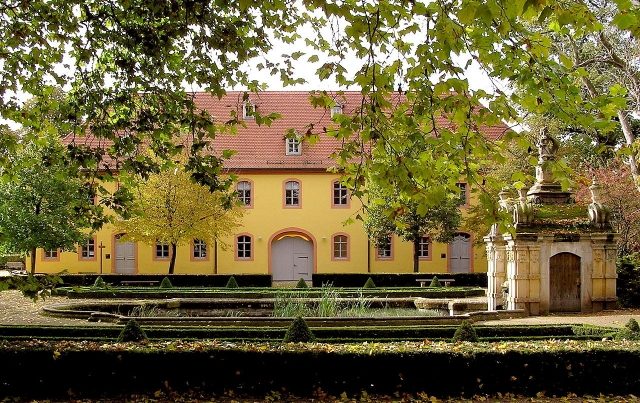
From the mid-13th century until 1440, a collateral line of the Lords of Liebstedt, the Knights of Oßmannstedt, resided in the village. In 1290, they were granted the castle by the King. This castle was located on the left bank of the Ilm in its lower course, at the site of the current estate complex. The Ilm valley here makes way for a ford. The Kupferstraße (Copper Road) crossed the Ilm here, and from the castle, the road and traffic could be well monitored and controlled.
Later, the Knights of Oßmannstedt had to cede their feudal sovereignty to the Lobdeburgers and, from 1344, to the Landgraves of Thuringia.
From 1440, the Counts of Harras acquired the property. The estate and the castle were destroyed in 1450 during the Saxon Fratricidal War. Afterwards, the Counts established a knight's estate.
Then the Lords of Bünau took over the property. They built the manor house and laid out the park.
From 1783 to 1795, the Illuminati August Dietrich, Imperial Count of Marschall auf Burgholzhausen, was the owner of the privy estate in Oßmannstedt.
The country estate (or knight's estate) was the residence of the Wieland family from 1797 to 1803 (in May 1803, it was sold to the Hamburg merchant Christian Johann Martin Kühne (1758–1827)). The residence of the famous poet Wieland is now a memorial that combines a museum and a research center and was reopened on June 25, 2005. The Wieland Estate, as well as the house, belong to the Klassik Stiftung Weimar. In front of the house is a fountain, the Dolphin Fountain, on a landscaped pond. The poet's tombstone is also here, as is that of Sophie Brentano. A hiking trail from Oßmannstedt along the Ilm via Denstedt, Kromsdorf and its castle complex, and Tiefurt Castle to Weimar is a classic route. In addition to the Weimar poets and scholars Goethe, Schiller, and Herder, Heinrich von Kleist, among others, stayed in Wieland's house in Oßmannstedt. As a lord of the manor, Wieland was not the only one of the poets of Weimar Classicism who was not overly successful. Goethe had also owned an estate in Oberroßla and had to give it up at approximately the same time.
Take Mobile History with you
You are reading this text for free. Premium adds what matters on the road: descriptions read aloud, sites found through your camera, whole regions taken offline.
- Every description, including the ~17,700 Premium sites
- Audio guide: have descriptions read to you on location
- AR finder: see sites through your camera, with distance and bearing
- Unlimited saved sites
14 days free, then from €2.99 a month. Cancel anytime.
Source: Wikipedia · Licence: CC BY-SA 4.0 · Image: http://commons.wikimedia.org/wiki/File:Wielandgut_O%C3%9Fmannstedt_-_Gutshaus_mit_Delphinenbrunnen_02.jpg
This description draws on the facts documented in the linked Wikipedia article; Wikipedia content is licensed under CC BY-SA 4.0. Wording and editing: Mobile History.
Location: 51.0164, 11.4261