Educational Institution
ManorKrakow am See-Neu Sammit
Neu Sammit Manor
The estate, built in 1725 as the Neu Sammit outpost, was a small dairy farm with sheep and cattle farming, utilizing the surrounding heathlands. After the systematic afforestation of the barren sandy soil with pines starting in 1790, the von Weltziens sold Neu Sammit in 1793. Despite its primary use as pine forests, Neu Sammit is always referred to as a manor house rather than a forest estate. In 1850, the Bossow forester Kleinkamp reported to the Dobbertin monastery office that Friedrich Buchholz, as the owner of the estate, was clearing fir trees on the disputed border. On March 25, 1905, seven pine trees standing on the Neu Sammit border were removed by the monastery forester Friedrich Zebuhr from Schwinz, in agreement with the estate owner Maximilian Traun, and charged in equal parts by the monastery treasury.
Subsequent owners of the estate were:
- 1800 Johann Christoph Alexander Koenemann
- 1826 Heinrich Seeliger
- 1833 Ludwig Friedrich Lübbe
- 1835 Lawyer Dr. Georg Heinrich Franz Wertheimer from Rostock, who finally separated the small farm from Alt Sammit in 1839.
- 1849 Johann Friedrich Buchholz
- 1868 Otto Erbrecht
- 1873 Kammerjunker Otto Christoph Heinrich Gottlieb von Bülow, most recently with his son Werner Emil von Bülow
- 1885 Allodial estate
- 1896 Maximilian Traun
- 1910 Rittmeister Dr. Gotthard Graf von der Recke-Volmerstein
- 1925 Merchant Hans Adolf Friedrich Giesemann from Hamburg, expropriated in 1949
In 1910, Neu Sammit had only 10 horses and 14 cows. In 1925, the forest estate still comprised 817 hectares, of which 592 hectares were forest with the Grüner Jäger and 144 hectares were water. Forester Willenbrock was responsible for the forest, and fishing and lime burning were also leased out.
In 1942, there were still 578 hectares of forest, 140 hectares of water, and 95 hectares of unusable arable land. In addition to the boathouse on the Langsee, the forest estate included a greenhouse, a bee shed, a game larder, a wood shed, a carriage shed, a granary, a carpentry workshop, garages, a field, and a cowshed.
In 1942, the manufacturer Dr. jur. Peter Hußmann from Bad Liebenwerda wanted to buy the Neu Sammit forest estate for 253,400 Reichsmark. In 1945, the owners were forcibly expropriated and expelled by the communists.
From 1992, the former buildings of the farm were renovated. In 1998, the collapsed riding stable was converted into a two-story new building, becoming a modern educational and recreational center for children and youth. House 1 can accommodate up to 85 people.
Manor House
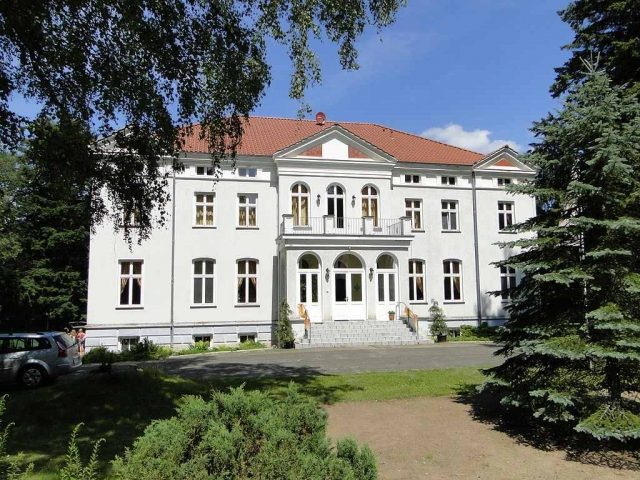
The manor house is located away from the former farm, serving as a hunting lodge in the park near the Langsee. It is a two-and-a-half-story plastered building with nine axes over a recessed basement under a flat hip roof. The front and rear facades each have a central risalit with a pointed roof. Next to the balcony on the front facade, there is a medallion in the gable triangle with the year of construction 1887 by the builder Otto von Bülow.
The manor house, as the center of the complex, divides the park into an entrance and lake side and was separated from the estate buildings on the western side by an imposing gate system. Outside the park, the old ice cellar is still located.
After 1945, the manor house was used as a sanatorium for lung diseases, an outpost of the Güstrow district hospital, and as a retirement home. From 1990 to 2006, it was a nursing home under the sponsorship of the Arbeiter-Samariter-Bund (ASB), after which it stood empty. Since its acquisition on December 3, 2007, the former hunting lodge, now House 2, with its park and the "Schlossblick" sun lounge, has belonged to the Neu Sammit children and youth meeting center as a youth castle. After gradual renovation, the manor house was occupied on May 18, 2009.
Park
Created as a park around 1900 between the adjacent forest and the Langsee, it is reminiscent of the landscape design of that era in this region and is now an indispensable part of the ensemble of farm, manor house, and park in Neu Sammit.
In addition to the open lawns around the manor house down to the lake, the small-leaved lime (Tilia cordata), the Douglas fir (Pseudotsuga menziesii), the sycamore maple (Acer pseudoplatanus), the grand fir (Abies grandis), the white mulberry (Morus alba), the European white elm (Ulmus laevis), the Eastern white pine (Pinus strobus), the horse chestnut (Aesculus hippocastanum), and the copper beech (Fagus sylvatica) are among the most striking trees in the park.
The octagonal tea house on the Langsee was demolished after the Second World War.
Take Mobile History with you
You are reading this text for free. Premium adds what matters on the road: descriptions read aloud, sites found through your camera, whole regions taken offline.
- Every description, including the ~17,700 Premium sites
- Audio guide: have descriptions read to you on location
- AR finder: see sites through your camera, with distance and bearing
- Unlimited saved sites
14 days free, then from €2.99 a month. Cancel anytime.
Source: Wikipedia · Licence: CC BY-SA 4.0 · Image: http://de.wikipedia.org/wiki/Datei:Neu_Sammit_Gutshaus_2011-07-06_111.JPG
This description draws on the facts documented in the linked Wikipedia article; Wikipedia content is licensed under CC BY-SA 4.0. Wording and editing: Mobile History.
Location: 53.6232, 12.2296