To be privately owned
ManorHeilbronn-Frankenbach
Hipfelhof Manor
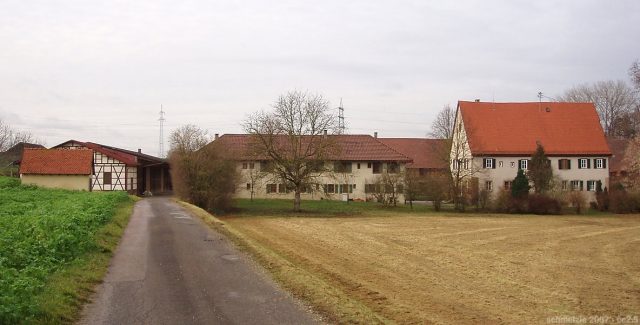
The Hipfelhof is a historic estate in the Frankenbach district of Heilbronn in Baden-Württemberg.
Settlement History
The Hipfelhof, located west of Frankenbach, was first mentioned in 1229 when Pope Gregory IX confirmed the possession of Bebenhausen Monastery in Hüppelbure. Other historical names include Hipfelbeuren, Hüpfelhof, and Hupphilbura. In 1250, the Imperial Vogt Wilhelm von Wimpfen donated his property at Hipfelhof to the hospital master of the Order of the Holy Spirit in Wimpfen. Further traces of settlement are found southwest of the current estate, suggesting that the Hipfelhof settlement was once more extensive and widespread. The name Hipfelbeuren also indicates a village settlement, whose ownership, according to the preserved documents, was already very fragmented in the 13th century.
A pilgrimage chapel was located near the village in the Middle Ages, for which a priest was first mentioned in 1475. In the 16th century, the settlement came into the possession of the Stephansfeld Abbey, which belonged to the Diocese of Strasbourg and to which the administration of the Wimpfen hospital had passed. Around 1550, the Imperial City of Heilbronn lent the convent in Stephansfeld the majority of what would later amount to up to 17,700 guilders, for which the city received the Hipfelhof as collateral, as well as the church patronage and the parish benefice in Flein. The House of Württemberg, the hospital in Wimpfen, and the Counts of Hanau sought possession, which was nevertheless sold to the city of Heilbronn by a convent master in 1601. In the documents regarding this sale, only a farm is mentioned, suggesting that a large part of the village structure of the settlement had already disappeared by then.
The sale to the Imperial City of Heilbronn was controversial, leading to several complaints to the Imperial Court Council, and the matter remained in limbo. In 1619, the city of Heilbronn took possession of the estate, whereupon Stephansfeld and Wimpfen again filed a complaint. In 1628, a settlement was reached between the convent master and the order with the imperial commission's decision that the city of Heilbronn had to return the estate to the order, and the order would pay its debts.
In 1695, the estate consisted of the farmhouse, the chapel, and a barn, and came into the possession of the hospital in Memmingen. The buildings were occasionally renovated and expanded over time: the chapel was renovated in 1715/18, and the mill and rectory were built in the late 18th century.
In 1803, the property fell to Bavaria, but shortly thereafter was gifted to the Bavarian Foreign Minister Maximilian von Montgelas. In 1812, the publisher and baronial family von Cotta acquired the estate, which remained in family ownership until 1959. Due to its Bavarian affiliation, the land belonging to the estate had its own demarcation, but then came under the administrative jurisdiction of Frankenbach. During World War II, the chapel located north of the current estate was destroyed.
The estate continues to exist today, with one of the buildings serving as the administrative office for Südzucker.
Hipfelhof Project
From 1949, the Heilbronn District Office had plans for the construction of a large settlement for a total of 4000 to 5000 people, where predominantly commuters from the industrial cities of Heilbronn and Neckarsulm would find a new home and from which they could quickly reach the industrial areas in Heilbronn and Neckarsulm by bicycle. After examining several settlement options in the greater Heilbronn area, the land belonging to the Hipfelhof appeared most suitable. The Württemberg-Baden Ministry of Agriculture and the Interior Ministry signaled their agreement to financial support within the framework of social housing, as the Heilbronn district could not finance the project from funds under the law for the procurement of settlement land and land reform. While a survey in September 1949 already showed nearly 1000 families from the Heilbronn area expressing interest in resettlement, the acquisition of the land proved difficult. Initially, it was assumed that the land reform land surrender of the Hipfelhof owner, Baron Cotta von Cottendorf, would amount to 120 hectares. However, since the Ministry of Agriculture had declared the Hipfelhof a special operation in seed cultivation, the land surrender was reduced to 20 hectares, whereas the District Office had already requested almost 40 hectares in May 1949 and 80 hectares in October 1949 for settlement construction from the State Settlement Office. After Baron Cotta von Cottendorf did not agree to a voluntary increase in his land surrender, Minister of Agriculture Heinrich Stooss ordered him in February 1950 a land surrender of 45 hectares, which was implemented by expropriation order in August 1950 after tough negotiations. For the planned settlement, the district would only have to acquire another 25 to 35 hectares from private hands. In February 1951, Baron Cotta von Cottendorf filed an appeal against the expropriation. Although the expropriation was found to be lawful, the Administrative Court in Stuttgart prohibited the use of the disputed land for social housing purposes. The District Office then developed a plan for settling the area with full-time, small-scale, and part-time settlements, but this was also rejected by the Minister of Agriculture in December 1951. The Hipfelhof lands were not settled. The planned large commuter settlement was instead built in Amorbach.
Buildings+
In the northwest of the complex is the three-story Cotta'sche Villa (No. 6) from 1855, which was extended in 1865 and 1875 and is surrounded by park-like grounds.
In the northeast of the complex is the former rectory (No. 10, also called Speisemeisterei or Jägerhaus), built in 1791 and renovated in 1855, as well as the mill (No. 8) from 1784 with a two-story storage annex. The north facade of the mill features an ornate former portal and figural decorations on the window lintels. An old aqueduct leads to the mill from the north, showing an inscription stone dated 1843.
In the south of the complex is a farmstead with residential and commercial buildings, arranged at right angles around a farmhouse garden. The larger residential building (No. 1, Südzucker administration) was built as a two-story half-timbered structure around 1700, while the smaller residential building (No. 2) was created by converting a stable building from 1830. The commercial buildings (Nos. 3, 4, and 7) were partially rebuilt on older foundations after a fire around 1870.
Take Mobile History with you
You are reading this text for free. Premium adds what matters on the road: descriptions read aloud, sites found through your camera, whole regions taken offline.
- Every description, including the ~17,700 Premium sites
- Audio guide: have descriptions read to you on location
- AR finder: see sites through your camera, with distance and bearing
- Unlimited saved sites
14 days free, then from €2.99 a month. Cancel anytime.
Source: Wikipedia · Licence: CC BY-SA 4.0 · Image: https://commons.wikimedia.org/wiki/File:Hipfelhof1.jpg
This description draws on the facts documented in the linked Wikipedia article; Wikipedia content is licensed under CC BY-SA 4.0. Wording and editing: Mobile History.
Location: 49.1590, 9.1467