The Castle can be visited
ManorProbsteierhagen
Hagen Manor
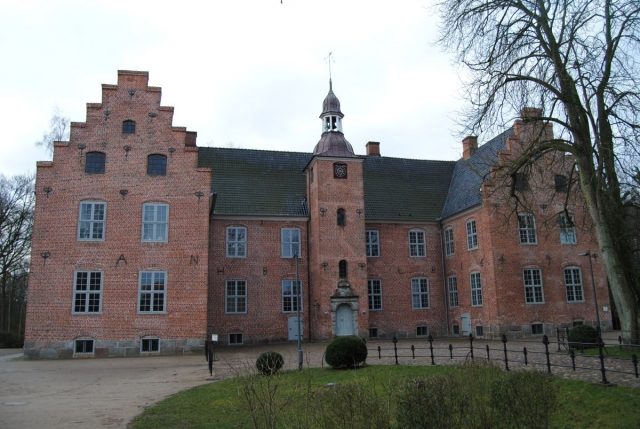
Hagen Castle, located in the municipality of Probsteierhagen near Kiel in Schleswig-Holstein, is the manor house of the former noble estate of the same name. The 17th-century building has housed a cultural and event center since 1969. After extensive renovation from 2007 to 2011, it has been accessible to visitors again since 2011.
The first mention of Hagen dates back to 1264 as indago comitis ("Count's Enclosure") in the Kiel city book. At that time, the area served as a hunting ground under the Counts of Schauenburg, from which the name of the later estate was derived.
The noble estate economy at Hagen was established in the 16th century. In 1534, it was first mentioned in a document under Christoph von Pogwisch, whose family remained at Hagen and the nearby Dobersdorf estate for the following century. A first, no longer existing manor house on the estate grounds likely dated from this period. On the occasion of the wedding of Lucia von Pogwisch, the last heiress of the Hagen Pogwisch line, to Hinrich von Blome in 1646, the current manor house was built from 1647 to 1649. Hagen Estate thus passed into Blome's possession.
For the following centuries, the manor house served as the family seat of the Hagen-Blome line, which also included Waterneverstorf Estate, among others. However, Hagen never played a significant role in Holstein's regional history, and even major changes of ownership, which were quite common on other estates, did not occur. In 1814, the estate came into the so-called Blome Family Foundation through an inheritance contract, which existed until 1932. In that year, the former noble estate was dissolved, the land parceled out and sold, and the manor house was converted into a school building. During the Second World War, it served as a military hospital for naval personnel; after the war, the elementary school moved back in and remained in the castle until 1969.
After the school closed, Hagen Manor, which had been referred to as a castle by the local population for generations, was converted into a cultural center. After severe fungal and mold infestation was discovered at the beginning of the 21st century, extensive renovation of the almost 400-year-old building took place from 2007 to 2010. The castle remained closed during this time, and the usage concept for the complex was also revised. Since 2011, Hagen has been open to visitors again. The rooms of the castle can be rented for private events, and concerts and readings also take place. In addition, apartments and a doctor's office have been set up on the upper floor.
Buildings+
The Manor House
Hagen Manor was built for Hinrich Blome and Lucia von Pogwisch from 1647 to 1649. Iron wall anchors on the central wing with the letters HBLB commemorate the builders. Hagen was built as a two-story, three-winged structure on a cellar plinth. The center of the courtyard of honor is marked by a slender stair tower, which also contains the main portal emphasized with sandstone decor. Another building wing protrudes from the south-facing garden facade, which was added to the existing manor house in the mid-18th century, giving the castle an almost Y-shaped floor plan.
The building was constructed at the transition from the Renaissance to the Baroque, a phase that only took place in Holstein after the Thirty Years' War. The originally horseshoe-shaped complex with its uniform window arrangement already shows Baroque influences, but it lacks typical contemporary ornamentation, and the strict stepped gables and the stair tower crowned with a lantern still refer to earlier building traditions of the Duchy. The manor house was once surrounded by moats, which further reinforced its rather defensive character. The moats are now drained and filled in on the courtyard side, but still partially visible on the southern side. In contrast to the strict exterior of the manor house, the interior design of the symmetrically divided building was already more clearly influenced by the Baroque era. The rooms of the castle received elaborate stucco decoration, supraports, and ornamental fireplaces until the beginning of the 18th century, and some of the furnishings have been preserved to the present day. The furnishings include the so-called Pogwisch Room, whose Baroque wall design from around 1725 is unique in a Schleswig-Holstein manor house. In the Pogwisch Room, the wall paintings were elaborately restored from 2009 to 2011 with significant financial support from the federal and state governments. Visitors today have the opportunity to view the restored rooms of the manor house, such as the so-called Blome Room and the Fireplace Room.
Farmyard and Garden
Some of the buildings in the farmyard, with large barns, still dated from the 17th century. After the estate operations ceased, outbuildings such as the gatehouse and the tenant's house were sold, and the large half-timbered barn from 1626 and a cow shed from the early 18th century were demolished. The former courtyard is now only recognizable in its basic features, as its original area has been built over with modern residential houses. In the 17th century, a Baroque garden was created simultaneously with the manor house and to its northwest, which was built over in the 1960s. South above the manor house is a 4.5-hectare landscape park, which was planted in the mid-19th century with valuable individual trees and tree groups. After the park had received little horticultural care for many decades and had taken on forest-like features, numerous wild-growing trees near the manor house were felled in the spring of 2009. As a result, the manor house has become more visible from the park. In this context, the area around the manor house has also been redesigned and replanted.
Take Mobile History with you
You are reading this text for free. Premium adds what matters on the road: descriptions read aloud, sites found through your camera, whole regions taken offline.
- Every description, including the ~17,700 Premium sites
- Audio guide: have descriptions read to you on location
- AR finder: see sites through your camera, with distance and bearing
- Unlimited saved sites
14 days free, then from €2.99 a month. Cancel anytime.
Source: Wikipedia · Licence: CC BY-SA 4.0 · Image: http://schloesserrundschau.de/schleswig/schloesser/ploen32.html
This description draws on the facts documented in the linked Wikipedia article; Wikipedia content is licensed under CC BY-SA 4.0. Wording and editing: Mobile History.
Location: 54.3599, 10.2849