To be privately owned
ManorKlütz-Grundshagen
Grundshagen Manor
History of the Building+
Early History and Construction+
The exact date of construction of the manor house is not known, but it is estimated to have been built around 1700. The first documented owner was the noble family von Bünau, who held the estate for several generations. The building was originally designed as a baroque country house, characterized by its symmetrical facade and a mansard roof.
18th and 19th Century+
In the mid-18th century, the manor house underwent significant renovations, adding elements of rococo style. During this period, elaborate stucco work and frescoes were added to the interior. The estate was acquired by the von Schönberg family in 1780, who further expanded the gardens and added several outbuildings, including a stable and a coach house.
The estate was owned by Otto Imperial Count von Bothmer. In 1840, ownership transferred to Ludwig König. In 1945, the owners were forcibly dispossessed and expelled by the communists.
20th Century and Present Day+
After World War II, the building was used for various purposes, including a school and a municipal administration office. Due to a lack of maintenance, the building fell into disrepair over the decades. In 1990, after the reunification of Germany, the manor house was privatized and extensively renovated. Today, it serves as a cultural center and hosts various events and exhibitions.
Architectural Features+
Exterior+
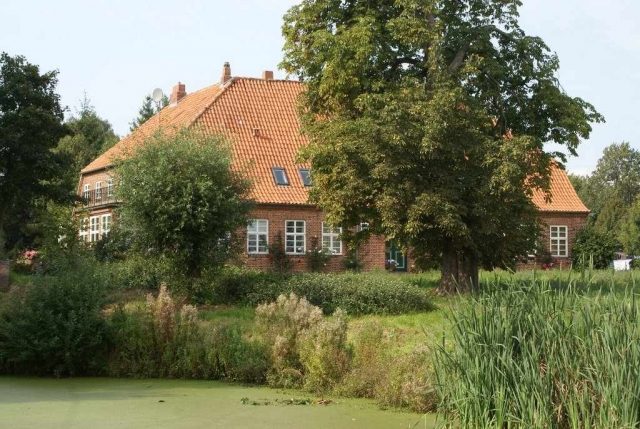
The manor house is a two-story building with a mansard roof. The facade is adorned with decorative pilasters and cornices. The main entrance is emphasized by a grand portal with a balcony above. The windows are symmetrically arranged and feature elaborate frames.
Interior+
The interior of the manor house boasts several well-preserved historical rooms. The grand hall on the ground floor features original stucco work and a large fireplace. The upper floor houses several salons with period furniture and paintings. A notable feature is the historic library, which contains a collection of rare books from the 18th and 19th centuries.
Gardens and Park+
Baroque Garden+
The manor house is surrounded by a meticulously maintained baroque garden. It features geometrically arranged flowerbeds, trimmed hedges, and a central fountain. Statues and sculptures are strategically placed throughout the garden, adding to its aesthetic appeal.
English Landscape Park+
Adjacent to the baroque garden is a sprawling English landscape park, designed in the 19th century. It offers winding paths, mature trees, and a picturesque pond. The park is home to a variety of plant species and provides a tranquil setting for visitors.
Significance+
The manor house is a significant example of baroque and rococo architecture in the region. It reflects the changing architectural styles and the history of its various owners. As a cultural center, it plays an important role in preserving local heritage and promoting cultural exchange. It is a protected historical monument and a popular destination for tourists and history enthusiasts.
Take Mobile History with you
You are reading this text for free. Premium adds what matters on the road: descriptions read aloud, sites found through your camera, whole regions taken offline.
- Every description, including the ~17,700 Premium sites
- Audio guide: have descriptions read to you on location
- AR finder: see sites through your camera, with distance and bearing
- Unlimited saved sites
14 days free, then from €2.99 a month. Cancel anytime.
Location: 53.9825, 11.1370