To be privately owned
ManorGerswalde - Friedenfelde
Friedenfelde Manor
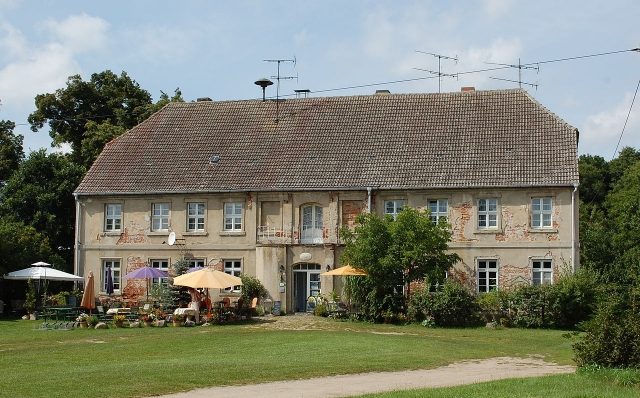
Gutshaus Friedenfelde is a listed manor house in the village of Friedenfelde, which belongs to the municipality of Gerswalde in Brandenburg.
The two-story plastered building has eleven axes. The house is covered by a half-hipped roof.
The current building dates back to a manor house built by Ernst Philipp von Münchow from 1743 onwards. After Joachim Erdmann von Arnim, father of the poet Achim von Arnim, bought the property in 1763, the building was converted in the Rococo style. The house is described for this period as having many towers and a Turkish appearance. However, a letter from 1811 mentions the collapse of two towers. Achim von Arnim, who owned the estate from 1804 to 1818, considered moving into Gutshaus Friedenfelde during this time. He lived in the house for periods. Another renovation took place around 1820, according to other sources between 1822 and 1840. During this, the decorations were removed again.
After several owners followed one another, Annois von Arnim acquired the property again in 1901, or 1904 according to another source. However, he did not live on the estate himself, which was managed by an administrator. His son then moved back into the estate in 1923 and also managed the property on site. In the course of the land reform, the Arnim family was dispossessed after the end of the Second World War. The agricultural land was distributed to farmers, but later managed by the Volkseigenes Gut Temmen. The manor house served as a rental property. A boundary stone in front of the manor house commemorates the time of the division of the land. The parcel boundary then ran through the building.
In the 1970s, the demolition of the house was planned. On the initiative of a resident, the manor house was then placed under monument protection by a resolution of May 24, 1979. There were then plans to set up a daycare center in the house. Structural alterations were partly initiated, but these were carried out improperly, especially in the area of the gentlemen's room. Since mid-1993, the house has been inhabited by the Nowatzki family. They acquired the building in 1996 and began a gradual renovation. In 1997, new windows were installed. Further work in the following period concerned the house's electrical system, water connections, the relocation of two tiled stoves, and the renewal of two entrance doors. From the end of 1999, the former estate kitchen was again usable as a kitchen. In May 2001, a café was opened on the ground floor, which was expanded in 2003/2004 to include a sanitary wing, fireplace room, and office.
Manor Park+
North of the manor house extends the manor park. It is assumed that it was laid out in the course of the Rococo conversion from 1763 onwards. At times, the park is said to have also included the vineyard to the west, on which a small pavilion probably stood for some time.
In its center, a rondel of eight lime trees and a central tree was probably laid out in the 1920s. A small bridge led over an outlet of the pond. The park was maintained until 1945. In later years, the overflow from the septic tank was directed into the park's pond. This led to over-fertilization and contamination. From 1995, as part of an AB measure, the park was cleaned and heavily overgrown elderberry was removed. The forgotten rondel was rediscovered. The path layout was recreated according to the information of a former employee of the manor. Today (as of 2012), the park presents itself more as a riparian forest.
The park contains maple, birch, beech, oak, alder, ash, hazel, chestnut, pine, lime, elm, and wych elm, with lime trees lining the main paths of the park. At the edge of the park are some old fruit trees, such as Boskop, Hasenkopf, and plum. In addition, there are blackberries, wood anemones, lilac, forsythia, gorse, bellflowers, dog rose, raspberries, elderberry, buckthorn, lily of the valley, spindle tree, moneywort, sea buckthorn, scurvy-grass, blackthorn, forget-me-not, and hawthorn.
The fauna of the park includes seven bat species. Treecreepers, jays, finches, green woodpeckers, hawfinches, cuckoos, tits, middle spotted woodpeckers, nightingales, golden orioles, black woodpeckers, sparrows, turtle doves, fieldfares, and tawny owls have been observed among the birds.
Take Mobile History with you
You are reading this text for free. Premium adds what matters on the road: descriptions read aloud, sites found through your camera, whole regions taken offline.
- Every description, including the ~17,700 Premium sites
- Audio guide: have descriptions read to you on location
- AR finder: see sites through your camera, with distance and bearing
- Unlimited saved sites
14 days free, then from €2.99 a month. Cancel anytime.
Location: 53.1380, 13.7286