To be privately owned
ManorDollrottfeld-Dollrott
Dollrott Manor
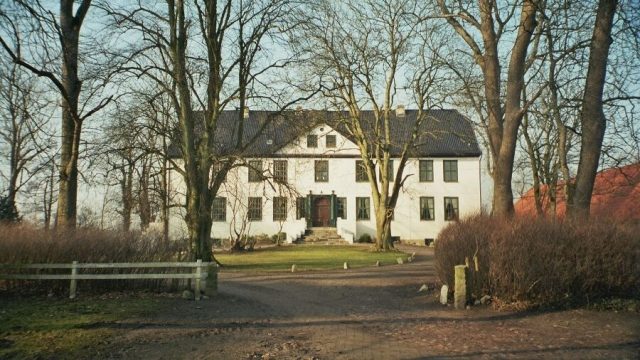
Dollrott Manor (Danish: Dollerød) is a 17th-century gatehouse converted into a manor house. The manor is located in the municipality of Dollrottfeld on the B 201 between Süderbrarup and Kappeln in the Angeln region.
In King Valdemar's Cadaster of 1231, a royal estate called dolruht (valley and clearing) is mentioned. It came into the possession of the von Ahlefeld family and was called Dolrade in documents. In 1609, Hinrich von Ahlefeld built the present rear central risalit, through whose gate the road initially passed, and very soon thereafter, as evidenced by discovered decorative painting, also the north wing. Above the gate passage, Hinrich von Ahlefeld placed a founder's plaque, on which he declared that the building should serve his "dearly beloved wife Anna von Ahlefeldt as a Leibgedinge," i.e., as a widow's residence.
During the Thirty Years' War, the manor was ducal-Gottorf property and was surrounded by a moat, largely preserved to this day, to protect it from passing troops and marauders. The road was rerouted around it. Nevertheless, there were quarterings, looting, and arson. In the 18th century, the names of the Königstein, Wedderkop, and Viereck families are associated with the manor. On the occasion of the wedding of Christine Elisabeth von Königstein to Carl Heinrich von Viereck, royal stable master, King Frederik IV visited the manor and donated his portrait. In 1789, two-thirds of the land belonging to the manor was parceled out ("verkoppelt") and all corvée services were abolished, allowing the village of Dollrottfeld to emerge.
Rochus Freiherr von Liliencron, the founder of the Allgemeine Deutsche Biographie and German folk song research, uncle of the poet Detlev von Liliencron, spent his childhood at Dollrott Manor and fondly remembered this time in Frohe Jugendtage, his memoirs. Around 1870, large farm buildings were erected, which, having become dilapidated, had to be demolished in 2013, except for the brick facade, and replaced by a modern hall. The manor has been in private ownership since 1910.
In 2008, during renovation work on the first floor, north wing of the manor house, late Renaissance ceiling paintings in grisaille technique were discovered.
Take Mobile History with you
You are reading this text for free. Premium adds what matters on the road: descriptions read aloud, sites found through your camera, whole regions taken offline.
- Every description, including the ~17,700 Premium sites
- Audio guide: have descriptions read to you on location
- AR finder: see sites through your camera, with distance and bearing
- Unlimited saved sites
14 days free, then from €2.99 a month. Cancel anytime.
Source: Wikipedia · Licence: CC BY-SA 4.0 · Image: http://de.wikipedia.org/wiki/Datei:Dollrott_Gutshaus.jpg
This description draws on the facts documented in the linked Wikipedia article; Wikipedia content is licensed under CC BY-SA 4.0. Wording and editing: Mobile History.
Location: 54.6435, 9.8314