To be privately owned
ManorDobersdorf
Dobersdorf Manor
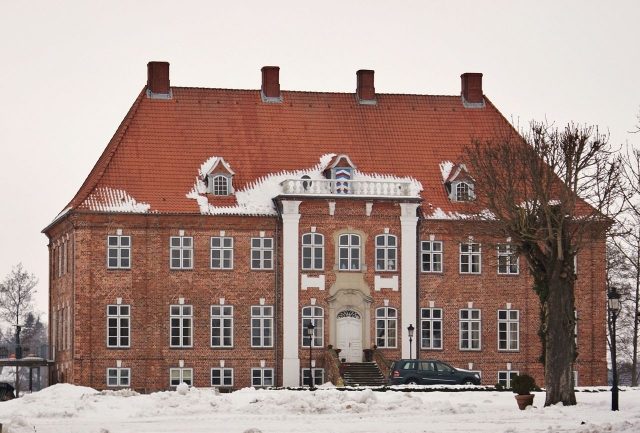
Gut Dobersdorf is located on the shore of Dobersdorfer See in the Plön district in eastern Schleswig-Holstein. The former noble estate dates back to a medieval moated castle, and some of the lands are still farmed today. The manor house at Dobersdorf is one of the last works of late Baroque in Schleswig-Holstein.
Dobersdorf was first mentioned in 1340, at which time there was a motte-and-bailey castle south of the estate, the remains of which are still visible in the terrain. Around 1475, Dobersdorf passed to the Pogwisch family, who founded the actual estate and owned it, along with the nearby Gut Hagen, until the 17th century. The 17th century was marked by numerous changes of ownership. After Hinrich Pogwisch, the last male heir of the family, died in 1625, Dobersdorf successively passed to the ancient noble families Reventlow, Brockdorff, and finally to the Rantzau. At the beginning of the 18th century, another change occurred, and around 1705, the estate passed to the Blome family, who remained there for just over a century.
Christoph Blome had the current manor house built in the second half of the 18th century, but due to a testamentary disposition, it was hardly used by his descendants. Blome left only daughters and apparently did not trust his sons-in-law with the administration of the estate, so it was instead transferred to a family foundation in the 19th century and managed by administrators. It was only towards the end of the 19th century that the manor house was regularly inhabited, after the estate was occupied in 1890 by Kuno zu Rantzau and his wife Marie, a daughter of Otto von Bismarck. After the death of the last two residents, Marie von Bismarck died in 1927, the manor house stood empty again. The estate operation was maintained until 1932, then the family foundation sold the property. The manor house temporarily served as a hotel, while the once almost 2,500 hectares of land were largely sold, and the estate was reduced to about 800 hectares. In 1960, Dobersdorf passed to the Brandenburg family Burgsdorff, who had to give up their possessions in eastern Germany as a result of the post-war events. Under them, the estate was reorganized, and the focus was placed on forestry.
Gut Dobersdorf remains in private ownership to this day and is usually not publicly accessible; the manor house can only be viewed from public paths. However, markets are regularly held on the estate grounds, and some of the outbuildings are rented out as holiday apartments.
Buildings+
The Manor House
The manor house was built under the Eutin court architect Georg Greggenhofer from 1770 to 1772 and is considered one of the last great buildings from the Baroque era in the Duchy of Holstein. The castle-like, eleven-axis building has a basement, a main floor, and an upper floor and is crowned by a high hip roof. On the courtyard and garden sides, the three central window axes project as a risalit from the building, which was constructed entirely of brick. The interiors of the manor house partly still feature preserved Rococo stucco work. Among the most important rooms are the vestibule, which connects to the courtyard-side grand staircase, and the garden hall behind it, which, like the ballroom on the upper floor above it, are emphasized from the outside by the central risalit.
The Estate Complex and the Garden
A Baroque courtyard complex is situated in front of the manor house, and a landscape garden adjoins it to the north. The courtyard area is divided into a courtyard of honor in front of the manor house and an economic courtyard located in front of it; however, the building stock was decimated by war damage and other circumstances. To the right of the manor house is the so-called Inspector's House from 1779, which later served as a Cavalier's House. The large barn east of the courtyard is a work by Rudolph Matthias Dallin from 1728; it was symmetrically opposite a large cow house, which was destroyed by a bomb hit in 1944. Access to the complex was provided by a gatehouse, which had to be demolished in 1980 due to dilapidation; the courtyard entrance is now bordered by the gatehouses.
Take Mobile History with you
You are reading this text for free. Premium adds what matters on the road: descriptions read aloud, sites found through your camera, whole regions taken offline.
- Every description, including the ~17,700 Premium sites
- Audio guide: have descriptions read to you on location
- AR finder: see sites through your camera, with distance and bearing
- Unlimited saved sites
14 days free, then from €2.99 a month. Cancel anytime.
Source: Wikipedia · Licence: CC BY-SA 4.0 · Image: http://de.wikipedia.org/wiki/Datei:Herrenhaus_Dobersdorf.JPG
This description draws on the facts documented in the linked Wikipedia article; Wikipedia content is licensed under CC BY-SA 4.0. Wording and editing: Mobile History.
Location: 54.3228, 10.2894