To be privately owned
ManorFahrenwalde - Bröllin
Bröllin Manor
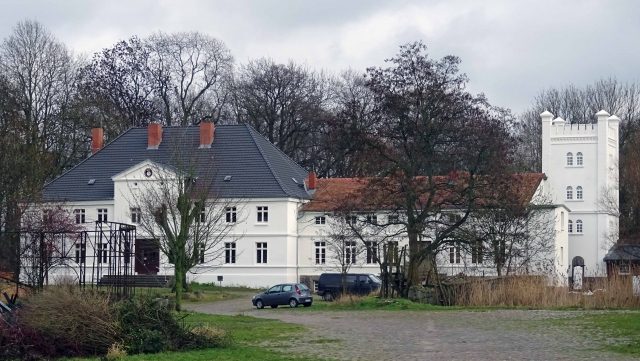
Schloss Bröllin is a manor house that has existed since at least 1233 in the German region of Vorpommern, about 30 kilometers from the Polish border.
It is one of the few manor houses in the region that have been preserved as a whole, and thus also an important testimony to the development of regional agricultural production. In the municipality of Fahrenwalde, it is registered as a historical monument.
Despite its name, "Schloss" Bröllin is not a castle in the true sense, but an old knight's estate. Inspired by the tower of the manor house, residents began to speak of the "Schloss" in the 1970s, which gave the place its current name.
Location+
Bröllin is located in the German-Polish border region, six kilometers south of Pasewalk and 40 km west of Szczecin, in the municipality of Fahrenwalde.
Architecture+
The manor house covers an area of about 50,000 m2 of land. The old stable buildings enclose the site in a rectangular shape. In the middle are the former granary and an old distillery. The latter was built after the Stoewahs family acquired the property in 1854.
The manor house is the oldest building on the estate and was built in the 18th century. A fieldstone church was built next to the estate in 1888 and now belongs to the Protestant parish of Brüssow.
Today, the manor house contains living quarters for residents and volunteers, administration, several offices, a common room, and a small library. Behind the manor house is the estate's garden with an old ice cellar and historic beehive.
The former sheep stable extends over 100m along the northern end and is mainly used as storage space. At the western end are a workshop and the former riding hall with a concrete floor and high ceiling.
The former bull stable in the south now houses the German-Polish meeting center. The building was completely renovated in 2005-2006 and expanded into a multifunctional center with guest rooms, as well as spaces for rehearsals, workshops, and conferences. The second former bull stable houses three studio rooms with sprung dance floors for rehearsals and productions.
Early History
The first historical mention of Bröllin is dated to 1233, when the place was still called Bralin, named after its then owners. The same family was also registered as owners in the land register of 1375, then under the name Brellyn. According to the records, the land measured 50 'Hufen', which corresponds to the current area of the estate. Between 1375 and 1738, the estate belonged to the von Lindstedt family, who resided in Bröllin from 1400. After the young B. H. von Lindstedt deserted from the army, the Prussian King Frederick William I handed the estate over to a von Görne, who in turn sold it to the Prüwer family.
The Prüwers expanded Bröllin's agricultural operations and built the neighboring village of Friedrichshof, where they settled farm laborers and shepherds, who in turn paid taxes to Bröllin. Friedrichshof remained under the administration of Bröllin until it was acquired by a municipal settlement company in 1931.
In 1854, the land was acquired by the Stoewahs family. This was a time of enormous growth for German agriculture. To meet the enormous demand, the latest technological developments were used in the development and conversion of the estate and buildings. This transformed Bröllin into one of the most modern agricultural production facilities of its time in the entire region. A large part of the agricultural buildings and the distillery date from this period. In 1945, the owners were expropriated and expelled by the communists.
GDR/LPG
After the Second World War, rural areas in the Soviet occupation zone were reallocated among various groups and individuals for agricultural use as part of the land reform. The Schloss Bröllin estate was continued by various agricultural production cooperatives (LPGs) with 2500 animals and 300 employees. After the fall of the Berlin Wall, the LPGs were liquidated and the estate became the responsibility of the Treuhandanstalt.
Today
In 1992, the newly founded non-profit association schloss bröllin e.V. leased the site from the Treuhandanstalt and began renovation work to transform the place into a production center for performing arts. The aim of the association is to engage in regional and international networks, conduct workshops and youth projects, and provide space for artistic production and research. The estate has been a protected monument since 1993 and became the property of schloss bröllin e.V. in 2000. The association also takes care of the preservation and maintenance of the buildings and the surrounding land.
Today, the manor house operates under the name Schloss Bröllin international art research location. It is owned and maintained by the schloss bröllin e.V. association and operated by employees and volunteers. Many volunteers find their way to Bröllin through the European Voluntary Service and regional initiatives or complete a Voluntary Ecological or Social Year. The association is supported, among others, by the Federal Cultural Foundation, the Ministry of Education, Science and Culture of the State of Mecklenburg-Vorpommern, the district of Vorpommern-Greifswald, LAG Soziokultur MV e.V and the Foundation for German-Polish Cooperation. Schloss bröllin e.V. participates in a number of regional networks and initiatives, including the "Region in Aktion" program of the Amadeu Antonio Foundation.
During the summer months, Bröllin hosts a number of national and international artists as part of its in-house residency program. Workshops, artistic projects, youth projects, conferences, and other events regularly take place in Bröllin. Over 500 productions in the fields of dance, theater, and performance have been produced in whole or in part at Schloss Bröllin to date.
Resident Artists+
From 1992 to 1994, Bröllin was the home and workplace of the RA.M.M. Theater under the direction of Arthur Kuggeleyn, which played an important role in the early development of the estate into a place for art and culture. Other groups and individuals such as POPE, Ziguri Ego Zoo (Anna Totó Company since 2001), tatoeba-theatre danse grotesque, Daniel Weissrot, Delta Rai, Martin Mengdehl, Yumiko Yoshoíoka and Jens Femerling have shaped the place in the following years. Currently, TEN PEN CHii art labors Joaxhim Manger lives and works on the estate.
Take Mobile History with you
You are reading this text for free. Premium adds what matters on the road: descriptions read aloud, sites found through your camera, whole regions taken offline.
- Every description, including the ~17,700 Premium sites
- Audio guide: have descriptions read to you on location
- AR finder: see sites through your camera, with distance and bearing
- Unlimited saved sites
14 days free, then from €2.99 a month. Cancel anytime.
Location: 53.4608, 14.0510