To be privately owned
ManorMarlow - Alt Guthendorf
Alt Guthendorf Manor
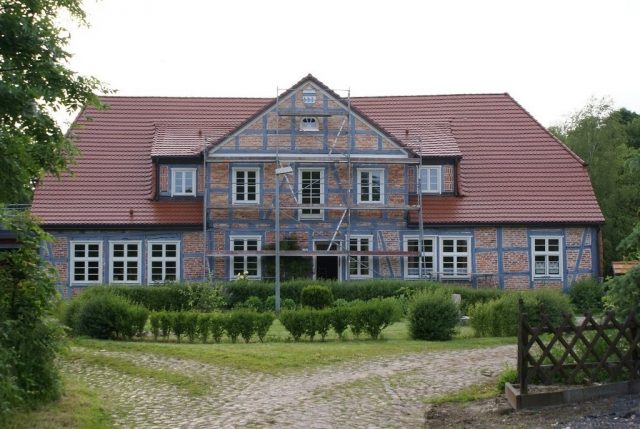
In 1210, "Guthendorp" is mentioned for the first time. On January 13, 1371, Duke Albert of Mecklenburg pledged the towns and castles of Marlow and Sülze, as well as 23 other places, to the Bishop of Schwerin.
At this time, the medieval defensive tower was probably built, which is proven to have stood in the pond behind the current location of the house. Today, only the former access in the form of a small dam can still be seen. Perhaps parts of the tower were later used in the construction of the house, which is indicated by the format of some stones in the cellar vault.
In 1576, the squires Kurt and Joachim von Zeppelin are named as owners of the village of Alt-Guthendorf. The airship builder Zeppelin is, by the way, related to the Mecklenburg Zeppelins. The von Zeppelin family resided in Alt-Guthendorf for almost 300 years, then the estate was sold to the monastery in Ribnitz. The monastery then leased the estate to Mr. von Hoben.
From 1794, Christian Ernst Friedrich von Vogelsang leased the villages. Christian Ernst Friedrich von Vogelsang was a leading figure in the Mecklenburg knighthood. He headed the Knightly Office in the northeast of Mecklenburg. In this capacity, he had to, for example, help organize the great advance of Napoleon's troops against Russia in 1813. In 1821, Christian Ernst Friedrich von Vogelsang died. The story of a hidden treasure is associated with his grave. This results from the extensive inscription on his tombstone. It is said to have stipulated that it could not be lifted for 100 years, which, together with the fact that he was childless, gave rise to the treasure legend. However, the inscription was respected, because despite the leveling of all graves at the church, the tombstone remained until the mid-1980s of the last century.
After the death of Christian Ernst Friedrich von Vogelsang, the estate fell to his brother Gustav Casimir Hardenatz von Vogelsang, who died in 1848. Thereafter, Hermann Ludolf Carl Emil Freiherr von Vogelsang resided in Alt-Guthendorf until 1862. He was elected as a knightly official deputy to the Mecklenburg Estates Assembly. In 1850, he converted to the Catholic faith and therefore had to resign from the Mecklenburg state parliament. Vogelsang then worked as a publicist on current and religious issues and the problem of a just social society. From 1859, he accompanied the young Prince of Liechtenstein on travels through Europe and, in gratitude, was granted the princely-Liechtenstein baronial title on May 10, 1859. In 1864, he came to Austria, where his literary activity sparked a Christian-social popular movement demanding social reforms. This led to the adoption of a series of social laws, against the resistance of the liberal party, some of which were considered exemplary for Europe. Vogelsang is therefore still considered an important personality in Austria today.
Subsequently, the estate changed tenants more frequently - the last lord of the manor was the Winter family. In 1945, the owners were forcibly expropriated and expelled by the communists. They had the estate completely renovated in the 1920s of the last century. After 1945, the manor house of Alt-Guthendorf was settled by refugees and divided in the course of the land reform. During GDR times, it served as a residential building for several families. A village shop was located in the central part. The village's cultural room was in the left wing.
Take Mobile History with you
You are reading this text for free. Premium adds what matters on the road: descriptions read aloud, sites found through your camera, whole regions taken offline.
- Every description, including the ~17,700 Premium sites
- Audio guide: have descriptions read to you on location
- AR finder: see sites through your camera, with distance and bearing
- Unlimited saved sites
14 days free, then from €2.99 a month. Cancel anytime.
Source: Wikipedia · Licence: CC BY-SA 4.0 · Image: Roland Neubert, Halle (Saale)
This description draws on the facts documented in the linked Wikipedia article; Wikipedia content is licensed under CC BY-SA 4.0. Wording and editing: Mobile History.
Location: 54.1602, 12.5321