To be privately owned
CastleHeroldsberg
Green Castle Heroldsberg
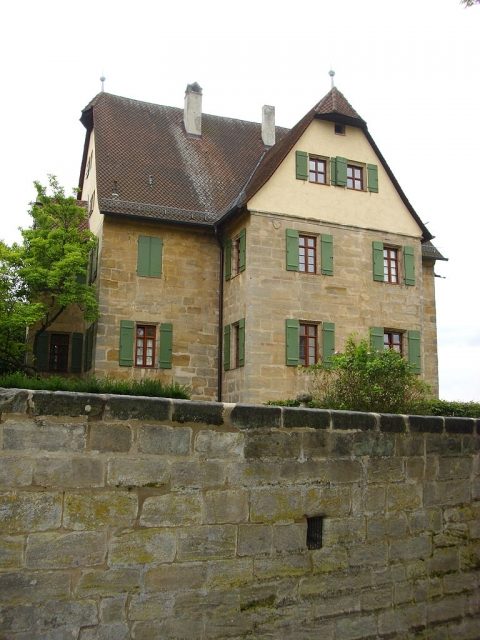
The so-called "Green Castle" is considered the oldest "castle", located opposite the church on a spur above the Gründlach valley, where research also seeks the former royal administrative or court seat. The first documented evidence of a castle, however, dates only from 1471, when Endres I. Geuder reported that he had "built a nobleman's seat at Heroltzberg to execute a nobleman's status". This is likely to refer not to the "White Castle", but to the "Green Castle". Its appearance is preserved in a silverpoint drawing by Albrecht Dürer from 1510, which shows the view from the Red Castle to the church. According to this, it was a single-story stone building with a high pitched roof, into which two large, also massive dormer windows with half-timbered gables, hipped roofs, and a ridge running north-south were skillfully integrated. In 1519, the manor was surrounded by a defensive wall; the year 1545 (?) affixed to the south gable likely indicates structural changes. Shortly thereafter, the Green Castle was destroyed in the Second Margrave War in 1552.
During the reconstruction around 1560, a three-story sandstone building with a gabled roof and a hipped gable was erected, incorporating existing wall sections. The eaves sides show central risalits with dormer windows, the gable sides three-story bay windows; the Geuder coat of arms is found on the north gable. Allegedly "medieval" "pit prisons" have been preserved in the cellar. The small light slits and windows of the ground floor emphasize the defensive character of the seat. Single-story outbuildings were located south and southeast of the castle, with a garden to the east.
The designation "Rabensteiner Castle", also common for the "Green Castle", goes back to the second marriage of Johann Philipp Geuder with Anna Elisabeth Rabensteinerin von Döhlau, concluded in 1649. Johann Philipp Geuder (1597–1650) was one of the outstanding personalities of the family, served as Anhaltine and Brandenburgian councilor, and finally held office as director of the three knightly circles in Franconia, Swabia, and on the Rhine. His descendants belonged to the Imperial Knighthood and adopted the surname "Rabensteiner", such as Johann Georg Geuder called Rabensteiner zu Heroldsberg, Stein und Lichtenfels (1677–1747), who gained great influence as Chancellor of the Order of St. John.
Probably around 1760, the painter Magnus Brasch from Nuremberg (1731–1787) created large-format murals for the Green Castle depicting the Geuder possessions of the time, which were transferred to the Red Castle in 1969.
War damage from 1945 was soon renovated. The castle was owned by Friedrich Karl Sigmund Freiherr von Geuder-Rabensteiner until 1963, followed by his sister Emilie until her death in 1977. Subsequently, the Nuremberg dentist Dr. Hans Much acquired it and had the building renovated. In recent years, renovation measures on the surrounding walls have been carried out by the castle owners Karola and Hans Much.
Take Mobile History with you
You are reading this text for free. Premium adds what matters on the road: descriptions read aloud, sites found through your camera, whole regions taken offline.
- Every description, including the ~17,700 Premium sites
- Audio guide: have descriptions read to you on location
- AR finder: see sites through your camera, with distance and bearing
- Unlimited saved sites
14 days free, then from €2.99 a month. Cancel anytime.
Source: Wikipedia · Licence: CC BY-SA 4.0 · Image: http://commons.wikimedia.org/wiki/File:Gr%C3%BCnes_Schloss_vom_Kirchenweg_her.jpg?uselang=de
This description draws on the facts documented in the linked Wikipedia article; Wikipedia content is licensed under CC BY-SA 4.0. Wording and editing: Mobile History.
Location: 49.5357, 11.1578