Public library
CastleWeimar
Gelbes (Yellow) Castle
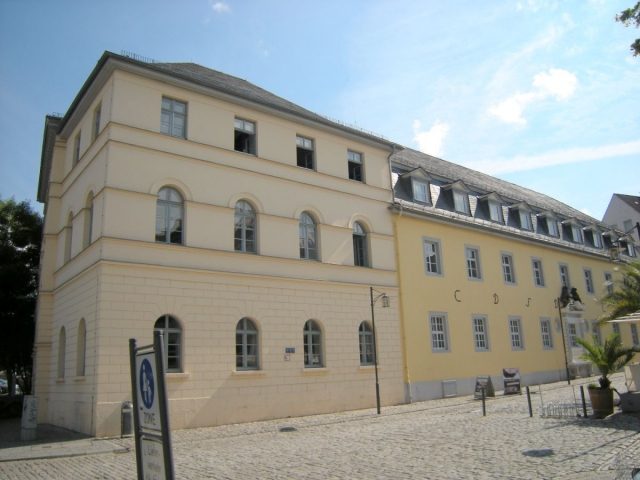
The Yellow Palace in Weimar is a listed Baroque building from 1704, which was built as a widow's residence for Duchess Charlotte Dorothea Sophie. It belongs to the historic palace complex in Weimar's city center and is a structural expression of the former court and residential city. Johann Sebastian Bach gave music lessons here for the two princes of Duke Johann Ernst III. The successful writer August von Kotzebue spent his youth in the house. Years later, the palace was appointed as the seat of the Thuringian Ministry of Finance. Since 1998, the building has been part of the Klassik Stiftung Weimar and since 2005, it has been part of the new study center of the Duchess Anna Amalia Library.
Urban Context+
The Yellow Palace is part of the historic palace complex around Weimar's "Platz der Demokratie" (formerly "Fürstenplatz"), where the "Green Palace" with the Duchess Anna Amalia Library is also located. The Yellow Palace forms the northern end of this urban ensemble.
The main front of the Yellow Palace faces north towards the "Grüner Markt" (formerly "Burgplatz"), which emerged in 1837/38 from the space freed up by the demolition of the "Alte Hauptwache" and some house gardens. In the immediate vicinity to the east, the late-classical building of the "Neue Wache," erected between 1834 and 1838 by Chief Building Director Clemens Wenzeslaus Coudray (1775–1845), adjoins the palace. To the south, the Yellow Palace borders the formerly freestanding "Gleichenscher Hof" (16th century) or the city residence of the Counts of Gleichen (later seat of the police and savings bank). And on the west side, the narrow Kollegiengasse leads directly past the Yellow Palace.
Together with the Red Palace (1574–1576) to the south and the two classical "Torhäuser" (gatehouses) (1820) by Coudray, the historic building complex known as "Markt 15" forms a building ring enclosing an inner courtyard.
The Yellow Palace, named after its original facade color, was built between 1702 and 1704 on Weimar's Burgplatz as a result of the conversion of a 16th-century free house by the Baroque architect and court master builder Johann Mützel (1647–1717) with the purpose of creating a new widow's residence for Duchess Charlotte Dorothea Sophie (1672–1738), born Landgravine of Hesse-Homburg and wife of Duke Johann Ernst III of Saxe-Weimar (1664–1707). The iron majuscules "C.D.S.D.S.L.H.H.", which are distributed across the entire north facade, are the initials for Charlotta Dorothea Sophia Dux Saxoniae Landgrafia Hasso Homburgiae. On the west facade, the large black numerals "1.7.0.4." attest to the building's construction period. The main front of the yellow-plastered, two-story palace building with a mansard roof was emphasized, in addition to the initials, by an imposing "Lion Portal," named after the two lions above the Duchess's coat of arms. However, the main access was from the west via Kollegiengasse through a mighty column portal (see photo from 1938 under Weblinks).
Johann Sebastian Bach (1685–1750) was a frequent guest at the Yellow Palace during his time in Weimar between 1708 and 1717. Together with his friend and distant cousin Johann Gottfried Walther (1684–1748), who had been organist of the city church of St. Peter and Paul in Weimar since 1707, he gave music lessons at the Yellow Palace for the musically extremely gifted Prince Johann Ernst IV of Saxe-Weimar (1696–1715) and his half-brother Ernst August I of Saxe-Weimar-Eisenach (1688–1748).
After the death of Duchess Charlotte of Hesse-Homburg in 1738, the Yellow Palace was used as an administration building and later as the residence of various court officials. Among others, the Brunswick Major Levin Karl Christian Kotzebue lived in the house. At that time, he was serving as Legation Councillor and secret Referendary in the service of Duchess Anna Amalia. His wife Christina Kotzebue (née Krüger) and his daughter and later writer Karoline Ludecus (1757–1827) soon also moved to Weimar into the Yellow Palace. In 1761, the famous son August von Kotzebue (1761–1819) was born here and spent part of his youth in the house. He was one of the most frequently performed dramatists of his time and wrote more than 200 plays before being stabbed to death by a fraternity member in Mannheim in 1819.
In 1774, the ducal chamber was moved to the Yellow Palace, where it remained until its dissolution in 1848. In 1838, an annex for the "Neue Wache" and the Weimar "Pagerie" was added to the eastern part of the palace. In 1852, the Yellow Palace became the seat of the "Staatsministerium Dep. III" (third department for finance), which was accompanied by significant structural changes that connected the entire palace even more closely with the neighboring "Gleichenscher Hof." In the years 1910/1911, the architect Carl Friedrich Dittmar had further supplementary buildings constructed as a separating transverse block in the inner courtyard of the building ring between the "Neue Wache" and the "Rote Schloss," creating a small northern inner courtyard at the Yellow Palace and a narrow southern courtyard between the gatehouses and the Red Palace.
In 1911, it was planned to install a fountain in the courtyard of the Yellow Palace. Thereupon, the sculptor and professor Gottlieb Elster (1867–1917) created the original bronze sculpture "Tax Collector" (1912) for the fountain figure, an official carrying files and money, as he shuffles as a tormented civil servant across the courtyard and the long corridors of the neighboring princely Ministry of Finance. The sandstone fountain erected in the courtyard is therefore called the "Aktenmännchenbrunnen" (File Man Fountain).
After the founding of the state of Thuringia on May 1, 1920, the Yellow Palace became the seat of the Thuringian Ministry of Finance, which existed as a central state authority from December 3, 1920, to June 12, 1945. During World War II, the interior of the Yellow Palace was almost completely destroyed by a heavy bomb hit and was significantly altered during reconstruction after 1945. The former Lion Portal of the north facade remained, but was converted into a window with a balustrade. The large column portal to Kollegiengasse, however, could no longer be saved.
Between 1992 and 1997, the facades of the "Markt 15" building complex underwent a historically appropriate restoration in several stages. Until 1994, the Yellow Palace served as the seat of the Weimar city administration. After the Thuringian district reform on July 1, 1994, this moved to the building at Schwanseestrasse 17. The "Aktenmännchenbrunnen," extensively renovated from 1985 to 1989, was dismantled in 1998 due to planned construction work in the inner courtyard of the Yellow Palace and found its new location in front of the new main seat of the city administration in 2007.
Current Use+
In 1998, the Klassik Stiftung Weimar acquired the Yellow and Red Palaces and, from 2002 to 2005, restored them in its largest construction project to date, costing a total of 23 million Euros (half borne by the federal government and half by the Free State of Thuringia), through renovation and expansion, to use them as extensions and a new study center for the Duchess Anna Amalia Library (HAAB) located opposite in the Green Palace. The reason for this was the long overdue consolidation of the library''s holdings, which had grown to about one million volumes and were distributed in some 20 depots throughout the city. For this purpose, a deep magazine and a parking magazine were additionally built under the "Platz der Demokratie," which are connected to the palaces by an underground passage.
The building erected in 1910 in the inner courtyard of the building complex was demolished and replaced by a new general entrance building for the new study center, which also houses an underground reading room with daylight. A multi-story, 18-meter-high book cube with 16 glazed skylights was placed in the old inner courtyard of the Yellow Palace, presenting itself from the outside with rough exposed concrete and from the inside in an elegant wooden shell. It functions as a large book cabinet with two-story galleries and wall-mounted shelves. In addition to free access to around 100,000 volumes, the book cube offers a photo library with 150,000 image motifs, various event rooms, and a reading café. The study magazine is connected to the main house (Green Palace) via an underground passage. The Yellow Palace itself was gutted and structurally rebuilt to accommodate the books and the resulting ceiling loads. The Red Palace, on the other hand, was carefully renovated and is used in its current structure for the administration and cataloging of the holdings.
Take Mobile History with you
You are reading this text for free. Premium adds what matters on the road: descriptions read aloud, sites found through your camera, whole regions taken offline.
- Every description, including the ~17,700 Premium sites
- Audio guide: have descriptions read to you on location
- AR finder: see sites through your camera, with distance and bearing
- Unlimited saved sites
14 days free, then from €2.99 a month. Cancel anytime.
Source: Wikipedia · Licence: CC BY-SA 4.0 · Image: http://schloesserrundschau.de/thueringen/schloesser/weimar005.html
This description draws on the facts documented in the linked Wikipedia article; Wikipedia content is licensed under CC BY-SA 4.0. Wording and editing: Mobile History.
Location: 50.9796, 11.3309