The church can be visited
ChurchDresden-Albertstadt
Garnisonkirche St. Martin
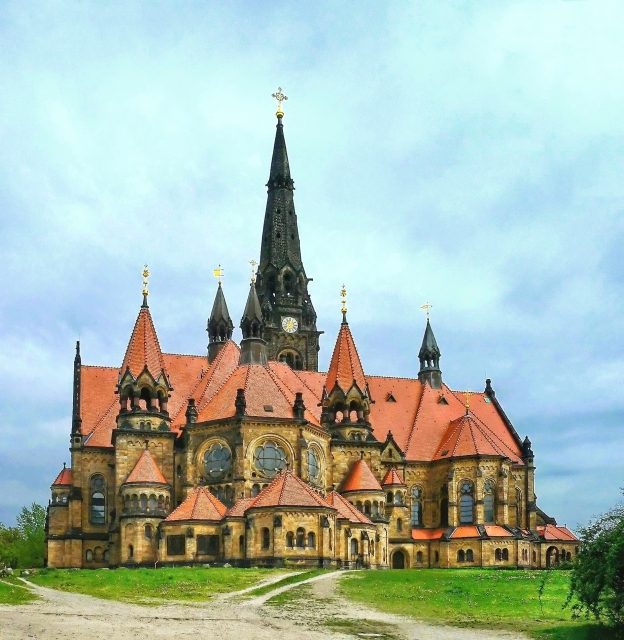
The Garrison Church of St. Martin (actually Simultankirche St. Martin) in Dresden was the garrison church of Albertstadt, which was built as a military city for large parts of the Saxon Army. The double church was built in the second construction phase in a central location of the barracks complex between 1893 and 1900.
It was divided into two separate church spaces for the Protestant and Roman Catholic denominations, of which only the Catholic part has been used for sacred purposes since 1945. The Simultankirche St. Martin has since been the parish church of the St. Francis Xavier community in Dresden-Neustadt.
The church is located on Stauffenbergallee (formerly Heeresstraße or Carolaallee) in the immediate vicinity of the central arsenal building, today's Bundeswehr Military History Museum. The entrances to the church are on its northern side, facing Stauffenbergallee. This unusual arrangement simplified the entry and assembly of the religiously mixed military troops.
East of the church runs the slightly enclosed ravine of the Prießnitz; the church itself is not only opposite the Prießnitz valley but also slightly elevated opposite the city center of Dresden. To the south, it overlooks Alaunpark, the green lung of the trendy Outer Neustadt district. Except for the south side, the Garrison Church is not surrounded by other buildings, but by a park and forest landscape.
Architecture+
The church is a building of Historicism. In its exterior design, elements of Romanesque style were primarily adopted. The surrounding buildings of the garrison are also predominantly historicist, but primarily oriented towards the classical style. The architects of the church were Hermann Viehweger and William Lossow, who is best known as the architect of Leipzig Central Station. The building material of the church is Cotta sandstone.
The Garrison Church is one of the last sacred buildings of Historicism in Dresden. Just two years after its consecration, the Christuskirche by the office of Schilling & Graebner in Strehlen, one of the first churches of reform architecture, was begun. William Lossow also incorporated stylistic elements of the counter-movement to Historicism in later buildings.
The strict separation of the two church parts is not immediately apparent from the outside. The Simultankirche has an implied cruciform nave, which is, however, separated by a wall. The Catholic part is in the eastern nave, the Protestant part occupies the implied transept. Especially the richly structured south facade therefore suggests a longitudinal building. The choirs of both parts are oriented to the south and thus parallel. The Protestant space is the larger one.
The church has only one church tower, which, with its height of 90 meters and the church's elevated position, sets a landmark in Dresden. It is placed on the north facade approximately between the two church parts. Originally, the tower carried six bells in two bell frames installed one above the other. Three of the bells were removed in the First World War. The empty, iron bell frame is preserved. During the Second World War, two more bells were replaced by iron ones.
Only during construction was it discovered that the design did not include a sacristy. The necessary rooms were added later – an explanation for the low building parts on the south side, which appear like annexes. The two organs for the two parts of the church were originally to be built back-to-back on the dividing wall. However, during installation, it turned out that the organ in the Catholic part did not fit, so it was installed instead on the south facade, where it covers a window. The remaining free wall bears a deliberately incomplete-looking mural. In and on the church, there are about 900 columns with as many capitals, none of which is identical to another.
After the German Empire was founded, a military complex was built in Dresden's Albertstadt for initially about 10,000, later slightly more, soldiers of the Royal Saxon Army. This allowed the previously scattered individual barracks, which were surrounded by the city, to be replaced. The Christian pastoral care for the garrison continued to be provided by the city's churches. Based on the principle "Cuius regio, eius religio" laid down in the Peace of Augsburg and the decision of Elector Moritz of Saxony for Protestantism, Dresden was almost exclusively Evangelical-Lutheran, so Catholic military personnel had previously used Dresden's only Catholic church, the Catholic Hofkirche on Schlossplatz. The Evangelical care for the garrison was provided by the Dreikönigskirche on Hauptstraße. Albertstadt was primarily financed by reparations payments from France after the Franco-Prussian War, and the church bells were also cast from the metal of captured cannons.
The competition for the construction of the church was won by the office of William Lossow and Hermann Viehweger. For the Simultankirche, three foundation stones were laid on October 28, 1895, one for each of the two church parts and a third for the tower as an expression that the tower belongs to neither church part. The church was consecrated on October 28, 1900. The building contains a gallery dedicated to King Albert I, but he only visited the church twice.
During the air raids on Dresden city center on February 13 and 14, 1945, the church was not hit. The Schützenkaserne in the immediate vicinity of the church received a direct hit and was not rebuilt. Neither Albertstadt as a military target nor the densely populated Outer Neustadt in the vicinity of the church were targets of bombardments in any attack on Dresden.
After the war, the church lost its function as a garrison church. The Catholic St. Francis Xavier community, whose church on Hauptstraße in the Inner Neustadt was destroyed, found a replacement in the Garrison Church. Since then, the name of this sacred building has been Simultankirche St. Martin. The Protestant part was initially used by the community of the destroyed St. Pauli Church, which, however, in the mid-1960s, renounced the use of the space, which was far too large for them, and set up community rooms in the rectory.
In the post-war period, Albertstadt – also due to the destruction in the city center – primarily took on an important function as a storage and archive location. Thus, accessible parts of state institutions such as the State Library and the Art Collections were later also located in the garrison buildings. The phonotheque of the library was located in the Protestant part of the Garrison Church. With the reopening of the museum and exhibition buildings, Albertstadt gradually relinquished these tasks over the decades. Since 2002, the phonotheque has also been located in the main building of the new Saxon State Library − State and University Library.
With the opening of the Albertstadt Barracks in 1998, which houses the Army Officer School, the Catholic part of the Garrison Church was again used for services by both Catholic and Protestant military chaplains.
In the same year, the Garrison Church, which had been managed as federal property since 1990, was sold together with the surrounding property to a private investor. The usage rights remain unaffected. Part of the building serves as a depot for the Dresden Puppet Theater Collection.
Organ+
The organ in the Catholic part of the Garrison Church was built in 1900 by the Dresden organ building company Gebrüder Jehmlich. Interestingly, the organ was connected to the Jehmlich organ in the Protestant part of the Garrison Church: both instruments had a common wind system. From 2003 to 2004, the instrument was restored by the original builder. It has 21 stops on two manuals and pedal.
Take Mobile History with you
You are reading this text for free. Premium adds what matters on the road: descriptions read aloud, sites found through your camera, whole regions taken offline.
- Every description, including the ~17,700 Premium sites
- Audio guide: have descriptions read to you on location
- AR finder: see sites through your camera, with distance and bearing
- Unlimited saved sites
14 days free, then from €2.99 a month. Cancel anytime.
Source: Wikipedia · Licence: CC BY-SA 4.0 · Image: Thomas Eichler
This description draws on the facts documented in the linked Wikipedia article; Wikipedia content is licensed under CC BY-SA 4.0. Wording and editing: Mobile History.
Location: 51.0746, 13.7595