To be privately owned
CastleWerbach - Gamburg
Gamburg Castle
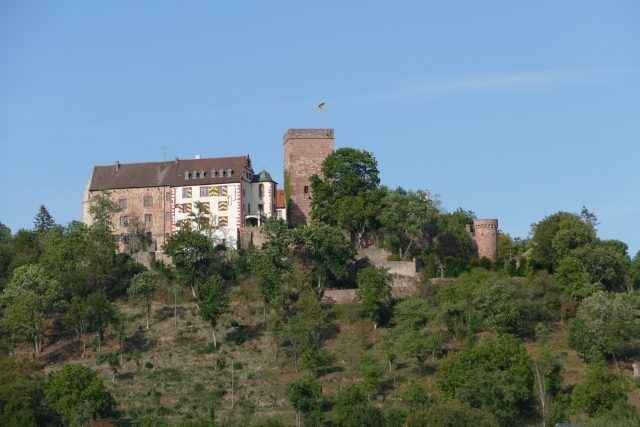
Gamburg Castle is a spur castle in Gamburg, a district of the municipality of Werbach in the Main-Tauber district, Baden-Württemberg. It is located directly above Gamburg on a mountain spur above the Tauber river.
The castle has been in private ownership and inhabited since 1546.
The castle was built in the mid-12th century by the Archbishops of Mainz, first mentioned in 1157 as "castrum Gamburc" and simultaneously passed as a fief from Archbishop Arnold von Selenhofen into the possession of the noble free Beringer von Gamburg, who in return ceded the villula Brunnenbach, today's Schafhof near Bronnbach, to the Archbishop. In 1546, Eberhard Rüdt von Collenberg acquired the castle from the Archbishop of Mainz through exchange. Thereafter, the castle was inherited by Dietrich von Hattstein (1568), Eberhard Brendel von Homburg (1570), the cousins Hartmut the Elder and the Middle of Kronberg (1590), Hartmut the Elder of Kronberg alone (1592), the Lords (later Barons) von Dalberg (1606) and the Barons (later Imperial Counts) von Ingelheim (1722). In 1936, the castle complex passed to Count Emanuel von Westerholt-Gysenberg. After the war, displaced persons were accommodated here. In 1947, Count Westerholt rented parts of the castle to the Caritas Association; in 1949, the rural folk high school for North Baden and in 1957, a special school for resettlers were taken in as subtenants. Since 1980, the castle has been owned by the von Mallinckrodt family.
Complex+
The castle complex with an almost oval floor plan consists of a Staufer keep with a base area of approx. 10 × 10 meters and a wall thickness of approx. 3 meters, adjoining the former stables and the so-called Forester's House, the opposite so-called "Schloss" consisting of the Chapel Tower, the Palas, the Middle Building and the Rear Building, in which a chapel has been located since 1921, a Zwinger (outer bailey) with six semicircular bastions, a round corner tower, an outer gate with two round towers, as well as the neck ditch and the baroque castle park.
In contrast to many other castles, Gamburg was rebuilt several times, for example during the Renaissance, but it was never destroyed and was always inhabited. Even during the German Peasants' War, it remained undamaged as one of the few castles thanks to the personal intervention of Götz von Berlichingen.
The hall of the originally Romanesque Palas building, which was built by Beringer the Younger von Gamburg in the 1180s, has a floor area of 126 m². It originally had underfloor heating and is the only one whose original painting is still preserved. Its late Romanesque painting findings, discovered in 1986, are the oldest profane wall paintings north of the Alps (before 1219). They are provided with Latin and German inscriptions and tell, in the form of a continuous picture story, scenes from the 3rd Crusade under Emperor Frederick I Barbarossa. Beringer d. J. von Gamburg participated in the Third Crusade. He had joined the troops of the Bishop of Würzburg Gottfried von Spitzenberg Helfenstein, who had previously been Imperial Chancellor. For its time, this room with its unusually wide, Romanesque double arcades was a marvel of architecture.
Take Mobile History with you
You are reading this text for free. Premium adds what matters on the road: descriptions read aloud, sites found through your camera, whole regions taken offline.
- Every description, including the ~17,700 Premium sites
- Audio guide: have descriptions read to you on location
- AR finder: see sites through your camera, with distance and bearing
- Unlimited saved sites
14 days free, then from €2.99 a month. Cancel anytime.
Source: Wikipedia · Licence: CC BY-SA 4.0 · Image: Mobile Geschichte
This description draws on the facts documented in the linked Wikipedia article; Wikipedia content is licensed under CC BY-SA 4.0. Wording and editing: Mobile History.
Location: 49.6961, 9.6027