District Government of Swabia
ResidenceAugsburg
Fürstbischöfliche Residence
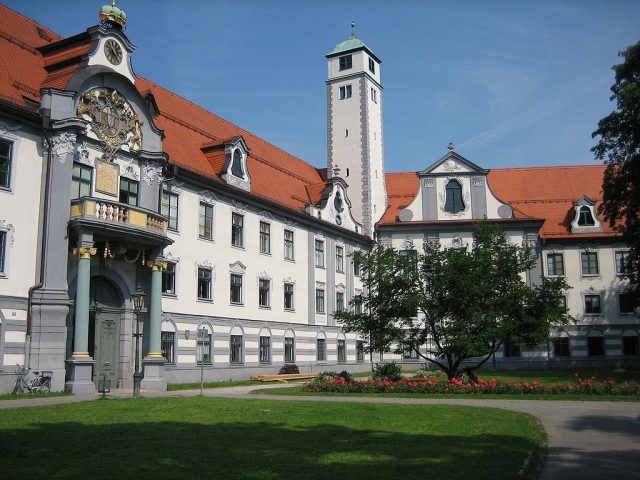
The former Prince-Bishop's Residence is a building complex in the old town of Augsburg. Built between 1740 and 1752 under Prince-Bishop Joseph Landgrave of Hesse-Darmstadt, incorporating older predecessor buildings, the late Baroque building has been the seat of the Swabian district government since 1817.
The Building+
The main building of the former Prince-Bishop's Residence originally consisted of three adjoining medieval houses, including the Palatine Tower, which was raised in 1507/1508. Already consolidated into a single building before 1680 under Bishop Johann Christoph von Freyberg, the main wing of the current residence was rebuilt in 1743 by Johann Benedikt Ettl, and the north wing by Franz Xaver Kleinhans until 1752, in the Late Baroque style.
The column-supported balcony above the magnificent east portal was added between 1784 and 1789 to commemorate a visit by Pope Pius VI in 1782. A southwestern extension over the former Palatine Chapel and a guardhouse were built in 1902.
Interior Decoration+
Inside the former Prince-Bishop's Residence, the former dining room in Rococo style from the reign of Bishop Joseph of Hesse-Darmstadt has been preserved.
The representative main staircase - the so-called "Prunkaufgang" (grand ascent) - was frescoed in 1752 by Johann Georg Bergmüller, director of the Imperial City Art Academy. The painting on the side walls shows, among other things, allegories of the three main rivers of the Prince-Bishopric of Augsburg - Danubius (Danube), Lycus (Lech), and Vinda (Wertach). Between coat of arms cartouches and drawings by the builder, four corner mirrors depict the Platonic cardinal virtues: Prudentia (Prudence), Justitia (Justice), Fortitudo (Fortitude), and Temperantia (Temperance). Above all, "Providentia Divina," divine providence, watches from the ceiling.
A small antechamber decorated with putti leads into the Rococo Hall. The eight oil paintings integrated into the wall paneling there show contemporary princely figures, including the then imperial couple Franz I and Maria Theresia. In the place of the ballroom, the predecessor building housed the room of the Augsburg Cathedral Chapter, where on June 25, 1530, the Confessio Augustana, the "Augsburg Confession" of the Lutheran Protestants, was proclaimed.
Fronhof+
East of the former Prince-Bishop's Residence is the Fronhof. Originally partly used as a cemetery for Augsburg Cathedral, the Fronhof served as a jousting and parade ground over the centuries before being converted into a public green space in 1878.
Hofgarten+
Until the secularization of the Prince-Bishopric of Augsburg, the Hofgarten, located west of the residence building, was in princely-episcopal possession. Since 1817, it has been owned by the Bavarian state and has been accessible to everyone since 1965.
Take Mobile History with you
You are reading this text for free. Premium adds what matters on the road: descriptions read aloud, sites found through your camera, whole regions taken offline.
- Every description, including the ~17,700 Premium sites
- Audio guide: have descriptions read to you on location
- AR finder: see sites through your camera, with distance and bearing
- Unlimited saved sites
14 days free, then from €2.99 a month. Cancel anytime.
Source: Wikipedia · Licence: CC BY-SA 4.0
This description draws on the facts documented in the linked Wikipedia article; Wikipedia content is licensed under CC BY-SA 4.0. Wording and editing: Mobile History.
Location: 48.3722, 10.8944