Restaurant
CastleSalzburg
Franziski Castle
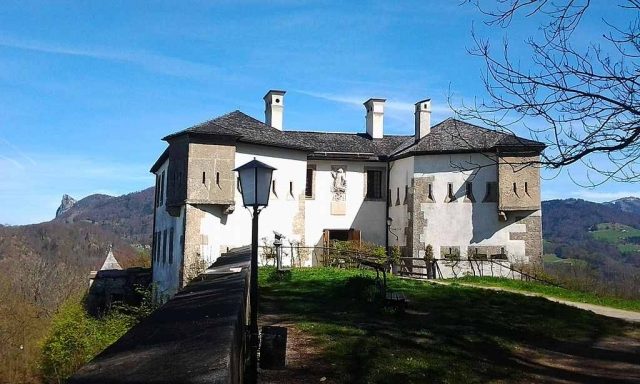
The Franziskischlössl is a former defensive structure on the Kapuzinerberg in the city of Salzburg.
The Franziskischlössl was built as part of the defensive system with its preserved approximately 3 km long fortress wall to the south and east, with gun bastions to the west and with scarified (artificially steepened) rocks to the north, including the two gun bastions (cavaliers) there, to secure the Kapuzinerberg and the city of Salzburg. The small castle also served, via a now ruined wall and the "Fürbergkavalier" (today a viewpoint), to secure the narrow valley from Fürberg (an offshoot of the Mönchsberg) to Kühberg (with its Neuhaus Castle).
The Franziskischlössl was erected by Archbishop Paris von Lodron in 1629 during the Thirty Years' War, when Salzburg was probably the best-defended city in Central Europe. It is dedicated to Saint Francis, "so that peace on the mountain may last forever and ever". The ornate wrought-iron railing, which today leads to the guest garden on the bastion, dates back to the time of its construction.
The Franziskischlössl subsequently served not only as a defensive structure but also as a hunting lodge in peacetime, the latter especially under Max Gandolf von Kuenburg, who expanded it. After the end of the Prince-Archbishopric, its military significance was modest. After 1816, the small castle was leased (naturally subject to revocation at any time in case of war). In 1848, the Franziskischlössl was inhabited only by an old soldier. At least since 1849, with interruptions only during a few war years, it has been a permanent inn.
The old, very large rainwater cistern, hewn into the rock, has been preserved (but without a stone well rim). Remarkable is the basement with its north-facing gun embrasures, which was essentially also broken out of the massive limestone rock (the cellar is not generally accessible). The outer moat, once also present to the east in front of the large gun bastion, is now filled in. Only a small section of the old moat with its bridge (once a drawbridge) is preserved to the east. The large park-like former meadow area south of the castle, with its former wide view to the south, is not preserved.
Today, the Franziskischlössl is a popular destination on sunny days, with the path to the castle often taken via the recently renovated bastion path directly along the Kapuzinerberg wall.
Take Mobile History with you
You are reading this text for free. Premium adds what matters on the road: descriptions read aloud, sites found through your camera, whole regions taken offline.
- Every description, including the ~17,700 Premium sites
- Audio guide: have descriptions read to you on location
- AR finder: see sites through your camera, with distance and bearing
- Unlimited saved sites
14 days free, then from €2.99 a month. Cancel anytime.
Source: Wikipedia · Licence: CC BY-SA 4.0 · Image: http://commons.wikimedia.org/wiki/File:Franziskischl%C3%B6ssl.jpg
This description draws on the facts documented in the linked Wikipedia article; Wikipedia content is licensed under CC BY-SA 4.0. Wording and editing: Mobile History.
Location: 47.8051, 13.0590