Church
MonasteryFrauenkirchen
Franziskanerkloster Frauenkirchen
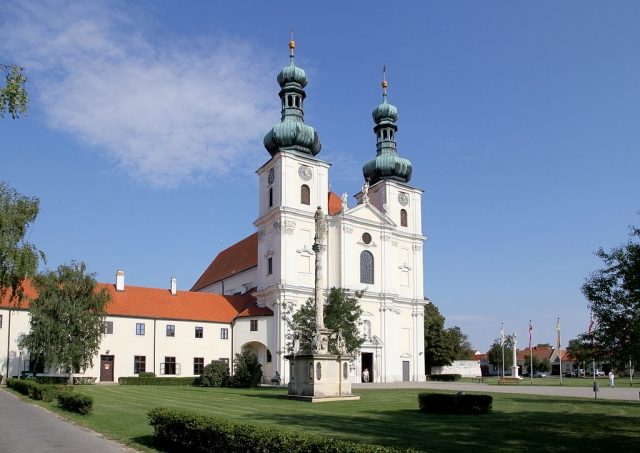
The Basilica of the Nativity of Mary is a baroque, Roman Catholic pilgrimage church in Frauenkirchen, Burgenland. The church made the town a well-known pilgrimage site as early as the 14th century.
In 1529, it was destroyed along with the entire village by the Turks; nothing remains of the church from that time. When the Esterházys came into possession of the town in 1622, the church was rebuilt under their aegis in 1668, and a Franciscan monastery was also erected here. Both, however, again fell victim to the Turks in 1683.
A new church was built again, in 1695 as a foundation by Prince Paul Esterházy through Francesco Martinelli. This church, which still stands today, was consecrated in 1702. In 1720, the Franciscan monastery was added. In 1990, the church was elevated to a Basilica minor by Pope John Paul II.
The Building+
The Baroque church is 53 m long, its interior is 18.5 m wide and 23 m high. It has two towers, which are also 53 m high and are each topped by an onion dome with a pavilion-like column structure, which is also crowned by a smaller onion dome.
The wide nave has four side altars on each side. Their magnificent overall impression is not created by rich furnishings, but by the two dominant colors white and gold. On the ceiling are splendid colorful stucco decorations, which are also adorned with several paintings (including by Luca Antonio Colomba). These pictures, dating from around 1700, show scenes from Jesus' life, the Annunciation of Mary in the choir, and the Coronation of Mary in the nave.
The high altar, which was gilded in 1873, is flanked by statues of the two Hungarian kings, St. Stephen and St. Ladislaus. Here is the miraculous image of Mary with the Child, made of linden wood, dating from the 13th or 14th century. This miraculous image, which has been restored several times, was brought here in a solemn procession from the castle chapel of Forchtenstein in 1661. During the Second World War, the miraculous image was kept in Vienna. In addition to this miraculous image of Maria auf der Heid, a Gothic statue of Mary is also venerated.
The pulpit is richly adorned with figures and is worth seeing; it was created in 1713. The same applies to the baroque choir stalls with images of saints and landscapes and the organ loft. The treasury with its remarkable stucco decorations is located in the former refectory.
Of the two crypts under the church, one served as a burial place for members of the order until 1870, while the other was used to inter members of the comital line of the Esterházys.
Between 1953 and 1960, the interior of the church was renovated, and the large square in front of the church was transformed into a green area.
Take Mobile History with you
You are reading this text for free. Premium adds what matters on the road: descriptions read aloud, sites found through your camera, whole regions taken offline.
- Every description, including the ~17,700 Premium sites
- Audio guide: have descriptions read to you on location
- AR finder: see sites through your camera, with distance and bearing
- Unlimited saved sites
14 days free, then from €2.99 a month. Cancel anytime.
Source: Wikipedia · Licence: CC BY-SA 4.0 · Image: http://commons.wikimedia.org/wiki/File:Basilika_Frauenkirchen.JPG
This description draws on the facts documented in the linked Wikipedia article; Wikipedia content is licensed under CC BY-SA 4.0. Wording and editing: Mobile History.
Location: 47.8363, 16.9289