Abbey
MonasteryNeuburg an der Donau
Franciscan Abbey
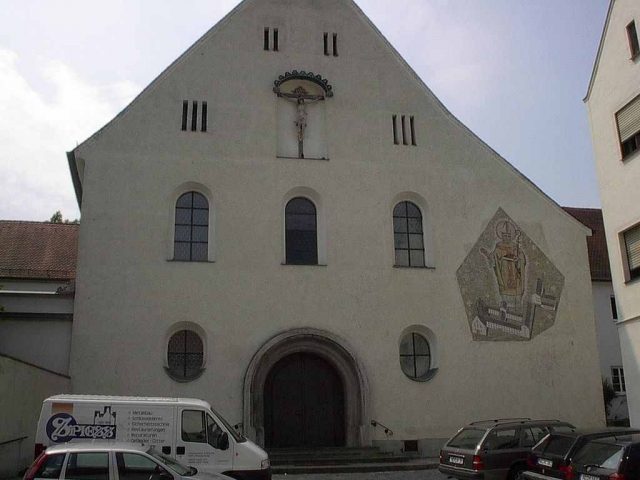
The Franciscan Monastery Neuburg an der Donau is a former Franciscan monastery in Neuburg an der Donau, which was founded by Count Palatine Philipp Wilhelm von der Pfalz (reigned 1653-1690) as a result of a vow. It existed since 1656 and burned down in 1793. In 1803, the monastery was secularized.
A Vow for the Monastery Construction
A vow is the cornerstone for the Neuburg Franciscan monastery, from which the current Priest Hospice Anton von Padua St. Augustin eventually emerged. Duke Philipp Wilhelm had little luck. The marriage remained childless and his first wife had died. Therefore, in 1653, the worried regent vowed to erect a church and a monastery with the Franciscan order in honor of Saint Anthony of Padua, if his second marriage should be blessed with children.
Promptly, the first child was born. The Duke took his vow seriously and obtained permission for the monastery construction in Augsburg. On December 31, 1656, the foundation stone was laid for the large building, and on March 5, 1657, experts marked out the site for the church. On August 26, 1657, the next celebration took place, when Baron von Servi handed over the foundation stone for the Franciscan church on behalf of the Duke. Joy radiated, and there were many benefactors from the population.
After a construction period of three years, again on August 26, in 1660, the solemn inauguration of the church and monastery took place by the Auxiliary Bishop of Augsburg, Caspar Zeiler. The Franciscans had already arrived in Neuburg in 1656 and filled the new monastery with life. Only the brewery was not yet finished.
The blessing of children was more than abundant in the end; his wife bore the Duke nine sons and eight daughters. The prince once ironically remarked: Now another vow would almost be necessary for the blessing of children to end.
The Great Fire
Even the powers of fate did not always bring blessings. On September 1, 1793, around noon, the church and monastery suddenly stood in blazing flames. Quadrian Willibald Fanger quickly gathered the most important papers and then jumped out of the window, severely injuring himself. A soldier, risking his life, retrieved the ciborium and the monstrance from the tabernacle. The fire brigades from Ingolstadt, Burgheim, and Rain rushed to Neuburg to save what could be saved. The monastery and church lay in rubble and ashes, as did some neighboring buildings.
The help from the population was great; there were many donations. Reconstruction proceeded rapidly. Just eleven months later, precisely on July 30, 1794, Dean Holl from the Heilig Geist parish in Neuburg consecrated the new church. The 13 fathers and ten brothers moved into the rebuilt monastery building on November 6, 1794.
The Secularization
Barely nine years later, a new blow of fate occurred. Secularization was in full swing, and the monastery was dissolved. In 1804, the religious were deported to the dissolved Kaisheim Abbey and soon after came to Ingolstadt. The monastery was to be converted into a barracks for 900 men. But the conversion costs were disproportionate. The state now sold the property.
The church became a porcelain factory, the church tower was demolished, the side altars and altar tables were smashed, and the inventory was removed. The church housed the glaze and the earth mill, and the presbytery contained the kiln. The upper part of the cells served as the manufacturer's dwelling and for crockery storage.
No blessing rested upon these worldly events. In 1854, a forced auction took place. The Brothers of Mercy of Neuburg acquired the entire area and established a priest hospice there. A renovation in 1857 gave the church its present appearance. Bishop Michael Deimlein consecrated the house of God to Saint Augustine. Since then, the institution has been called Priest Hospice St. Augustin, which is ecclesiastically assigned to the parish of St. Peter.
Take Mobile History with you
You are reading this text for free. Premium adds what matters on the road: descriptions read aloud, sites found through your camera, whole regions taken offline.
- Every description, including the ~17,700 Premium sites
- Audio guide: have descriptions read to you on location
- AR finder: see sites through your camera, with distance and bearing
- Unlimited saved sites
14 days free, then from €2.99 a month. Cancel anytime.
Source: Wikipedia · Licence: CC BY-SA 4.0
This description draws on the facts documented in the linked Wikipedia article; Wikipedia content is licensed under CC BY-SA 4.0. Wording and editing: Mobile History.
Location: 48.7331, 11.1782