Museum
FortressWunstorf
Fortress Wilhelmstein
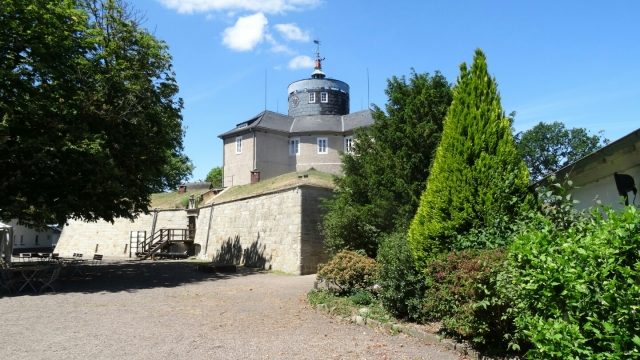
Wilhelmstein is a 1.25-hectare artificial island in Lake Steinhude in the Hanover region, created for military reasons in the 18th century. The Wilhelmstein fortress has been located there ever since. Today, the island near Hagenburg is a popular excursion destination, reachable by "Auswanderer-Boote" (emigrant boats) from Steinhude and Mardorf.
Origin+
Count Wilhelm zu Schaumburg-Lippe had the island and the fortress built between 1761 and 1767. The island fortress, built in the typical star-shaped bastion system of the time, was considered the center of the small state of Schaumburg-Lippe despite its small size and served its defense. Count Wilhelm wanted to protect the small county, which at that time had only 17,000 subjects, against possible annexation attempts by other powers. His military experience as an artilleryman in the Seven Years' War and as a commander in Portugal proved beneficial in the planning.
The fortress in Lake Steinhude was intended to become an impregnable refuge and prevent an attacker from seizing the county. The case of defense actually occurred 20 years after the completion of the fortress (see Siege of 1787 below). The foundation stone was laid in 1761 in the southwest area of the lake, 1.4 km from the shore. The construction project was named Wilhelms Insuln, as it initially consisted of Wilhelmstein as the fortress island with 16 secondary islands (Wilhelmsinseln).
Between 1761 and 1765, the island on which the fortress was to be built was raised. For five years, the population brought in about 30 m³ of fill material consisting of sand, gravel, and stones every workday. In summer, fishermen transported the material in their boats; in winter, farmers brought it on sleds. The 1.2 km long Hagenburger Canal was specially dug as a branch canal from Hagenburg Castle to Lake Steinhude for delivery. Despite Count Wilhelm's claim to corvée labor, he had the workers paid.
Construction Description+
Fortress
On the island, which was then much smaller than today, a star-shaped redoubt with four bastions, a citadel, and pincer-shaped tenailles was initially built between 1765 and 1767. While the outer walls consisted of stone blocks, brick was used inside. The soldiers were housed in the casemates inside the fortress. The bulletproof vaults also served to store ammunition and provisions. Above the casemates, a small castle was built as living quarters for the fortress commander and officers. It had a tower, on which an observatory was located from 1774. For the guards' patrols, there was a narrow berm around the fortress at water level and a path around the small castle on top of the fortress.
Outworks
Around the fortress island, 16 further islands were built as outworks, initially as platforms on wooden piles and beams. They formed four outer bastions, four central ravelins, and eight smaller curtain walls. The outworks were connected to each other and to the fortress island by drawbridges. In addition to cannon emplacements, they housed permanent buildings with workshops, magazines, a hospital, and study rooms, as well as a windmill. A small harbor, which still exists today, was built in the southwest. Five small gunboats were stationed there. The Count also had an experimental garden laid out on one of the outworks.
Early on, waves and ice caused damage to the outworks. The wooden piles also rotted quickly in the water. Already in 1772, the outworks were given a solid foundation by filling them with sand and stones. The outworks no longer exist in their original form today. They were integrated into the main island when the spaces between them were filled in around 1810. This transformed the star-shaped redoubt into the island in its current, almost square shape with sides of about 100 m. Of the formerly 16 houses, nine still exist today (for sailors, sergeants, servants, barracks, forge, infirmary, powder house, cattle house). These are mostly not original wooden buildings from 1767, but stone replicas from the mid-19th century.
Armament and Garrison
The fortress possessed the most modern armament of its time, with 166 cannons in 1777. These included three-, six-, and twelve-pounder cannons (named after the weight of the cannonball) as well as mortars. By 1850, there were only about 100 guns, as some had been sold. Four long embrasures for cannons are embedded in the fortress walls.
In case of war, a garrison of 800 soldiers was planned, half of whom were intended for the fortress and the outworks respectively. In the early years, the regular strength was 250 soldiers, later around 150 men. In 1782, the garrison was reduced to 22 men for cost reasons.
Soldier service on the fortress was not without health risks. Constant dampness caused colds and rheumatism. In peacetime, soldiers therefore served on the island for a maximum of ten days, being accommodated on land in Hagenburg and Steinhude. Some soldiers' wives also lived on the island, doing laundry and other housework for the garrison. In winter, the island was sometimes cut off from the mainland when the ice was not yet strong enough to bear weight and boats could not operate. For this reason, large quantities of food and fuel were stored in the fortress. In winter, the garrison had to keep the islands ice-free with long saws.
Wilhelmsteiner Feld
In 1772, the Wilhelmsteiner Feld was created on the southwest shore of Lake Steinhude as a landing place for the Wilhelmstein's boat fleet. The supervision of these works was carried out by Artillery Premier Lieutenant Ernst Carl von Colson (1746–1795) of the highly countly Schaumburg Lippian Artillery Corps. This involved the drainage of an originally swampy area. Redoubts and other fortifications and training facilities were built there. The area was also used for agriculture, as its produce was intended to supply the island fortress in case of war. Deserving soldiers received farmsteads in the Wilhelmsteiner Feld. After the Count's death in 1777, the military and civilian facilities were sold, and the areas reverted to moorland.
Functions+
From its completion in 1767 until the death of its builder, Count Wilhelm, in 1777, Wilhelmstein served a military function as a fortress. During this time and thereafter, the island acquired further functions:
Military School
Upon completion of the island fortress in 1767, Count Wilhelm established a military school there, which he called the Practical Artillery and Engineering School. It served to train officers, non-commissioned officers, and enlisted men of the artillery and engineering corps. The students lived alternately on the island and in Steinhude. Attending the multi-year school was free of charge. It not only imparted military knowledge such as ballistics and tactics but also taught general subjects such as physics, medicine, chemistry, history, and foreign languages from 1770 onwards. In the first 10 years of the military school's existence, 44 officer candidates were trained. The most famous student was the later Prussian general and army reformer Gerhard von Scharnhorst. He began his service on Wilhelmstein in 1773 at the age of 18 and later received the Golden Medal of the War School. After the death of Count Wilhelm in 1777, his successor Philipp Ernst moved the school to Bückeburg, where it was dissolved in 1787.
Prison Island
After the death of Count Wilhelm in 1777 and the relocation of the military school to Bückeburg in 1787, the fortress island had largely become functionless. Consequently, it was converted into the state prison of the County of Schaumburg-Lippe. Initially, mainly serious criminals serving long or life sentences were incarcerated. Around 1815, there were an average of 10 permanent inmates on the island; in total, about 300 prisoners were held in the prison, which existed for over 80 years. They had to perform forced labor on the island. Some deceased inmates were buried on the island. Due to its location in the water, the prison island was considered escape-proof. Three escapes are known, across the ice and by swimming on a wooden plank, at least one of which failed. In 1867, the prison was closed, and the last inmates were transferred to correctional facilities on the mainland.
Historic Excursion Destination
Excursion traffic to the island began early. The first visitor signed the guestbook in 1767, the year the fortress was completed. Initially, visitors, averaging about 50 per year, were nobles or high-ranking military personnel. The siege of 1787 gave the fortress island a high degree of notoriety, so that from 1790 onwards, up to 300 people visited the island annually. After its use as a prison ended in 1867, tourism increased significantly. The island was already being prepared as a visitor destination by the House of Schaumburg-Lippe at this time. Surrounding health resorts, such as Bad Nenndorf, Bad Eilsen, and Bad Rehburg, ensured high visitor numbers. Prominent island visitors included Johann Gottfried Herder, Friedrich de la Motte Fouqué, Jérôme Bonaparte, and Emperor Wilhelm I.
A further increase in tourism to the island began around 1900, also due to the Steinhuder Meer Railway, which started operation in 1898. For the fishermen of Lake Steinhude, tourism to the island meant a new source of income. They acquired larger boats in the form of "Auswandererboote" for passenger transport.
In the 21st century, the island owner Prince Alexander zu Schaumburg-Lippe carried out extensive renovations of the historic island buildings between 2005 and 2009 for around 1 million euros to make the island more attractive for tourism. 7 of the 9 island houses were restored and made usable again.
Siege of 1787+
For a long time, the island fortress was regarded as a playful whim of a militarily enthusiastic "cannon count" in the person of Count Wilhelm zu Schaumburg-Lippe. When he died in 1777 without a male heir and his successor Philipp Ernst also died in 1787, the Landgraviate of Hesse-Kassel laid claim to the County of Schaumburg-Lippe. Hessian troops occupied the county in February 1787 without encountering resistance. Only about 150 men entrenched themselves on Wilhelmstein. The Hessians, numbering around 2,800 men, besieged the fortress island. The cannon bombardment failed because the cannons could not be positioned close enough due to the marshy shore of Lake Steinhude. The tactic of starving out the fortress garrison also failed: Wilhelmstein was supported by the Electorate of Hanover, to which the northern shore of the lake belonged. During the siege, the imperial leadership granted Prussia and the Electorate a mandate to liberate the County of Schaumburg-Lippe by force if necessary. When this coalition amassed several thousand soldiers, the Hessians retreated.
Current Situation+
Ownership
The island of Wilhelmstein, located in Lake Steinhude, is owned by the noble family Schaumburg-Lippe. It is currently managed by an island bailiff of the princely court chamber in Bückeburg. This includes the right of access to the island by motorboat on the otherwise motorboat-free lake. Originally, Lake Steinhude also belonged to the Principality of Schaumburg-Lippe. However, the Prince ceded half of it to the state after the November Revolution of 1918/19 to prevent expropriation. With the territorial reform of 1974, the remaining half of Lake Steinhude was sold by the Prince to the district of Hanover for 5 million DM.
General
The restored buildings offer a café, a souvenir shop, seminar rooms, and overnight accommodation for tourists. One of the island houses contains a small exhibition about the Steinhuder Meer Nature Park. Approximately 80,000 day visitors, arriving by "Auswandererboote" or passenger ships, visit the island annually. Sailboats can moor at the island for a fee.
The entire fortress is now a museum that can be visited for an entrance fee. It displays maps, weapons (mortars, cannon barrels, cannonballs, rifles), and other objects from the history of the complex. Former living and detention cells are also recreated.
Since 2005, 20 couples per year have again had the opportunity to get married in the former room of the island commander. Weddings on the island were already performed from about 1900 and were very popular. However, after World War II, interest in island weddings declined.
Exhibitions
Since 2003, the art association Meerkunstraum e.V. has presented a series of open-air exhibitions on Wilhelmstein Island under the title "Durch-Blick" (Insight). In 2013, the artist Timm Ulrichs showed five installations in his exhibition "Im Glashaus" (In the Glass House) on the island under the motto "People who live in glass houses..."
Miscellaneous+
From the island, in 1772, the first submarine in Germany, the Steinhuder Hecht, was launched.
The fortress served as a model for Fort Nossa Senhora da Graça in the city of Elvas in Portugal, which Count Wilhelm zu Schaumburg-Lippe had built in the 18th century in the style of Vauban. The Portuguese king initially named the fort "Fort de Lippe" in honor of the Count. It served to defend against the Spanish.
Take Mobile History with you
You are reading this text for free. Premium adds what matters on the road: descriptions read aloud, sites found through your camera, whole regions taken offline.
- Every description, including the ~17,700 Premium sites
- Audio guide: have descriptions read to you on location
- AR finder: see sites through your camera, with distance and bearing
- Unlimited saved sites
14 days free, then from €2.99 a month. Cancel anytime.
Source: Wikipedia · Licence: CC BY-SA 4.0 · Image: Jörg Heldt
This description draws on the facts documented in the linked Wikipedia article; Wikipedia content is licensed under CC BY-SA 4.0. Wording and editing: Mobile History.
Location: 52.4605, 9.3076