The Fort can be visited
FortressSande - Mariensiel
Fortress Wilhelmshaven-Fort Mariensiel
The creation of the city of Wilhelmshaven can be traced back to the German-Danish conflict of 1848, during which the Danish navy blocked German shipping traffic. This led to the demand in Prussia and the North German Confederation for their own navy. Consequently, Prussia purchased the present-day urban area of Wilhelmshaven from the Duchy of Oldenburg on the Jade Bight. However, at that time, these were just meadows and fields.
In 1856, King Friedrich Wilhelm IV approved the construction of workshops and magazines in the Jade area. A short time later, the idea of building warships themselves arose, which is why the port facilities were expanded with slipways. On June 17, 1869, King Wilhelm I inaugurated the new port facilities with the docks and gave the associated "city" the name Wilhelmshaven.
Since the establishment of the first naval facilities in 1856, fortifications played a paramount role. Even during the planning of the so-called "naval establishment," questions regarding the protection of the naval facilities were considered. Thus, the harbor basin was built 3200 paces away from the Jade fairway, because, according to the technology of the time, this provided protection against enemy ship guns that did not yet have a long range. Coastal batteries, on the other hand, were intended to combat enemy ships.
Until the war of 1870/71, Wilhelmshaven was secured with numerous coastal batteries and field redoubts, but this war and the technical advancement of weapons showed that the entire planning had to be rethought. By World War I, the three large forts Rüstersiel, Schaar, and Mariensiel, and the small Fort Altona, had been built. Nevertheless, even this ring of fortifications no longer met the requirements, and further small forts and coastal batteries were constructed. Twenty-one small outer forts were built. These small forts corresponded to the typical Prussian infantry works that were built all over the German Empire at that time. All buildings, batteries, and fortifications were built so low that they were completely hidden from the sea side by the dike. Even the lighthouses were built to be collapsible so that they could not serve as orientation from the sea side.
This large number of fortifications and forts were not razed to the same extent after World War I as was the case in other cities. In this respect, these facilities could continue to be used or were reclaimed by nature. The entire Wilhelmshaven fortification had never been used until then. This changed abruptly with the outbreak of World War II. Although the old fortifications were completely outdated, they were ideally suited for the development of air defense. Thus, all fortifications were honored again: crews moved in, and anti-aircraft guns were set up.
After World War II, almost all fortifications were blown up by the British occupation forces. Only a few remnants are still visible. The rubble was removed years later.
Fort Mariensiel
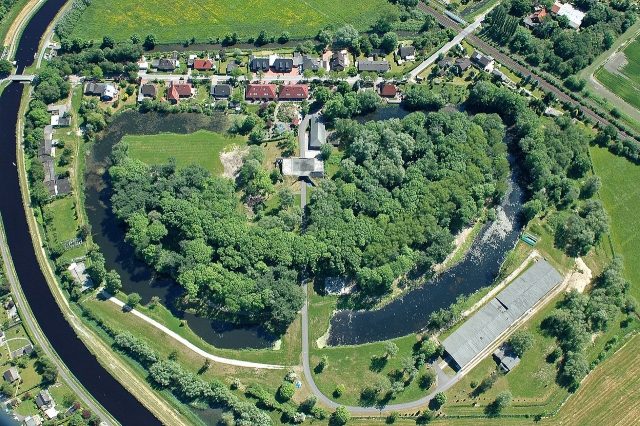
From 1876, the three new forts were built around Wilhelmshaven. These were Fort Rüstersiel, Fort Schaar, and Fort Mariensiel. The Maade, a deep channel that serves to drain the area, was chosen as the line of defense.
Fort Mariensiel was armed with ten 15cm L/28 cannons and eight 12cm cannons. Construction took place between 1876 and 1880. After the end of World War I, the fort and its surroundings were used for defusing former naval ammunition. On December 17, 1919, around 2:00 PM, a massive explosion occurred in a barracks near the fort. 40,000 15cm grenades exploded. The disaster cost 27 workers their lives. At that time, no expert soldiers could be motivated for this work, so private companies carried out these tasks quite carelessly. On September 8, 1920, another explosion shook the fort when an attempt was made to defuse naval mines. Seventeen dead and numerous injured were the result.
After World War II, the most important facilities were blown up by the British. Only the former storage rooms of the artillery and ammunition depot remained. These were used by the Wilhelmshaven Naval Arsenal as an external warehouse until 1994. Today, a community meeting point is located in the former guardroom. The storage rooms are used by a construction company.
Take Mobile History with you
You are reading this text for free. Premium adds what matters on the road: descriptions read aloud, sites found through your camera, whole regions taken offline.
- Every description, including the ~17,700 Premium sites
- Audio guide: have descriptions read to you on location
- AR finder: see sites through your camera, with distance and bearing
- Unlimited saved sites
14 days free, then from €2.99 a month. Cancel anytime.
Location: 53.5130, 8.0456