The Fortress can be visited
Museum
FortressSenftenberg
Senftenberg Fortress
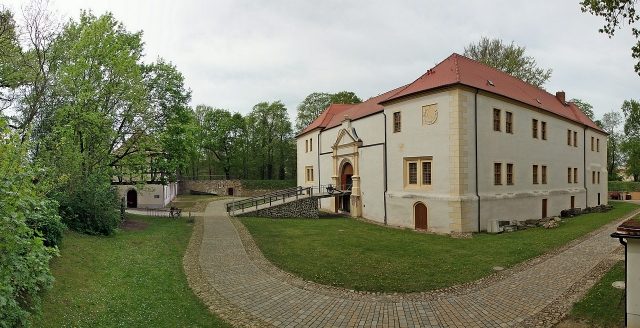
Senftenberg Fortress is a citadel-like fortress that was used militarily until the 18th century. The fortress complex with its surrounding castle park is now one of the architectural monuments in Senftenberg. Its almost completely preserved earthen ramparts are a special feature from the perspective of monument protection.
Development+
Very little is known about the predecessors of the fortress from the 12th and 13th centuries. The preserved fortress only emerged from the 16th century under Saxon administration. Senftenberg belonged to the Electorate of Saxony since 1446, before it transferred to Prussia in 1815. In the 16th century, the castle building, which is located in the middle of the complex, underwent a fundamental reconstruction. In the 17th century, the earthen ramparts were rebuilt into their form preserved to this day. Additionally, a water pond was dammed around the complex to make storming the ramparts more difficult and to prevent mining. In 1764, the military use of the fortress was abandoned. Since then, the complex has been used for various civilian purposes, such as an administrative building, a prison, or a school. In 1913, the first predecessor of today's museum "Castle and Fortress Senftenberg - Museum of the OSL District" was established.
Current State+
A closed earthen rampart with four bastions surrounds the complex. Access is via the fortress gate located in the northwest bastion and the adjoining postern. The postern was newly constructed as part of the renovation work after reunification, as the original casemate system, with the exception of the gate front, was demolished at the end of the 19th century. The area of the former water pond and the glacis is now used as green space. The dam is still recognizable on the street "Zum Steinwall". In the middle of the courtyard stands the castle, a closed four-sided complex, which houses the museum. The so-called Commander's House is located on the south curtain wall. On the northeast bastion there is a powder tower, which is a new construction from the beginning of the 20th century. A narrow passage leads under the east curtain wall to a small side gate.
Take Mobile History with you
You are reading this text for free. Premium adds what matters on the road: descriptions read aloud, sites found through your camera, whole regions taken offline.
- Every description, including the ~17,700 Premium sites
- Audio guide: have descriptions read to you on location
- AR finder: see sites through your camera, with distance and bearing
- Unlimited saved sites
14 days free, then from €2.99 a month. Cancel anytime.
Source: Wikipedia · Licence: CC BY-SA 4.0 · Image: Norbert Kaiser
This description draws on the facts documented in the linked Wikipedia article; Wikipedia content is licensed under CC BY-SA 4.0. Wording and editing: Mobile History.
Location: 51.5164, 14.0069