The remains of the fortress can be visited
FortressKoblenz-Asterstein
Fortress Koblenz-Werk Glockenberg
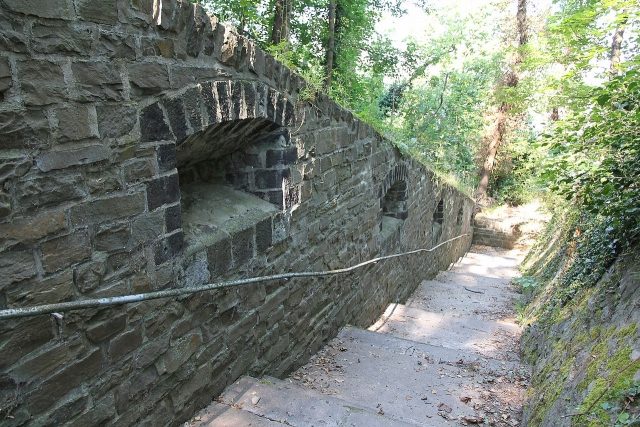
The Glockenberg work was part of the Prussian Fortress of Koblenz and belonged to the Pfaffendorfer Höhe system. Of the work built in 1822 and razed in the 1920s, only remnants and a part of the Teufelstreppe (Devil's Staircase) remain in today's Koblenz district of Asterstein.
The Glockenberg work was built in 1822 south of Fort Asterstein as a two-story tower in the form of a half-redoubt. In 1900, the work was abandoned, and the rampart was leveled after 1906. After the First World War, the facility, like the other Koblenz fortress works, had to be de-fortified in execution of Article 180 of the Treaty of Versailles. The ditch walls, two ditch defenses, two ammunition rooms, a caponier, etc., were designated for destruction. The connection to Fort Rheinhell was to be breached. The Koblenz De-fortification Office submitted a preservation request for the tower and the staircase system to the Horchheimer Gate fortification (the so-called Teufelstreppe).
Work on the Glockenberg began on April 18 and was reported completed on July 13, 1927, albeit with the reservation of the still pending decision on the preservation request, which was finally granted. The remaining parts of the facility, mainly the tower, were largely removed in 1935. During the redevelopment of the property in the 1950s by the new owner, the municipal green spaces and cemetery office under the direction of Hans Wilhelm Mutzbauer, part of the still existing cellar vaults was built over, preserving the former kitchen rooms of the original tower and the basement of a two-story annex from 1864, which was used as a storage room. Here, a commemorative plaque with the inscription Hptm. Sntg. / Pr Lt. Frdhm. / Mstr. Mcklr. / 1864 can also be found. In addition, there is an undefined, approximately four-meter-long section of wall in the area of the former ditch to Fort Rheinhell.
The Teufelstreppe, of which only half of its original length remains after the expansion of the B 42 in the 1990s, was left to decay for several years and was consequently closed to pedestrian traffic. In June 2012, the staircase was cleared of dirt and debris in a large-scale cleaning operation initiated by the Pfaffendorfer Beautification Association and the General von Aster Carnival Society. A decision on the reopening of the Teufelstreppe, which after all represents the shortest connection between Asterstein via Pfaffendorf to the city center, was initially delayed. On July 11, 2014, the restored Teufelstreppe was handed over to the public.
Take Mobile History with you
You are reading this text for free. Premium adds what matters on the road: descriptions read aloud, sites found through your camera, whole regions taken offline.
- Every description, including the ~17,700 Premium sites
- Audio guide: have descriptions read to you on location
- AR finder: see sites through your camera, with distance and bearing
- Unlimited saved sites
14 days free, then from €2.99 a month. Cancel anytime.
Source: Wikipedia · Licence: CC BY-SA 4.0 · Image: http://de.wikipedia.org/wiki/Datei:Teufelstreppe_01_Koblenz_2014.jpg
This description draws on the facts documented in the linked Wikipedia article; Wikipedia content is licensed under CC BY-SA 4.0. Wording and editing: Mobile History.
Location: 50.3505, 7.6106