The Fortress can be visited
FortressHeldrungen
Heldrungen Fortness
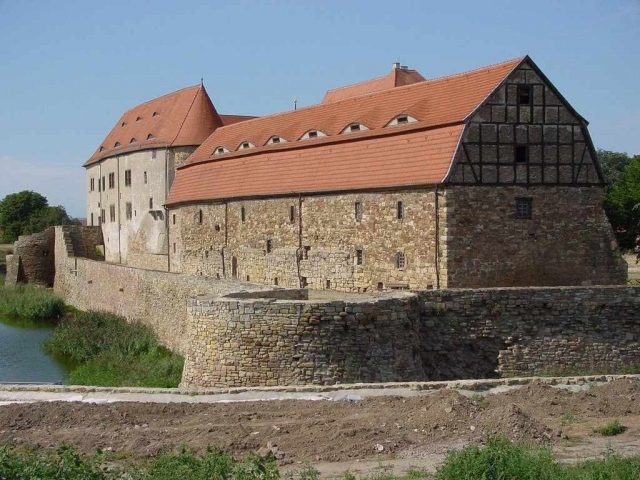
Heldrungen Fortress is a fortress with two moats, four Vauban bastions and five rondels, located in the Thuringian town of Heldrungen on the southern edge of the Goldene Aue, southeast of Bad Frankenhausen. The core of the fortress appears as a bastioned castle from 1519, while the surrounding ramparts and bastions date from 1668. The main gate of the fortress is flanked by two mighty round towers.
Layout+
The multi-story Renaissance castle dates back to a 13th-century castle and still shows some architectural elements from the Gothic period in its structure, such as the window arrangement. A Romanesque keep, also known as the "Müntzer Tower" because of the peasant leader imprisoned there, is integrated into the south wing of the castle. The building has been rebuilt several times over time and dilapidated parts have been demolished, yet today the castle presents itself in an exemplary restored version.
The baroque fortress is essentially an earthwork with a sparse use of masonry.
Today, the castle houses a youth hostel and a castle café. The outer grounds of the fortress are freely accessible.
Since 1976, a Müntzer monument created by artists Hans-Hermann Richter and Johann-Peter Hinz has stood in the open space in front of the north wing, depicting princely servants framing the captured Müntzer. A powerful young couple and three defeated peasants complete the object.
The first fortification was probably a wooden refuge for the inhabitants of the nearby manor "Roter Hof". The first documented mention took place in 1126. The castle was owned by the Lords of Heldrungen. Around 1190, a first stone, Romanesque castle complex was built. Around 1400, the castle came into the possession of the Counts of Hohnstein. Due to high debts, they had to sell the castle to Count Ernst II of Mansfeld in 1479. Count Ernst II of Mansfeld had the castle renovated and expanded into a residence from 1501. From 1512 to 1518, the four-winged Renaissance castle complex was built for Count Ernst II and his second wife Dorothea von Solms. In the years after 1519, fortifications with a total of 12 rondels in two fortress belts and a double moat were built around the castle. The moated castle became a fortress that was considered impregnable in its time. The complex of castle and independent fortress belt is characterized by the early Renaissance emerging in Saxony and represents an early example of the "bastioned castle". Comparable are Hartenfels Castle in Torgau, Wittenberg Castle in Wittenberg and Moritzburg in Halle.
During the Peasants' War, the fortress played an important role as a retreat for the regional nobility. After the Battle of Frankenhausen, the peasant leader Thomas Müntzer was imprisoned and tortured in the castle in 1525 until his execution. In the Schmalkaldic War, battles for the fortress took place in 1546 and 1547. In the Thirty Years' War, on October 23, 1632, the fortress was conquered by Wallenstein's troops under General Merode. All fortress inmates were murdered after the conquest. Until 1645, the fortress frequently changed hands during the Thirty Years' War before it was conquered by the Swedes in 1645. During the siege, the fortress was severely damaged. Still in 1645, the outer ramparts were razed. From 1664 to 1668, Johann Moritz Richter built a new modern outer fortress belt according to the Vauban system. From 1680, the fortress lost its importance and the entire complex slowly fell into disrepair. Through the Congress of Vienna, the town and fortress of Heldrungen came to the Kingdom of Prussia in 1815. Due to its lack of military importance, the fortress was removed from the list of Prussian fortresses in 1860.
From 1930, initial preservation measures were carried out. After the Second World War, buildings of the moated castle were used as housing by some families. Later, a youth hostel was opened in the moated castle and a Müntzer memorial was established, which was removed after 1990. From 1974, extensive renovation and restoration measures were carried out by the GDR to preserve the building fabric. These works were continued after German reunification. Especially the inner and outer fortification rings with the bastions could be saved from decay. In 1990, the castle café was opened.
Visit+
The outdoor area of the fortress is freely accessible. An interior visit is possible by prior arrangement with the local history association "Schloss Heldrungen e. V.".
Take Mobile History with you
You are reading this text for free. Premium adds what matters on the road: descriptions read aloud, sites found through your camera, whole regions taken offline.
- Every description, including the ~17,700 Premium sites
- Audio guide: have descriptions read to you on location
- AR finder: see sites through your camera, with distance and bearing
- Unlimited saved sites
14 days free, then from €2.99 a month. Cancel anytime.
Source: Wikipedia · Licence: CC BY-SA 4.0 · Image: Roland Neubert, Halle (Saale)
This description draws on the facts documented in the linked Wikipedia article; Wikipedia content is licensed under CC BY-SA 4.0. Wording and editing: Mobile History.
Location: 51.2989, 11.2189