The Fortress can be visited
Museum
FortressAbbenfleth
Grauerort Fortress
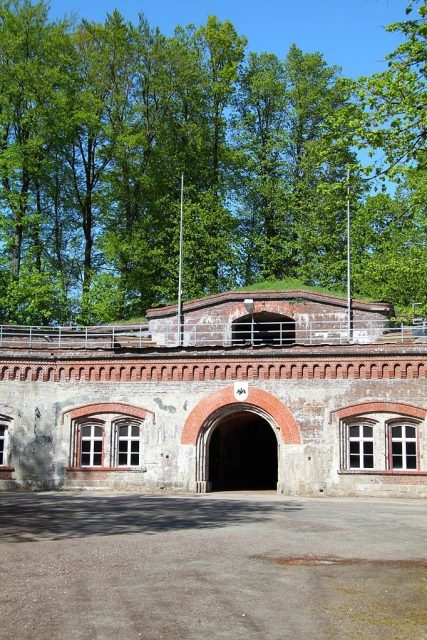
Grauerort Fortress was built by the Prussians between 1869 and 1879 to protect against enemy ships on the Elbe near the village of Abbenfleth. The high old marsh near the Elbe's fairway was used to quickly establish effective protection for Hamburg's harbor during a period of increasing tensions with France. The fortress was already operational during the Franco-Prussian War of 1870/71. However, the fortress was never involved in combat.
Structure+
The Grauerort high-wall fort is a typical example of Prussian fortress architecture from the second half of the 19th century. The fort, with its rhomboid hexagonal layout formed by a 10 m high earthen wall, nestles against the Elbe dike. Towards the Elbe, the walls are casemated. On the two 68 m long flanks, five modern breech-loading recoil guns of 28 cm caliber were positioned.
Towards the Elbe, the fort is secured by a 3 m high escarpe or Carnot wall, which can be defended with cannons and rifles from two caponiers. The remaining walls are secured by a 20 m wide moat. The entrance is formed by a bridge, which leads through a hollow passage into the interior of the fort and is secured by a rifle caponier and guard bunkers. The bridge was originally designed as a drawbridge, and the hollow passage was secured by an anti-storm grid.
The fortress was built by the Prussian army from 1869 to 1879 near Abbenfleth, close to Stade. Already during the Franco-Prussian War of 1870/71, the fortress was provisionally operational. However, until modern times, there were never any combat operations in which the fort would have been involved.
Due to further weapon development, the fortress was removed from the list of active fortresses in 1895 and converted into a mine depot during and after the First World War.
From 1914, the fortress was converted into a provisional mine depot for the Imperial Navy. For this purpose, a storage area for ammunition was set up west of the facility, outside the fortress wall. Its use as a mine depot became permanent after the explosion of the Cuxhaven-Groden mine depot in 1922 and continued until the end of the Second World War. In 1926, a 250 m long landing pier was built into the Elbe, allowing ships to be loaded and unloaded directly. During the Second World War, two anti-aircraft guns were deployed at the fortress.
At the end of the war, the British army confiscated the fortress, which was not destroyed and was used as emergency accommodation until the end of the 1950s.
From 1960, the demilitarization company Kaus & Steinhausen dismantled ammunition on the property. Kaus & Steinhausen moved their operations to the former explosives factory Dragahn in 1985 for safety reasons.
Grauerort then fell into disrepair more and more until an association began to care for the preservation of the facility from 1997. The subsequent additions are now being removed to restore the listed building to its original state and to be able to use it as a modern museum.
Museum+
Grauerort Fortress has been restored by the "Festung Grauerort" e.V. support association since 1997. Since 1998, it has been open to the public again (Sundays and public holidays between April and October, and year-round for groups by appointment). Today it is used as an event venue and museum.
Take Mobile History with you
You are reading this text for free. Premium adds what matters on the road: descriptions read aloud, sites found through your camera, whole regions taken offline.
- Every description, including the ~17,700 Premium sites
- Audio guide: have descriptions read to you on location
- AR finder: see sites through your camera, with distance and bearing
- Unlimited saved sites
14 days free, then from €2.99 a month. Cancel anytime.
Location: 53.6778, 9.4903