Museum
FortressDömitz
Dömitz Fortress
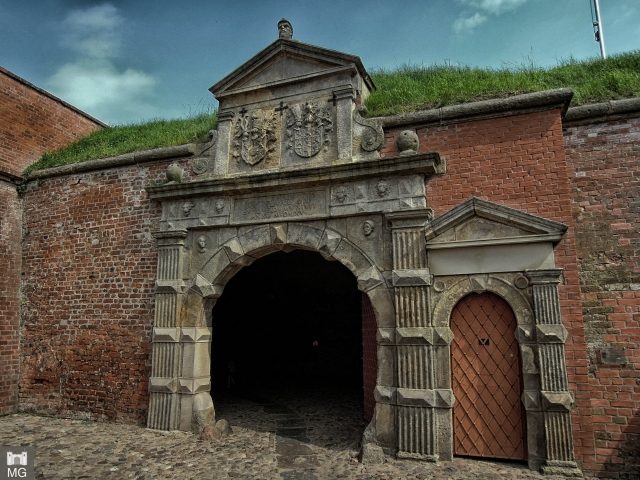
Dömitz Fortress is a fortress in Mecklenburg-Vorpommern. It is strategically located on the Elbe River in the town of Dömitz.
The Mecklenburg Duke Johann Albrecht I had the largest fortress in Mecklenburg built between 1559 and 1565 to secure Mecklenburg's southwestern border and the Elbe crossings. For this purpose, he had the existing castle there expanded. The military used the fortress until 1894. It survived the centuries unscathed and is still an impressive lowland fortress today. Bastions, casemates, and the commandant's house can be visited.
During the Thirty Years' War, the town and fortress served as a base for changing parties, including Tilly and Wallenstein. In 1635, the entire town was burned down for defensive purposes. In 1809, the first battles of the Wars of Liberation against Napoleon took place here. Cannonballs are still embedded in the brick wall today, commemorating the bombardment of the fortress in the 19th century.
Since 1750, the fortress was also used as an asylum and prison. The writer Fritz Reuter, who wrote in Low German, spent the last part of his fortress imprisonment here from 1838 to 1840. He was released on August 25, 1840. In his book Ut mine Festungstid ("From my Fortress Time"), he reports on this period.
Layout+
The fortress has a pentagonal layout (cf., among others, the citadels of Turin, Jaca, and Lille, as well as the mountain fortress Wülzburg) with bastions at rifle shot range. The walls between the bastions (so-called "curtains") are up to 9 meters high. The entire complex was planned by the Italian Francesco a Bornau. It was built in only six years, for which Johann Albrecht I had a brickworks specially built nearby and even employed masons from Italy to compensate for the labor shortage in the surrounding area.
The elaborate fortress gate was built in the style of Dutch Late Renaissance in 1565. The inner gate was built in 1790. The three-story brick building of the commandant's house with an east tower dates from the 14th and 15th centuries. The buildings in the courtyard have been replaced by newer constructions.
Take Mobile History with you
You are reading this text for free. Premium adds what matters on the road: descriptions read aloud, sites found through your camera, whole regions taken offline.
- Every description, including the ~17,700 Premium sites
- Audio guide: have descriptions read to you on location
- AR finder: see sites through your camera, with distance and bearing
- Unlimited saved sites
14 days free, then from €2.99 a month. Cancel anytime.
Source: Wikipedia · Licence: CC BY-SA 4.0 · Image: Mobile Geschichte
This description draws on the facts documented in the linked Wikipedia article; Wikipedia content is licensed under CC BY-SA 4.0. Wording and editing: Mobile History.
Location: 53.1424, 11.2457