Museum
CastleFelsberg
Felsburg Castle
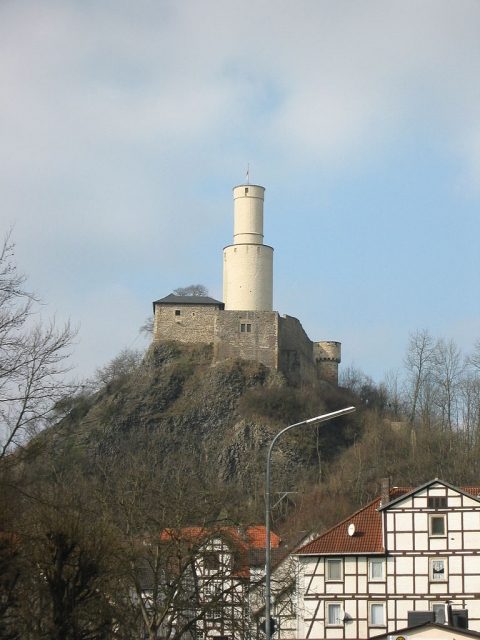
The Felsburg in Felsberg on the Eder in Hesse is the partial ruin of a hilltop castle, 199 m above sea level, on a basalt cone. It is maintained by an association.
The Felsburg and the (Vice-)Counts of Felsberg were first mentioned in 1060, and the town of Felsberg (Velisberc) was first documented in 1090.
The Romanesque substructure of the castle from the 11th century is located on a columnar basalt cone above the town of Felsberg on the old Salt Road, which led from Bad Sooden-Allendorf on the Werra to the Ruhr area. The Eder ford near Felsberg was strategically important. The castle was the seat of the Velisberc family of counts, who demonstrably lived in the castle from 1090 to 1286, but then withdrew to their possessions in the Hessisch Lichtenau area and soon died out.
In 1238, the castle and town of Felsberg initially came under the Landgraviate of Thuringia, but soon after, as a result of the separation of Hesse from Thuringia after the death of Heinrich Raspe, they passed to the Landgraviate of Hesse. The castle then became the seat of a number of landgravial bailiffs. In 1367, landgravial knights led by Knight Konrad Spiegel zum Desenberg defeated a force of Abbot Berthold of Hersfeld in the Eder lowlands near the nearby Altenburg. In 1375, the landgravial ministerialis and Vogt of Lower Hesse, Friedrich von Felsberg, inhabited the castle; two years earlier, the Landgrave had pledged him the tax revenues of the town of Felsberg. From 1333 onwards, Landgrave Heinrich II, "the Iron", expanded the Felsburg, and the fortifications were further extended in 1387, 1388, and 1392. In the Mainz-Hessian War of 1427, Landgrave Ludwig I of Hesse led his levy from Felsberg against the Mainz commander Gottfried von Leiningen, who, starting from Fritzlar with 600 horsemen, devastated the area of Gudensberg, Felsberg, and Melsungen. Ludwig decisively defeated him on the Großenengliser Platte between Fritzlar and Großenenglis and again near Fulda, even though the Archbishop of Mainz, Konrad III von Dhaun, had by then taken command of his army himself, thus forcing Electoral Mainz to the Peace of Frankfurt.
From 1455 to 1458, the alchemist Klaus von Urbach lived at Felsburg; Landgrave Ludwig I had brought him to produce gold. From 1511, Landgravine Anna, the mother of Philip the Magnanimous, inhabited the castle. Landgrave Moritz of Hesse-Kassel held his last Landtag before his abdication at the castle in 1626. The Felsburg survived the Thirty Years' War almost unscathed but then slowly fell into disrepair. In 1762, the Felsburg was conquered by Hessian hunters under Major von Linsingen in the Seven Years' War and shortly thereafter destroyed by French troops.
The Complex+
The castle has an almost trapezoidal layout. On the north and west sides are late Gothic zwinger with keyhole embrasures from the 14th century. The entrance with its gate also dates from the 14th century. The gate is reinforced by two flanking towers and equipped at its base with two machicolations, which allowed for the defense against enemies on the ground.
In the center of the castle, near the northern wall, is the keep from 1388 with a narrow superstructure. A covered battlement was attached at the setback to the upper part of the tower. The current access was only later broken through the three-and-a-half-meter-thick walls. The entrance leads to the tower dungeon.
On the south wall stands the castle chapel dedicated to Saint Pancras. In 1544, Landgrave Philip the Magnanimous stored 297 tons of gunpowder in the chapel. The powder magazine was used for 300 years and was only abandoned in Electoral times.
Interesting Facts+
The Felsberg Castle Association leased the castle from the Prussian state. From 1950, securing and repair work was carried out. A castle museum was established in the castle chapel. Today, the castle belongs to the State of Hesse and is managed by the Administration of State Castles and Gardens of Hesse.
Take Mobile History with you
You are reading this text for free. Premium adds what matters on the road: descriptions read aloud, sites found through your camera, whole regions taken offline.
- Every description, including the ~17,700 Premium sites
- Audio guide: have descriptions read to you on location
- AR finder: see sites through your camera, with distance and bearing
- Unlimited saved sites
14 days free, then from €2.99 a month. Cancel anytime.
Source: Wikipedia · Licence: CC BY-SA 4.0 · Image: http://de.wikipedia.org/wiki/Felsburg_%28Hessen%29#mediaviewer/Datei:Felsberg_%28Hesse%29_2006-02-25.jpg
This description draws on the facts documented in the linked Wikipedia article; Wikipedia content is licensed under CC BY-SA 4.0. Wording and editing: Mobile History.
Location: 51.1358, 9.4204