The Castle can be visited
Museum
CastleMoritzburg
Fasanenschlösschen
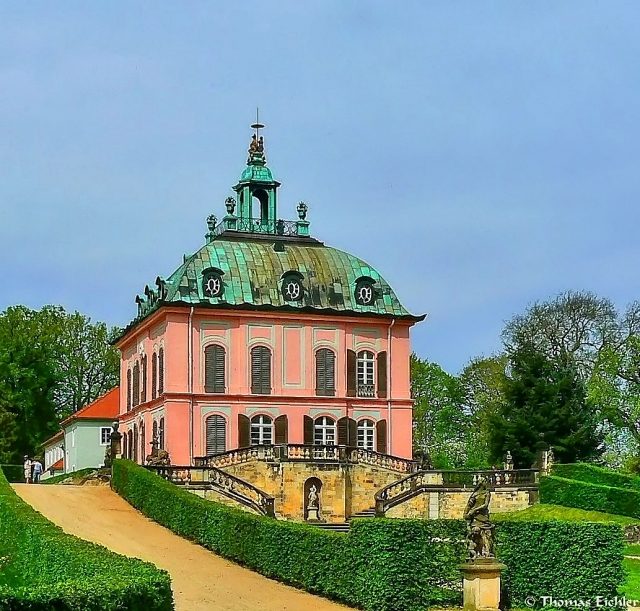
The Fasanenschlösschen (Pheasant Castle) is located in the municipality of Moritzburg near Dresden. It is situated in the pheasantry of the Moritzburg Palace Park, which was laid out in 1728. The small castle stands on the Lower Großteich Bärnsdorf near the Moritzburg Lighthouse. It is visually connected by a sightline to Moritzburg Palace, which is 2.5 kilometers away and located exactly to the west.
The Fasanenschlösschen was presumably built in the Rococo style with Baroque architectural elements by court architects Johann Daniel Schade and Johann Gottlieb Hauptmann between 1769 and 1782. A single-story pavilion, which had already been erected on the same site in 1738–1739, was extended and converted in the Chinoiserie style. Shortly thereafter, the complex was supplemented by the Garnhaus, the Venus Fountain, a residential house for Count Marcolini, and a maritime complex with a harbor, pier, and lighthouse on the Lower Großteich Bärnsdorf.
The Fasanenschlösschen is a square-shaped building with two stories. On the south and east sides are Baroque staircases. The more distant staircase leading to the south is lined with putti. It stands at the upper end of a water axis in the extensive park, which points towards Moritzburg Palace. The paths leading to the Fasanenschlösschen are accompanied by sandstone figures.
The interior is equipped as a country residence with all necessary functional areas. On the ground floor were the study, living room, bedroom, toilet, and an antechamber. A tea and coffee kitchen was also located here; the actual court kitchen was in the neighboring house. The upper floor houses the dining room, the largest room in the building. Servant's quarters were located in the attic.
The Fasanenschlösschen was used by King Frederick Augustus I of Saxony as a summer residence.
Until 1945, the Fasanenschlösschen was owned by the House of Wettin, who were dispossessed and expelled by the communists. It was used as an ornithological outpost of the Dresden Museum of Zoology until 1996.
Present Day+
Today (2014), it is used as a museum with guided tours of the premises. Furniture, wallpapers, and contemporary accessories from various eras are displayed.
Pheasant breeding played a major role in the history of the castle of the same name. Even before the time of Augustus the Strong, pheasants were present at this location. Pheasant breeding is continuously verifiable until 1916. Since 2006, pheasant breeding in the espalier gardens has been attempting to build on past successes.
The Fasanenschlösschen is one of 24 properties managed by the State Enterprise Palaces, Castles and Gardens of Saxony.
Take Mobile History with you
You are reading this text for free. Premium adds what matters on the road: descriptions read aloud, sites found through your camera, whole regions taken offline.
- Every description, including the ~17,700 Premium sites
- Audio guide: have descriptions read to you on location
- AR finder: see sites through your camera, with distance and bearing
- Unlimited saved sites
14 days free, then from €2.99 a month. Cancel anytime.
Source: Wikipedia · Licence: CC BY-SA 4.0 · Image: Thomas Eichler
This description draws on the facts documented in the linked Wikipedia article; Wikipedia content is licensed under CC BY-SA 4.0. Wording and editing: Mobile History.
Location: 51.1684, 13.7063