Cultural Events
CastleStein
Faber Castle
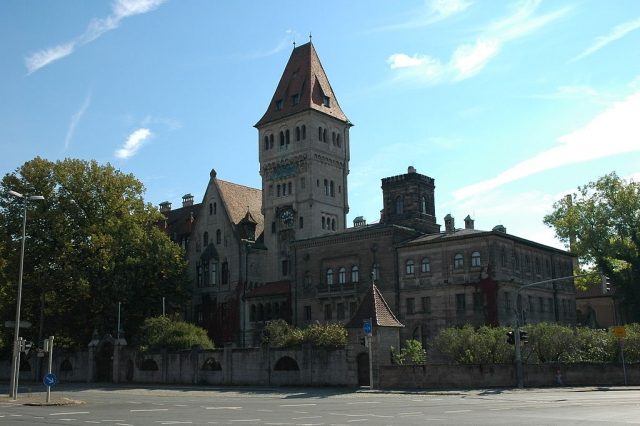
Faber-Castell Castle, also known as Steiner Castle, Schloss Faber-Castell, and sometimes called the Pencil Castle, is a historicist castle complex from the 19th and early 20th centuries, consisting of two parts.
The castle is located in the Middle Franconian town of Stein, on the border with Nuremberg. The associated Faber Park belongs to Nuremberg.
From 1843–1846, the so-called Old Castle was planned and built by architect Friedrich Bürklein in the Neo-Renaissance style for Lothar von Faber. Three wings enclose the square, four-story tower, whose roof is crenellated. The Faber-Castell family, who became wealthy through pencil production, had the New Castle built in 1903/1906 according to plans by Prof. Theodor v. Kramer in the style of German Romanticism. Both parts are connected by the richly structured, five-story tower.
Some of the representative rooms were created by the then-emerging architect and designer Bruno Paul. The Old and New Castles were connected by the five-story tower, through which the gate passage leads.
The New Castle houses a generously designed staircase, above which there is a stucco ceiling with Art Nouveau decor. On the first floor, there was formerly a living suite, divided into a Lemon Room, a Month Room, and a Louis-seize Room. The Lemon Room gets its name from the furniture that was in it at the time, which was made of lemon wood; the ceiling of the Month Room shows the zodiac signs. On the second floor, there is a Tapestry Hall, whose tapestries are unfortunately no longer present, a Music or Ballroom, and a former Dining Room. The furniture of both castles has been lost. Nevertheless, the castle is "an artistic peculiarity and, in its overall layout, a remarkable example of historicism in Franconia."
The Faber-Castell family lived in the castle until 1939, after which it was confiscated by the Wehrmacht. After the end of World War II, American occupation troops moved in. Until the early 1950s, journalists observing the Nuremberg Trials lived here. AFN Nuremberg maintained its studios here until its relocation to the Grand Hotel in January 1950. The Nuremberg Albrecht Dürer Society organized the exhibitions Ars phantastica and several Positionen+Tendenzen in the Dürer Year 1971. After decades of neglect, the complex has been used again for events since the 1980s and was a filming location for the movie Hanni & Nanni.
Take Mobile History with you
You are reading this text for free. Premium adds what matters on the road: descriptions read aloud, sites found through your camera, whole regions taken offline.
- Every description, including the ~17,700 Premium sites
- Audio guide: have descriptions read to you on location
- AR finder: see sites through your camera, with distance and bearing
- Unlimited saved sites
14 days free, then from €2.99 a month. Cancel anytime.
Source: Wikipedia · Licence: CC BY-SA 4.0
This description draws on the facts documented in the linked Wikipedia article; Wikipedia content is licensed under CC BY-SA 4.0. Wording and editing: Mobile History.
Location: 49.4174, 11.0213