The Fortress-Tower can be visited
FortressPuchenau
Fortress Linz-Warte Edelburga
The Linz Tower Fortification, or Maximilian Tower Line, was a fortification system built in the early 19th century. It consisted of a belt of fortified towers around the city of Linz and is also known as the Danube Fortress Linz, the Entrenched Camp of Linz, or the Maximilian Fortification System.
The construction of the Linz Tower Line goes back to an initiative by Archduke Maximilian Joseph of Austria-Este. His experiences from 1809, when it was not possible to stop Napoleon on his advance to Vienna, likely played a role. Maximilian therefore proposed an imperial fortification system in which strategically important places would be defended by a line of freestanding towers. However, only the fortification of Linz was realized.
Basic Idea
A ring of freestanding fortified towers (so-called detached works) is built around the city to be defended, forming a far advanced defensive line so that the enemy's cannons cannot reach the city. The towers themselves are strongly fortified and equipped with cannons. The distance between the towers is such that they can cover each other. If the attacker succeeded in conquering a tower, it could be shelled from the neighboring towers. Several thousand soldiers could be deployed within the tower line.
This system was already proposed by Marc-René Marquis de Montalembert in the second half of the 18th century. However, Montalembert's towers were too elaborate and expensive to be built in large numbers. Maximilian preferred to build simpler, but more densely arranged towers. He also protected his towers with a glacis, from which only the upper part of the tower protruded. Furthermore, Maximilian dispensed with fortifying the core work.
The Test Tower on Freinberg
In 1828, Maximilian had a test tower built on Freinberg near Linz at his own expense. With this tower, demolition tests and test bombardments were carried out in the presence of Emperor Franz I. Maximilian's opponents wanted to make this test fail through unfair experimental conditions. Nevertheless, the test tower essentially passed its baptism of fire.
Since the final tower line was built at a greater distance around the city, the test tower could no longer be used. Maximilian had the tower extended and a chapel (Maximilian Chapel) built next to it. He donated the tower and chapel to the Jesuits. Today, the tower is part of the Kollegium Aloisianum, a Catholic private school.
The Construction of the Tower Line
The construction of the tower fortification began in 1831. To speed up the construction, Maximilian had pre-financed it with his own capital. By 1833, most of the structures were completed. Due to the rectification of construction defects and the sometimes sluggish military equipment, the tower line could only be handed over to the military in 1838. Test bombardments took place before the handover.
From the start of construction, the tower line was visited by numerous domestic and foreign guests, by officers, diplomats, princes, and also by Emperors Franz I and Ferdinand I. Most visitors expressed positive opinions, which was a satisfaction for Maximilian-Joseph.
Abandonment of the Fortification
Already in 1858, just 20 years later, the fortification system was abandoned. Advances in weapon technology – cannons with rifled barrels had a greater range and ammunition effect – severely limited its strategic value. Furthermore, many towers were already dilapidated.
During the Austro-Prussian War of 1866, the towers north of the Danube were briefly reactivated, causing unrest in the city. During the Bosnian Campaign of 1878, towers 9 and 10 served as prisoner-of-war camps. In the First World War, tower 9 was used as an ammunition and supply depot and is still known today as the "Pulverturm" (Powder Tower). Individual towers were already sold in the 1860s. The remaining towers were handed over to the financial directorate for sale in the 1870s.
Warte Edelburga+
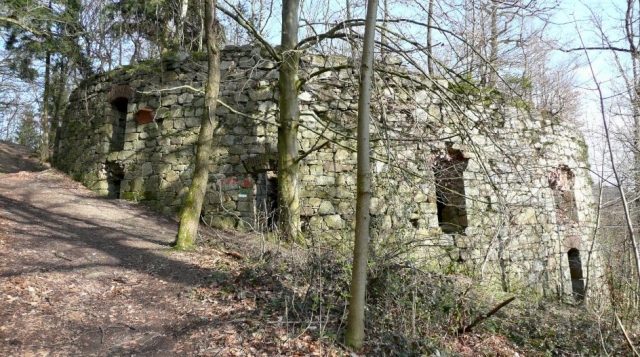
The Warte Edelburga is part of the so-called connecting structure of the Linz Tower Fortification, which was built in the aftermath of the Napoleonic Wars to fortify the city of Linz. The Warte Edelburga is located above the slope of the Danube and was connected by a descending wall to the Klause Kunigunde, which was located on the bank of the Danube and no longer exists today. The watchtower itself is a three-story tower with a semicircular floor plan.
Structure of the Tower Fortification+
All objects of the fortification system bore names of female saints. The 32 towers, however, are generally designated with Arabic numerals, and the towers of the fort with Roman numerals. There is no tower 17 (instead, the "Klara" battery and Thekla were built), but there is a tower 30 ½ next to tower 30.
The tower fortification consisted of:
- 27 normal towers
- 5 segment towers
- 2 outworks (Viktoria and Constantia),
- the two connections located on the Danube,
- 2 casemated batteries (Thekla and Klara) and
- the fort on Pöstlingberg
In an emergency, the towers were to be connected by a palisade line. The construction of intermediate batteries was planned at 20 prepared locations. The Danube would have been blocked with a chain between the Klausen Adelgunde and Kunigunde.
The Normal Towers
The normal towers consisted of three concentric rings of rubble stone walls, as well as brick vaults. They had the following floors (from top to bottom):
- Deck - From the open deck, the attacker was to be fought with 18-pound defensive cannons. In peacetime, it was covered with a removable wooden roof.
- Embrasure floor - Here were 7-pound howitzers. These were to be used if the deck was hit by the enemy.
- Living floor - Accommodation for 60 soldiers
- Magazine floor - Ammunition and food supplies for four months. A well was dug in the innermost wall ring.
The towers were surrounded by a ditch, in front of which lay the glacis (earthen rampart, partly reinforced with rubble stone walls). Only the uppermost part of the tower with the deck protruded from the glacis. The magazine and living floors were below ground level. The entrance on the embrasure floor was accessible via a drawbridge at the gorge (rear side).
The Segment Towers
Towers 26 to 30, located on the Danube in today's harbor area, were smaller and had a segmental floor plan. They had only two floors, the magazine floor and a combined living and embrasure floor. None of the towers have been preserved.
The Danube Connections
To the left and right of the Danube were the so-called connections. Directly on the bank was a Klause, which was connected to a wall that led up the slope and ended at a watchtower. Iron rings were built into the Klausen, into which a chain could be hung to block the Danube.
The Fort on Pöstlingberg
The fort on Pöstlingberg, the main base of the camp, was located at the highest point of the fortification line. From there, the entire Linz area could be overlooked.
The fort comprised two large towers (II and IV, corresponding to the normal towers), three small towers (I, III, and V), and a watchtower as an entrance gate (VI). The towers were connected by curtain walls and walls. Above the curtain wall between towers II and III, a semicircular area for a battery was prepared.
The preserved parts of the complex are now used for tourism. Tower II (Beatrix) houses the Grottenbahn, a popular tourist attraction, especially with children. Tower IV (Maria) became the terminal station of the Pöstlingbergbahn. The other towers were converted into a music house (Tower I, Othilie) and a viewing terrace (Tower V, Euphemia).
Take Mobile History with you
You are reading this text for free. Premium adds what matters on the road: descriptions read aloud, sites found through your camera, whole regions taken offline.
- Every description, including the ~17,700 Premium sites
- Audio guide: have descriptions read to you on location
- AR finder: see sites through your camera, with distance and bearing
- Unlimited saved sites
14 days free, then from €2.99 a month. Cancel anytime.
Source: Wikipedia · Licence: CC BY-SA 4.0 · Image: http://commons.wikimedia.org/wiki/File:Warte_Edelburga.jpg
This description draws on the facts documented in the linked Wikipedia article; Wikipedia content is licensed under CC BY-SA 4.0. Wording and editing: Mobile History.
Location: 48.3136, 14.2492