Monastery (active)
MonasteryHamburg-Nord
Dominikanerkloster St. Johannis
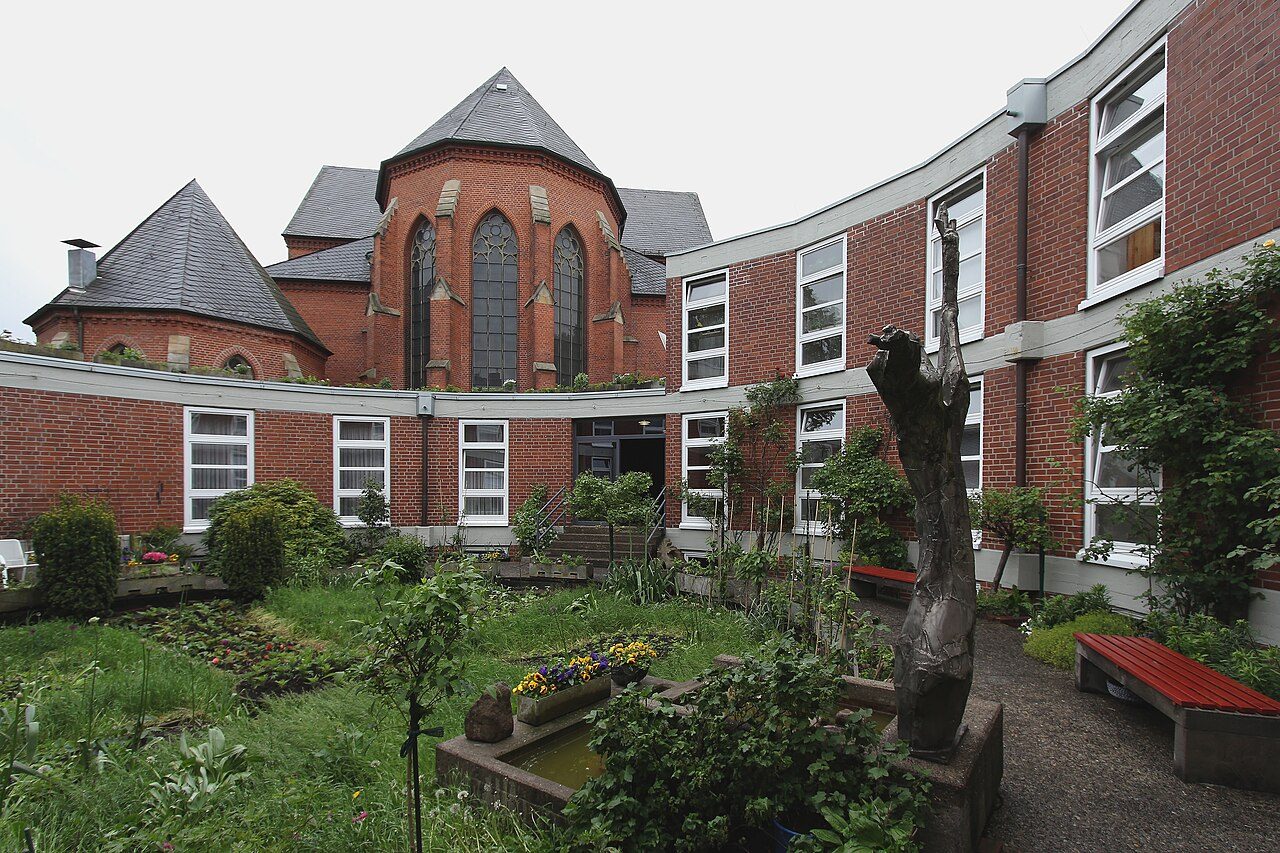
The Dominican Monastery St. Johannis, a significant cultural monument in Hamburg, is located in the Barmbek-Süd district and is structurally connected to St. Sophien Church. Dedicated to Saints John the Baptist and John the Evangelist, it represents a successful blend of traditional and modern architecture.
History+
The monastery's origins trace back to 1236, when a predecessor building was erected on the site of today's Rathausmarkt. Following a fire in 1314, it had to be completely rebuilt. In the 16th century, the monastery housed 41 monks and 13 novices. With the introduction of the Reformation in 1529, all Catholic monasteries in Hamburg were dissolved. The buildings of the former monastery subsequently served various purposes, including as the Johanneum grammar school and accommodation for nuns. The monastery church was used as a Protestant place of worship until the French period, then as a storage facility, gymnasium floor, and parade ground, before being demolished in 1829. The remaining monastery buildings were removed in 1840/41. Since 1962, the Dominican Order has once again been present in Hamburg. Due to Hamburg's diaspora situation for Catholics, a connection to the St. Sophien parish in Barmbek was chosen, where a suitable plot of land was available. In 1966, Bishop Johannes von Rudloff consecrated the new monastery, which was handed over to six Dominicans. The religious community is involved in the pastoral work of St. Sophien, preaches in other Catholic communities in Hamburg, and focuses on theological education and life counseling.
Location+
The Monastery St. Johannis is situated in Hamburg-Barmbek-Süd, at the corner of Weidestraße and Elsastraße, directly adjacent to St. Sophien Church. It is centrally located within the city of Hamburg.
On site+
The circular building with brick facades and brutalist-influenced eaves was constructed from 1964 to 1966 by architects Rau, Bunsmann, and Scharf. The design took into account an underground bunker located at the edge of the property. The building, with a maximum of three stories, appears rather simple from the outside, as the almost windowless cloister runs along the exterior, and most rooms face the inner courtyard. This courtyard opens towards the apse of the church and functions as a monastery garden. Only the entrance area and the event hall, spanning two levels, feature larger windows facing outwards. The ground floor and lower ground floor comprise various rooms for the monastery's work, such as guest rooms, common rooms, dining rooms, consultation rooms, parish offices, and a library, which is a scientific library belonging to the AKThB. The upper floors house the private living quarters for up to 13 friars. A five-sided monastery chapel, oriented northeast, is connected to the other rooms via the staircase. The entrance door features an aluminum ornamentation by Hermann Stehr, who also created the sculpture “Große Predigt I” in the inner courtyard. Inside, there are paintings by Karl Goris, Gerd Winner, Albert Reck, and Jes Bundsen. The chapel, illuminated by a skylight, is dominated by a modern altar by Rudolf Krüger and houses an 18th-century painting by Johann Christoph Achert.
Nearby+
- Neuer Mariendom (sacred building, approx. 2817 m away)
- Palais Görtz (residence, approx. 4560 m away)
- Herrenhaus Wellingsbüttel (manor house and estate, approx. 7452 m away)
- Adelssitz Wilhelmsburg (residence, approx. 10290 m away)
Take Mobile History with you
You are reading this text for free. Premium adds what matters on the road: descriptions read aloud, sites found through your camera, whole regions taken offline.
- Every description, including the ~17,700 Premium sites
- Audio guide: have descriptions read to you on location
- AR finder: see sites through your camera, with distance and bearing
- Unlimited saved sites
14 days free, then from €2.99 a month. Cancel anytime.
Location: 53.5796, 10.0348