department store
MonasterySoest
Dominikanerkloster Soest
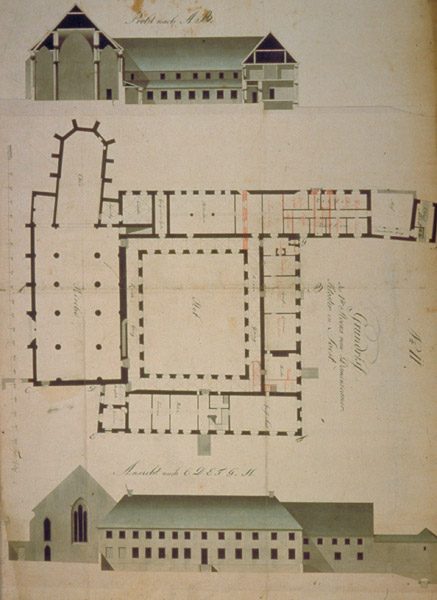
The Dominican Monastery of Soest, also known as the Black Monastery, was established in the city of Soest, North Rhine-Westphalia, between 1228 and 1232. It is one of the historical sacred buildings of the region and was a significant convent of the Dominican Order.
History+
The precise circumstances of the monastery's founding and its initial benefactors are not fully documented. While the involvement of the noble lords of Plettenberg is presumed, it is not definitively substantiated by historical sources. Like other mendicant orders, the Dominicans in Soest faced opposition from the local parish clergy, who viewed the new communities as competition. Papal privileges in 1265 and 1305 confirmed the order's rights. In 1241, the monastery was recognized as a full convent, which required a minimum of twelve members. Offices within the monastery included Prior, Subprior, and Lector. The convent initially belonged to the Teutonia province of the order and later to the Saxonia province, leading to disputes with the Archbishops of Cologne. The monastery was located within the parish of the Wiesenkirche, which resulted in a legal dispute over parish rights in 1288/89. Pope Benedict XI subsequently defined the rights of the secular clergy and mendicant orders. The Dominicans in Soest also oversaw the Dominican convent of Paradiese from 1251 and the convent of Galiläa from the 15th century. Following the introduction of the Reformation in Soest around 1531/32, the Dominicans experienced restrictions but managed to maintain their presence, focusing on the pastoral care of the remaining Catholic minority. By 1754, the convent still comprised 40 friars. Towards the end of the 18th century, the economic situation deteriorated due to declining income. The community was dissolved in 1814, and the monastery church, Zum heiligen Kreuz, was demolished in 1820.
Location+
The former Dominican monastery was situated in the city of Soest, a historic town in North Rhine-Westphalia, Germany.
On site+
Today, one wing of the original monastery building remains, structurally connected to an adjacent department store. The presence of the Dominicans, also known as the 'Black Friars,' is still commemorated in Soest by the street name Brüderstraße in the pedestrian zone. The monastery's archives are now preserved in the State Archives of Münster.
Nearby+
- Sassendorf Castle (Bad Sassendorf) (Castle, approx. 4689 m away)
- Broel Manor House (Welver) (Manor and Estate House, approx. 4932 m away)
- Ahse Manor House (Welver) (Manor and Estate House, approx. 7688 m away)
- Nehlen Castle (Berwicke) (Castle, approx. 7722 m away)
Take Mobile History with you
You are reading this text for free. Premium adds what matters on the road: descriptions read aloud, sites found through your camera, whole regions taken offline.
- Every description, including the ~17,700 Premium sites
- Audio guide: have descriptions read to you on location
- AR finder: see sites through your camera, with distance and bearing
- Unlimited saved sites
14 days free, then from €2.99 a month. Cancel anytime.
Location: 51.5750, 8.1035