The church can be visited
CathedralBautzen
Cathedral of St Peter
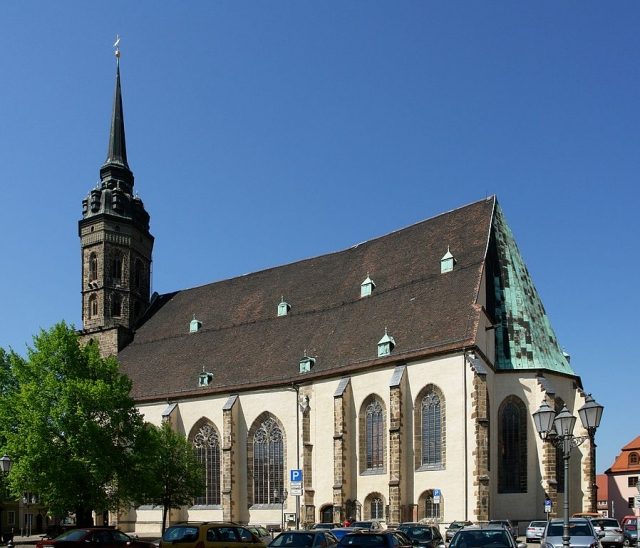
St. Peter's Cathedral is an interdenominational church in Bautzen, Germany. It is among the oldest and largest interdenominational churches in Germany. Located in the heart of the city's "Old Town", the church and the square it is situated within is a major tourist attraction.
First Churches
The first church was built around the 1000 AD. Near the beginning of the 13th century, a cathedral was built under the supervision of Bishop Bruno II. The Bishop established the Catholic priest foundation at this time as well. This first cathedral was not specifically the Cathedral of St. Peter, as both John the Baptist and St. Peter were the patron saints for the church.
Modern Cathedral
Between 1456 and 1463, the cathedral that now stands was constructed and named after St. Peter. A fourth nave was added to the original structure.
A fire decimated much of the city and church in 1634, and the church required a new vault and significant restoration work. The entire interior of the church, with the exception of the original Gothic-style which can still be seen today.
Various cities came to Bautzen to help rebuild the city and Cathedral. Names of many Germanic cities are written on the lintels in the church to commemorate the rebuilding of the cathedral.
The church is a mixture of several different architectural styles, the most prominent being Gothic and Baroque. The early church was entirely a Gothic structure, but it has since been heavily modified. Today, only parts of the interior are Gothic in nature. The Baroque dome was added to the tower in 1664.
Simultaneum Era
In 1523, An Evangelical Lutheran started preaching in the church. Since 1530, both Catholics and Lutherans have shared the building. A 4 meter (12 ft) tall screen separated the sanctuary. In 1583, the dean of the cathedral, Johann Leisentrit, ordered that a contract be made between the two sects defining when each would be able to use the cathedral, among other details. This contract is still in effect today and has been only interrupted a few times in history, such as the Bohemian Uprising of 1620 that expelled the Catholics from the building for a short time.
Today, Catholic and Lutheran altars are located on separate sides of the sanctuary. The Catholic high-altar was built in 1723. It was designed by a student of Balthasar Permoser, the same man that designed the Zwinger in Dresden. The altar murals were painted by the Venetian painter Pellegrini.
Take Mobile History with you
You are reading this text for free. Premium adds what matters on the road: descriptions read aloud, sites found through your camera, whole regions taken offline.
- Every description, including the ~17,700 Premium sites
- Audio guide: have descriptions read to you on location
- AR finder: see sites through your camera, with distance and bearing
- Unlimited saved sites
14 days free, then from €2.99 a month. Cancel anytime.
Source: Wikipedia · Licence: CC BY-SA 4.0 · Image: http://de.wikipedia.org/wiki/Datei:St_Petri_church_Bautzen_101.JPG
This description draws on the facts documented in the linked Wikipedia article; Wikipedia content is licensed under CC BY-SA 4.0. Wording and editing: Mobile History.
Location: 51.1824, 14.4237