The church can be visited
CathedralBrandenburg an der Havel
Cathedral St. Peter und Paul
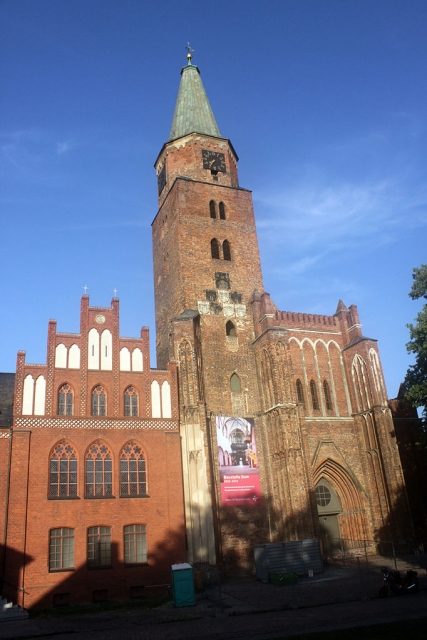
Brandenburg Cathedral of Saints Peter and Paul in Brandenburg an der Havel is generally referred to as the "Cradle of the Mark" and, as the "Mother of all Märkisch churches," holds supra-regional cultural-historical significance. The Protestant cathedral parish belongs to the Evangelical Church Berlin-Brandenburg-Silesian Upper Lusatia.
In the winter of 928/929, troops of the Saxon-Christian ruler Henry I conquered one of the main Slavic fortresses east of the Elbe, Brandenburg. This laid the foundation for the establishment of the Diocese of Brandenburg, which was completed by Emperor Otto I in 948 – other authors place it in the year 964 –.
A single document from Bishop Wilmar from the year 1170 indicates that the construction of a cathedral began with the initial conquest of Brandenburg. This church was lost during the Great Slavic Uprising of 983. Its location has not yet been archaeologically proven.
During the Reformation from 1527, the Roman Catholic Diocese of Brandenburg ceased to exist, and its cathedral was lost to the Catholic Church. Since then, the cathedral has been a Protestant church building. The Brandenburg Cathedral Chapter continues to exist as a Protestant cathedral chapter to this day.
Building History and Form+
On October 11, 1165, the foundation stone for the current cathedral was laid. The former seat of the Bishop of Brandenburg was in the Old Town of Brandenburg, which was on royal territory. For a short time, St. Gotthardt Church, the main church of the Old Town, served as the bishop's church.
With the start of construction, the Premonstratensian convent moved to the Cathedral Island.
When choosing the location, the highest point of the Cathedral Island was selected. Other aspects to consider were the division of the former Slavic castle area into a margravial and an episcopal district.
During the construction of the cathedral, the foundation was laid up to seven meters deep, but nowhere did it reach naturally grown soil. The entire construction area is located on inhomogeneous cultural soil. In particular, filled-in parts of the former ring moat and the rampart of the Slavic castle run beneath the cathedral foundations, which would subsequently lead to considerable static problems.
Another factor influencing the structural stability is its location on an island surrounded by the Havel, with its fluctuating groundwater level. The degree of saturation of the subsoil significantly affects its bearing capacity.
Originally, the cathedral was planned as a single-nave fortified and missionary church with a closed westwork, as can still be seen today at Havelberg Cathedral. After the victorious suppression of the Great Slavic Uprising, architecture considering military needs became unnecessary. Now, a two-towered west facade was desired, as a cathedral church was entitled to two towers. However, the south tower never rose above its stump level, which, according to various authors, was due to financial and structural reasons.
Brandenburg Cathedral of Saints Peter and Paul is the first building in the Mark Brandenburg to be constructed entirely of unrendered brick. The oldest stone buildings in the Mark (the base of the westwork of St. Gotthardt Church in Brandenburg's Old Town and the west wall of St. Petri Chapel at Brandenburg Cathedral) were still built with fieldstones.
The main entrance beneath the nave gable is accompanied by impressive limestone capitals. There are sculptural representations, for example, of the fox preaching to the geese, of the monkey probably playing chess, and a medieval construction scene with a crane.
The nave was built in the late Romanesque/early Gothic style and later provided with two side aisles. The nave has five bays, and the side aisles each have seven bays up to the beginning of the crossing.
Originally fitted with a flat wooden ceiling, the naves were later vaulted with pointed arches (rib vaults) during Gothic alterations.
From the crossing, a single-nave north and south transept extend, as well as a high choir reserved for the canons. The choir already shows a High Gothic form.
A special feature is the two-nave, four-bay crypt located beneath the High Choir, whose construction was already anachronistic at the time of its creation. It must probably be regarded as a prestige object.
Valuable in the crypt are the Romanesque grotesque capitals.
The Prussian architect Schinkel undertook crucial rescue and reconstruction measures on the cathedral in the 19th century. Among other things, he clad the west gable of the nave in Neo-Gothic style, which has been adorned with a huge Star of David since the first half of the 15th century. Furthermore, access to the crypt in the nave was relocated with a wide staircase. The latter works were reversed in the 1960s, and the original Romanesque appearance was restored.
Furnishings+
From the early period of the bishop's church, a remarkable number of medieval tomb slabs of bishops and provosts have been preserved.
In the nave, on the northern wall, there is an elaborate epitaph made of marble and alabaster for Dean Adam von Königsmarck, who died in 1621, crafted by Christoph Dehne.
Among the altars, the Lehnin Altar, restored with great effort, is particularly noteworthy.
In the High Choir, there is an approximately six-hundred-year-old three-gabled shrine for storing liturgical vestments, a Gothic tabernacle (sacrament house), choir stalls, and above the choir's end towards the crossing, a large crucifixion group from the 15th century. A triumphal cross, whose crucifix is dated to approximately 1250, is located in the crypt.
Further valuable medieval furniture can be found in the Cathedral Museum. On display, alongside an extensive collection of liturgical vestments and other textiles, books, sculptures, and altars, is also a panel painting from the 15th century, the "populous Calvary."
The crypt houses a late Romanesque Man of Sorrows, and the aforementioned "Colorful Chapel" possesses unique medieval plaster painting.
The cathedral treasures also include an excellently preserved medieval Lenten veil, the so-called Brandenburg Lenten Veil, an elaborate pictorial embroidery from the 13th century.
Wagner Organ+
The organ by Joachim Wagner dates from 1723 to 1725. Its facade, created by Johann Georg Glume, a student of Schlüter, rises above the stained-glass rosette incorporated by Schinkel into the dividing wall between the nave and the tower vestibule. In the years 1998-1999, the instrument was cleaned and restored. It has 33 stops (2010 pipes) on two manuals and pedal.
Peripheral Buildings+
To the north of the cathedral, there is a monastery complex with refectories, dormitories, a cloister, and ancillary rooms (including the "Colorful Chapel") and a central garden. The west wing of this complex was demolished in the 18th century to make way for the building of the Ritterakademie (Knight Academy). To the northwest, a larger, multi-story building protrudes from the rectangular footprint of the monastery complex, bearing the name "Spiegelburg" in old writings. The former use of this building is unclear; it probably served as an episcopal residence. The monastery complex itself was the center of life for the resident canons in early times.
Today, the buildings of the monastery complex house the Cathedral Museum, which, among other things, stores the founding charter of the Brandenburg diocese and the first mention of the cities of Cölln and Berlin.
In the eastern cloister, in the capital of a column, there is a so-called "Judensau" (Jew's sow). Such a depiction was intended in the Middle Ages to defame and represent the inferiority of the old, Jewish religion. The sow suckling Jews symbolizes the synagogue. Particularly offensive is the fact that pigs are considered unclean by Jews. A similar depiction can be found on the Marienburg of the Teutonic Order on the Nogat.
Scattered throughout the castle courtyard are a number of separate houses, called curiae, which served as accommodation for the canons in later times.
Episcopal Use+
The Brandenburg Cathedral was abandoned early on as the "residence" of its bishops. The bishops preferred to reside on their estates, initially in nearby Pritzerbe, and later in Ziesar, about 30 km away. The provosts took over the local administration of the cathedral.
Modern Use+
Recent Prussian History
In 1848, Brandenburg Cathedral served as the meeting place for the National Assembly after it was moved there from Berlin. However, only a rump cabinet met in Brandenburg an der Havel.
Present Day
Brandenburg Cathedral is actively used by the Protestant Church of Brandenburg. In addition to regular services, the church is also a venue for cultural events such as summer music, concerts, and exhibitions. The cathedral also provides its church rooms for special exhibitions on contemporary historical topics.
Connected to the cathedral is the Cathedral Museum, which exhibits sacred art from ten centuries.
The Cathedral Archive is the oldest archive in the Mark Brandenburg and has been continuously operating since 1161. It contains valuable documents from the Saxon eastward expansion and the subsequent settlement era.
The cathedral and its ancillary buildings, especially the residence of Baron Heinrich August de la Motte Fouqué and the other curiae, are frequently used as cultural event venues, including by the Brandenburg Theater with its series "Erlesener Dom" (Exquisite Cathedral). An important contribution to the preservation of this significant building is made by the "Dom zu Brandenburg" support association, whose honorary chairman is former Federal President Richard von Weizsäcker.
On the night of December 11, 2002, the main building of the Burgmühle on the Cathedral Island burned down due to arson and has been under reconstruction since 2011.
In 2006, the Domgymnasium (Cathedral Gymnasium) opened its doors, continuing the educational tradition established by the Ritterakademie. A well-known alumnus of the Ritterakademie in recent times was, among others, Otto Graf Lambsdorff.
Take Mobile History with you
You are reading this text for free. Premium adds what matters on the road: descriptions read aloud, sites found through your camera, whole regions taken offline.
- Every description, including the ~17,700 Premium sites
- Audio guide: have descriptions read to you on location
- AR finder: see sites through your camera, with distance and bearing
- Unlimited saved sites
14 days free, then from €2.99 a month. Cancel anytime.
Source: Wikipedia · Licence: CC BY-SA 4.0 · Image: https://commons.wikimedia.org/wiki/File:Dom_brb_2013.jpg
This description draws on the facts documented in the linked Wikipedia article; Wikipedia content is licensed under CC BY-SA 4.0. Wording and editing: Mobile History.
Location: 52.4153, 12.5676