The church can be visited
CathedralWurzen
St. Marien Cathedral
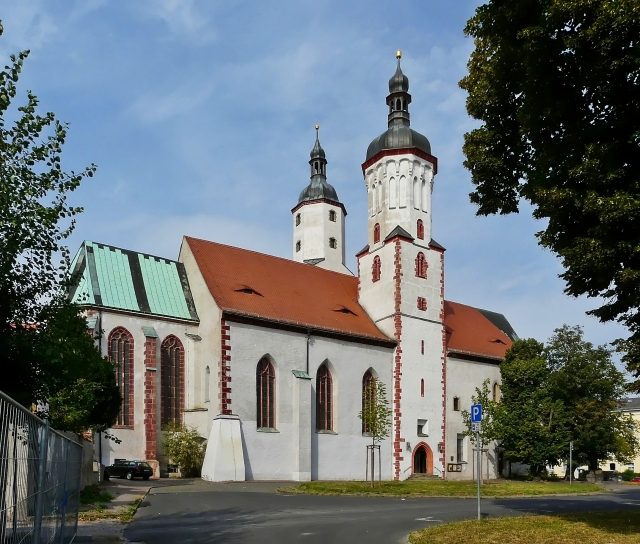
Wurzen Cathedral of St. Mary is an Evangelical church in the large district town of Wurzen in Saxony. Built as the collegiate church of the Wurzen Collegiate Foundation, it has been referred to as a cathedral since the end of the 15th century, when the Bishops of Meissen established their residence in Wurzen Castle.
Since 1542, the church has served for Evangelical worship. It is also used for church music concerts due to its excellent acoustics. A special feature is the uniform furnishing of the church with architectural sculptures by the sculptor Georg Wrba.
The Cathedral is an important architectural monument of the Wurzener Land era; in 2014, it can look back on its 900th anniversary.
The Cathedral is located in the southwestern part of Wurzen's old town on a hill that rises about ten meters above the Mulde floodplains extending to the west. North of the Cathedral, in the castle courtyard, stands Wurzen Castle, which has a structural connection to the Cathedral via the Old Custody. To the south is the Cathedral Square.
The Cathedral is a Gothic structure in its main parts, extending in an east-west direction, 60 meters long and 21 meters wide at the nave. The nave, spanning three bays, has two side aisles of different heights. To the east, a four-bay choir adjoins, ending in the chancel, an apse with a 5/8 closure. To the west, a choir also follows the nave. While the other areas of the church feature a simple cross-rib vault, the chancel has a star vault and the west choir has an elaborate and colorfully painted cell vault.
On the east side of each side aisle stands a tower. Thus, the towers are almost in the middle of the church building. They have baroque domes and lanterns and are designed differently. The slightly higher south tower, through which access to the church is also gained, is more articulated in its upper part. An annex adjoins the south tower in the area of the east choir, covering the otherwise visible Gothic buttresses and windows.
The first church, as a predecessor to the current Cathedral, was consecrated on August 16, 1114, by Bishop Herwig of Meissen († 1119) in honor of the Virgin Mary. It was the collegiate church for the collegiate foundation of Wurzen, which he founded in the same year. It was a flat-roofed Romanesque pillar basilica, roughly corresponding in size to today's nave.
The first major expansion was the addition of the four bays of the east choir between 1260 and 1290. In the middle of the 14th century, the nave was vaulted and the southern side aisle was extended into a hall, before a fire in 1470 destroyed large parts of the church. After reconstruction, the next extensions took place after 1500 under Bishop Johann VI von Saalhausen (1444–1518). In 1503, he had the west choir built, which he intended as his burial place, and in 1508, two bays were added to the east choir, which is now the chancel. From 1491 to 1497, he had the neighboring Wurzen Castle built as his episcopal residence, so the church now became a cathedral. The collegiate foundation became the cathedral chapter.
Although Evangelical services were already held in the Cathedral in 1542, the Catholic bishops still resided in the castle. The last bishop, Johann IX von Haugwitz (1524–1595), dissolved the Diocese of Meissen by handing it over to the now Evangelical cathedral chapter. The Saxon Elector August (1526–1586) became the new provost in Wurzen.
To increase seating capacity, galleries were installed in the northern side aisle in 1555 and in the southern side aisle in 1593. Except for minor alterations and repairs, the Cathedral remained unchanged until 1817. In this and the following year, a comprehensive redesign in the Neo-Gothic style took place. The leading builders were the Wurzen Cathedral Provost and architectural researcher Christian Ludwig Stieglitz (1756–1836) and the Dean of the Chapter Immanuel Christian Leberecht von Ampach (1772–1831). The existing installations, including the galleries, were removed. The Cathedral was made brighter by a light coat of paint on the walls and new windows. A new altar with Gothic carvings and a large altarpiece "Baptism of Christ in the Jordan" by Friedrich Matthäi (1777–1845), as well as Gothic choir stalls, were installed. The organ was renewed, and the floor and benches were replaced.
The last redesign of the interior took place in 1931–1932. It is primarily characterized by the radical removal of Neo-Gothic elements and the addition of numerous expressionist sculptures by the sculptor Georg Wrba, as well as the installation of the Jehmlich organ.
Since the Reformation, the Cathedral has been administered by a cathedral chapter, whose members are honorary ecclesiastical and secular representatives. It consists of the Cathedral Provost, the Dean, and five other members, the canons, who are appointed by the regional bishop as the provost.
Well-known members of the cathedral chapter in the past included Immanuel Christian Leberecht von Ampach, Paul Herfurth, Hermann Ilgen, Johann Georg Keil, Börries von Münchhausen, and Christian Ludwig Stieglitz.
Present Day+
Currently (as of July 2014), the following persons belong to the cathedral chapter: Cathedral Provost Christoph Richter, Cathedral Dean Leo von Sahr-Schönberg, Canons Eberhard Burger, Dietrich Lenk, Volker Nollau, Wolfgang Ratzmann, and Canon and Cathedral Cantor Johannes Dickert, as well as former Canon Horst Schulze.
The Cathedral does not have its own parish responsible for its upkeep. Donations and funding are necessary for its preservation.
The Cathedral is a regular venue for concerts with the Cathedral Choir St. Marien and the Youth Choir of Wurzen Cathedral, both directed by the Cathedral Cantor, Church Music Director Johannes Dickert.
The Cathedral Jubilee Year 2014 – 900 Years of the Cathedral – is being celebrated and honored in various ways with festive services, lectures, and special concerts, including with the Thomanerchor (July 8), the Thuringian Boys' Choir (July 29), and the Amarcord Ensemble (October 31). On May 18, 2014, MDR Figaro broadcast live the service from Wurzen Cathedral. On July 13, an Ecumenical Festive Service for the Canon's Day took place with the Provost of the Cathedral Foundation St. Marien Wurzen, Regional Bishop Jochen Bohl, and the Catholic Bishop emeritus of the Diocese of Dresden-Meissen, Joachim Reinelt. To commemorate the consecration of the Cathedral on August 16, 1114, a festive communion service is scheduled for August 16.
Furnishings+
Historical Furnishings
Little remains of the Cathedral's furnishings from before the Reformation, when it had seven altars alone. The most important artworks are three fully sculpted stone figures from before 1503, which were initially placed in the west choir and are now located with plinth and canopy on the north wall of the nave. Their creator is unknown. They depict Bishop Donatus of Arezzo († around 362), Emperor Otto I (912–973), and the Evangelist John. Otto I was the founder of the Diocese of Meissen, and Donatus of Arezzo and the Evangelist John were the patron saints of the diocese.
A sandstone relief with his coat of arms on the north wall of the east choir and a bronze plaque on the south wall of the southern side aisle, which formerly marked the location of his grave in the Cathedral, commemorate Bishop Johann VI von Saalhausen. On the north wall of the chancel (see image of lectern) is the tombstone of the widow of Bruno von der Pforte (died 1503), depicted in bas-relief. Bruno von der Pforte was enfeoffed with Königsstein Castle, its care, and office from 1465 to 1480.
A black and white marble memorial plaque in the east choir commemorates a great-great-grandson of Martin Luther, Johan Martin Luther (1619–1669), owner of the manor in neighboring Hohburg and canon in Wurzen Cathedral from 1649 until his death in 1669. A well-preserved tombstone of his first wife Regine, née Leyser († 1653), exists in the entrance area of the Cathedral.
The former altarpiece from 1817 has hung on the west wall of the southern side aisle since the Cathedral's redesign in 1932.
Wrba Furnishings
For the major interior redesign in 1931/1932, the sculptor Georg Wrba created a cycle of late Expressionist bronze cast sculptures that still dominate the Cathedral's furnishings today. The expressive crucifixion group dominates the chancel. The figure of a naked athlete forms the lectern at the boundary of the chancel. The east choir is flanked on both sides by four canon's stalls with the names of the canons of that time.
Most striking is the pulpit, which projects far into the area in front of the east choir, an elongated cuboid body supported by seven bundles of pipes. The apostles' heads at the base of the pulpit basket bear the facial features of the canons of that time, the artist, and the main benefactor of the Cathedral's renovation, the honorary citizen of Wurzen and later canon Hermann Ilgen, to whom a special memorial plaque is also dedicated.
The choir gallery in the west choir in front of the organ is enclosed by a grille with a central portrait of Luther and two young men on the sides. At the foot of the organ are three musical angels.
The Organ
The Cathedral's organ is a work by the firm Gebrüder Jehmlich, Dresden, from 1932. The instrument was renovated from 1998 to 2001 and again in 2007 by the Reinhold Organ Workshop, Bernsdorf.
Take Mobile History with you
You are reading this text for free. Premium adds what matters on the road: descriptions read aloud, sites found through your camera, whole regions taken offline.
- Every description, including the ~17,700 Premium sites
- Audio guide: have descriptions read to you on location
- AR finder: see sites through your camera, with distance and bearing
- Unlimited saved sites
14 days free, then from €2.99 a month. Cancel anytime.
Source: Wikipedia · Licence: CC BY-SA 4.0 · Image: Thomas Eichler
This description draws on the facts documented in the linked Wikipedia article; Wikipedia content is licensed under CC BY-SA 4.0. Wording and editing: Mobile History.
Location: 51.3693, 12.7327