German two-wheeler and NSU-Museum
CastleNeckarsulm
Neckarsulm Castle
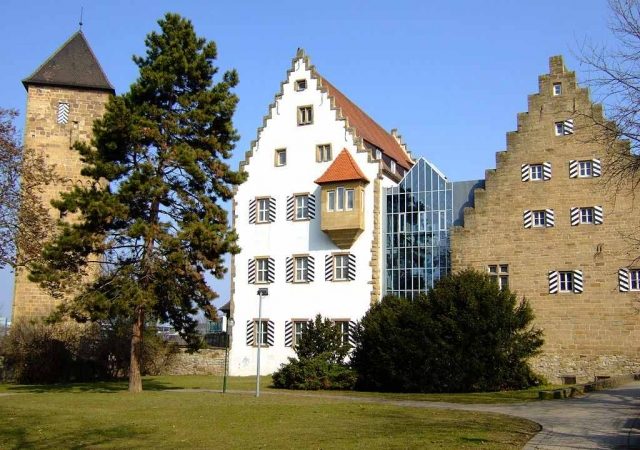
The Teutonic Order Castle Neckarsulm is one of the oldest buildings in the city of Neckarsulm. A predecessor building likely existed as early as the 13th century. The Teutonic Order Castle Neckarsulm was significantly shaped by the Teutonic Order, under whose rule Neckarsulm stood from 1484 to 1805. It was heavily damaged in World War II and rebuilt by the mid-1950s. Since 1956, the German Two-Wheeler and NSU Museum has been located in the Teutonic Order Castle Neckarsulm.
The Teutonic Order Castle Neckarsulm is located in the southwestern corner of the former city fortifications. The origins of the city castle probably date back to the 13th century. However, little is known about this period. Even then, there was a predecessor building, of which, after several renovations, the hall building (Palas, also called Steinhaus), the keep, and parts of the rampart wall are still preserved today. The ground floor of the keep is considered by historians to be the oldest preserved masonry in all of Neckarsulm.
Documents indicate that a stately complex in Neckarsulm, which already existed during the feudal rule of the Lords of Weinsberg, seated on the nearby Scheuerberg, in the 13th century, was expanded by the Archbishopric of Mainz after it acquired the town in 1335. In 1405, the Zwinger (outer bailey), moat, courtyard, and new house are mentioned, and again in 1411, the courtyard and new house of the Archbishopric. Structural findings indicate that the keep was raised around 1400 and that the "new house" is probably the stone house with a stepped gable that is still preserved today. Furthermore, a visitation report from 1720 mentions a Mainz electoral coat of arms, no longer present today, on a pillar of the complex. The city castle, with its walls, always formed a reinforcement of the city fortifications. The oldest building stock is located in a rectangle of approximately 25 x 35 meters. The walls of younger buildings partly rest on the massive walls of the first castle complex.
The complex came into the possession of the Teutonic Order in 1484, when it took over the rule of Neckarsulm. Immediately after the transfer of ownership, a castle chapel was erected in the complex, dated 1487 on the building, from which glass panes from around 1480 to 1488 have been preserved in the Württemberg State Museum, showing the coats of arms of the Palatine Electoral Marshal Engelhard von Neipperg († 1495), the Baden Landhofmeister Wilhelm von Neipperg († 1520), and the Deutschmeister Reinhard von Neipperg († 1496), as well as a depiction of the Last Judgment.
After the destruction of the castle on the Scheuerberg in the Peasants' War in 1525, which until then had been the official seat of the Teutonic Order, the Neckarsulm city castle became the official seat of the Teutonic Order. In the future, Order assemblies took place there, in which Deutschmeisters were elected or other important decisions were made. The Teutonic Order significantly rebuilt and expanded the castle complex. In 1539/1540, the so-called Bandhaus was built. The original city castle, i.e., the official residence, only received its current form after the Peasants' War in 1525. Likewise, the castle wine press was built after 1525. The keep was rebuilt several times, as evidenced, for example, by the coat of arms relief of the Grand Master and Deutschmeister Wolfgang Schutzbar (called Milchling) from 1551.
A plan from 1722 shows that by that time, in addition to the old complex, a large associated farmyard had been built to the north. Furthermore, in 1720, the tower had been crowned with a baroque onion dome, which existed until the Second World War. The buildings were rebuilt many times. One of the biggest structural changes occurred during the 19th century, when by 1834 some buildings located to the east towards the city were no longer present, and in their place, the new Schlossstraße (today's Urbanstraße), first mentioned in 1869, was created.
In World War II, the buildings largely survived the heavy attack on the city on March 1, 1945. However, on April 2, 1945, during another attack, the roofs were destroyed, and the buildings largely burned out. In 1949, the damaged buildings were restored to approximately their old form. The castle chapel, which once had a roof turret, and the keep with its formerly baroque onion dome received simpler roofs than before the destruction.
Buildings+
The complex of the city castle today consists of the following buildings:
- the keep forms the southwestern corner of the city fortifications and is set diagonally,
- to the east of it stands the so-called Amtshaus, the already mentioned hall building (Palas, or Steinhaus),
- next to it stands the Bandhaus (on Urbanstraße), which was originally a granary,
- south of these buildings were a gatehouse and an outwork, of which remains are preserved,
- on the western city wall north of the keep follows an annex building,
- directly adjacent to the annex building is the former castle chapel,
- further north follow the former castle wine press with a spacious cellar,
- north of the castle wine press is a smaller building: the stable (later referred to as a coach house or wood shed),
- on the northern boundary of the castle area, running east-west, is the former tithe barn,
- adjacent to the tithe barn is another building, which was formerly a horse stable (or riding hall, on today's Urbanstraße).
Not preserved along Urbanstraße (the former Schloss-Straße) are the washhouse, the castle barn, stables, and a gatehouse. These buildings were demolished approximately between 1843 and 1870.
Furthermore, between the Amtshaus and the keep there was a guesthouse (which rested on pillars) and between the annex and the Bandhaus a Zwinger building (among other things with a writing room and bakery), which closed off the inner courtyard in the southern castle area to the north. These two buildings are no longer present today and were probably demolished around 1850.
Usage+
After Neckarsulm's transfer to the Kingdom of Württemberg in 1805, the administrative building became the seat of the Oberamt Neckarsulm, which existed until 1938. The Bandhaus served as a Latin and Realschule from 1912 to 1945. The castle chapel, which was secularized after 1805, housed the Protestant parish from 1851 until the construction of the Protestant city church in 1888. Today, this castle chapel houses the wedding room of the Neckarsulm civil registry office, and the annex building is used by the restaurant "Museums-Stuben". Since 1956, the German Two-Wheeler and NSU Museum has been located in the Bandhaus and Amtshaus. During the renovation in 1991, the two historic buildings were connected by a modern steel-glass ramp staircase. The former castle wine press and the other farm buildings north of it are now managed by the Weingärtnergenossenschaft Neckarsulm-Gundelsheim eG.
Take Mobile History with you
You are reading this text for free. Premium adds what matters on the road: descriptions read aloud, sites found through your camera, whole regions taken offline.
- Every description, including the ~17,700 Premium sites
- Audio guide: have descriptions read to you on location
- AR finder: see sites through your camera, with distance and bearing
- Unlimited saved sites
14 days free, then from €2.99 a month. Cancel anytime.
Source: Wikipedia · Licence: CC BY-SA 4.0 · Image: https://commons.wikimedia.org/wiki/File:Neckarsulm_DtOrdensSchloss01.JPG
This description draws on the facts documented in the linked Wikipedia article; Wikipedia content is licensed under CC BY-SA 4.0. Wording and editing: Mobile History.
Location: 49.1916, 9.2224