To be privately owned
CastleWarstein-Mülheim
Mülheim Castle
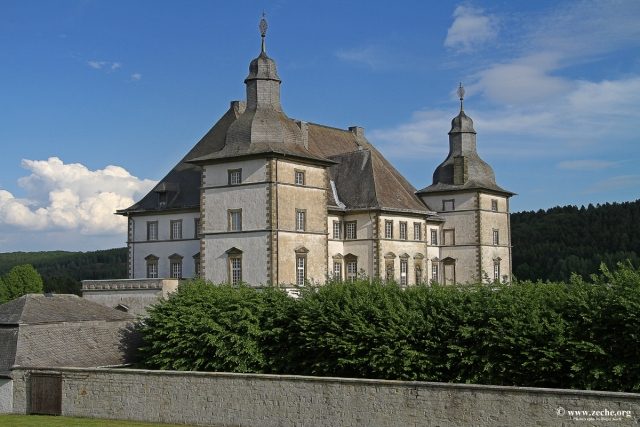
The Teutonic Order Commandery Mülheim in Sichtigvor (today the city of Warstein) was founded between 1266 and 1268. It existed until its secularization in 1809, initially falling to Hesse-Darmstadt and in 1816 to the Prussian state. Later, the buildings were used by various orders for different purposes.
Period of Origin
In the years 1266/68, a knight of Mulnheim bequeathed his property to the Teutonic Order. Since the main court was a fief of the Counts of Arnsberg, the Order had to cede a replacement court to them.
More difficult was the acquisition of the patronage rights of the existing parish church of St. Margaretha. The Patroklistift in Soest held the rights, and the Herdecke Abbey also claimed its rights after the death of the last lord of Mülheim. In 1275, Herdecke Abbey gave the patronage of the church in Allagen to the Patroklistift and received the patronage in Mülheim in return. However, for unknown reasons, this passed to the Teutonic Order in the same year. Nevertheless, the rights to invest the parish priest and the synodal rights remained with the Patroklistift. The priests of the Order also took over the pastoral care in the parish. The name of the church was sometimes also used for the commandery. With the transfer of the church, the not inconsiderable church properties also fell to the Order. Since the church itself had no assets of its own after the dissolution of the Order, the state is still responsible for its maintenance today. The church still serves as a parish church.
The Teutonic Order initially established only a settlement in Mülheim, which was elevated to a convent in 1290. The convent originally consisted of twelve knight brothers under a commander, analogous to the number of disciples.
Crisis in the Late Middle Ages
In the following years, the Order managed to considerably expand its initially modest possessions. Nevertheless, the means were too small to maintain the convent. Already at the beginning of the 14th century, it ceased to exist in its original form.
Subsequently, the commandery retained a certain importance as a training center for new knights. Numerous knights trained in Mülheim were sent to Livonia, participated in the military conflicts there, and settled there.
The commandery was increasingly affected by conflicts within the region. The settlement was severely damaged by the Soest Feud in the middle of the 15th century.
Rise to the Seat of the Land Commander for Westphalia
Since 1544, Mülheim, alongside the Münster Commandery, became a seat of the Land Commander of the Bailiwick of Westphalia. In the Truchsessian War of the 1580s, the institution was repeatedly plundered by troops of the Cologne Archbishop Gebhard Truchsess von Waldburg, who had converted to Protestantism. The role of Commander Neveling von der Recke was contradictory. On the one hand, he lived in Rüthen with a concubine and six children. On the other hand, he was one of the leading forces of the noble opposition in the Duchy of Westphalia against Truchsess von Waldburg's attempt at reformation.
After a brief recovery phase, the Thirty Years' War brought new destruction. Temporarily, the Land Commander moved to Münster for security reasons. Since then, there was no longer an actual convent in Mülheim. Only the Land Commander resided here. Land Commander Rab Luther Schilder († 1650) also lived with a mistress. He granted his children usufruct rights to the lands belonging to the commandery.
Overall, the war had plunged the Order in Westphalia into a deep, also financial, crisis. Land Commander August Oswald von Lichtenstein tried to counter this with administrative reforms. Thus, in 1656, the commanderies of Mülheim and Münster were organizationally united. Since then, Mülheim became the permanent seat of the Land Commander for the Bailiwick of Westphalia. Von Lichtenstein also tried to improve the economic basis of the commandery. For this purpose, the village of Sichtigvor was created, where subjects of the Order were settled. In 1688, the commandery was debt-free.
Lichtenstein's successors, Franz Wilhelm von Fürstenberg and Wilhelm von Plettenberg, also continued the upswing. In the second half of the 17th and at the beginning of the 18th century, the commandery experienced a new period of prosperity, which was reflected in lively building activity. Under Commander Georg Levin von Nagel, the upswing ended. The subsequent commanders made no significant structural changes, instead spending a large part of the income on their small but quite costly court.
Burdens also arose particularly from contributions during the Seven Years' War. The commandery finally had over 21,000 thalers in debt. Since the income no longer covered the maintenance, in 1777, the Osnabrück Commandery was added to Mülheim to increase income. The Brackel Commandery was also administered by Mülheim since the 1790s.
The last Commander, Franz Wenzel von Kaunitz-Rietberg, no longer resided in Mülheim but in Vienna. Since 1803, the Mülheim Commandery belonged to the Landgraviate of Hesse-Darmstadt. This resulted in the loss of various rights. In 1808, the Land Commander was in Mülheim for the last time. On July 24, 1809, Napoleon abolished the Teutonic Order. Shortly thereafter, the Mülheim Commandery and its possessions were taken over by the Hessian-Darmstadt state.
Possessions
A list of possessions from 1724 shows, in addition to numerous buildings, 500 Morgen of arable and pasture land, and approximately the same amount of forest. In addition, there were 800 Morgen of free noble property in individual farms and 8000 Morgen in villages and tributary cottages. The Seven Years' War ended this upward trend due to high contributions. The same applies to the Coalition Wars in the wake of the French Revolution.
Further Development
In 1809, with the dissolution of the Order, the Teutonic Order Commandery in Mülheim also ended. The possessions fell to the state, first to Hesse-Darmstadt and after 1816 to Prussia. The commandery served as a court and administrative seat for the Belecke district. Apartments for officials were also housed there. In 1840, the real estate was sold by the Prussian state to some noble landowners.
The commandery building was sold to the Order of the Salesian Sisters on March 19, 1860. They maintained a girls' boarding school there until the time of the Kulturkampf. In 1885, it was taken over by the Olpe Franciscans, who established a domestic science school there, a children's home for late repatriate children after the Second World War, and temporarily the community kindergarten. They maintained a children's convalescent home there until 1994. Subsequently, the Community of the Beatitudes owned and inhabited the commandery. In July 2009, the complex was sold to an investor. In 2011, a first attempt to auction the complex failed.
Buildings+
After a fire in 1593, the main building was rebuilt. At the beginning of the 17th century, Land Commander Rab Dietrich Overlacker had a wall ring erected around the commandery grounds. Around 1688, at the instigation of Land Commander Franz Wilhelm von Fürstenberg, the construction of a new commandery building began. Ambrosius von Oelde is considered the architect. In the further course of the 18th century, the commandery building was extended upwards, various outbuildings, a rent office (1734) and a rectory (1749) were erected.
Under Commander Wilhelm von Plettenberg-Lenhausen, the construction of a new church began in 1707. The Church of St. Margaretha is a three-bay, single-nave hall with a tower built into the west. The style is described as Gothicizing Baroque. The buildings of the commandery and the church together form a high-lying, quite extensive building complex. The main building is three-story with a central risalit, lateral corner towers, and a representative grand staircase.
Inside the main building is a house chapel. The large chapel visible today is said to be located on the site of the former refectory. After secularization, the chapel was desecrated, but later re-consecrated. In 1909, the Franciscans had the room enlarged. The historical windows were inserted into the new outer wall. However, the resulting extension disturbed the overall baroque character of the complex. The interior of the chapel was renovated in the 1950s.
Commanders+
- Dietrich von Heiden (1501–1536)
- Dietrich von Heiden d. J. (1537–1565)
- Neveling von der Recke (1565–1591)
- Georg von Hanxleden (1592–1609)
- Rab Dietrich Overlacker (1609–1632)
- Rab Luther Schilder (1632–1651)
- August Oswald von Lichtenstein (1653–1663)
- Johann Winold von Westrem (1663–1671)
- Franz Wilhelm von Fürstenberg (1671–1688)
- Wilhelm von Plettenberg (1692–1711)
- Georg Levin von Nagel (1712–1723)
- Franz Gaudenz von Westrem (1724–1729)
- Franz Wilhelm von Westrem (1729–1740)
- Ferdinand Moritz von Mengersen (1740–1788)
- Franz Wenzel von Kaunitz-Rietberg (1788–1806)
Take Mobile History with you
You are reading this text for free. Premium adds what matters on the road: descriptions read aloud, sites found through your camera, whole regions taken offline.
- Every description, including the ~17,700 Premium sites
- Audio guide: have descriptions read to you on location
- AR finder: see sites through your camera, with distance and bearing
- Unlimited saved sites
14 days free, then from €2.99 a month. Cancel anytime.
Source: Wikipedia · Licence: CC BY-SA 4.0 · Image: http://www.zeche.org/
This description draws on the facts documented in the linked Wikipedia article; Wikipedia content is licensed under CC BY-SA 4.0. Wording and editing: Mobile History.
Location: 51.4902, 8.2791