Vineyard
ManorGuntersblum
Deutschherren Manor
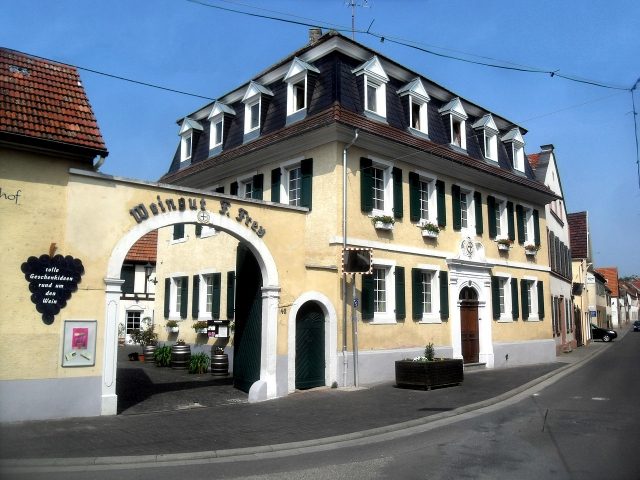
The Deutschherrenhof in Guntersblum, Rheinhessen, was a manor with a significant history. Today, a winery of the same name is located on the grounds of the former Deutschherrenhof. The property is now considered a cultural monument.
The history of the Deutschherrenhof dates back to the 15th century. During this time, Anthis Lock, a court sealer from the neighboring village of Hangen-Wahlheim, owned large parts of Guntersblum. After Anthis Lock died in the mid-15th century, his property passed to the noble court member Hans von Flomborn, also known as Partenheimer. After he died in 1490, his property passed to his widow, Anna von Albig, and from 1494 also to Anna von Albig's brother Hans von Albig. On September 29 of that year, Count Emich VIII von Leiningen enfeoffed Hans von Albig with his then Partenheim inheritance. At the beginning of the 16th century, Hans von Albig then took possession of the entire former Lock property.
After his death, the estate fell to the Teutonic Order. The property, now known as Deutschherrngut, was finally leased to the courtier Philipp Baber in 1554. Six years later, the property was leased to Gelbert Hunger. Almost 75 years later, in 1624, the property was again leased to Philipp Ludwig Steud, before Philipp Friedrich von Wachenheim bought it two years later. After the Thirty Years' War, the estate was owned by Matthes Soltz until 1662, before Anton Christrichard owned it shortly thereafter until 1697. From 1697, the property then passed into the possession of his son Johann Wilhelm Reichert. In 1712, Johann Adam Henkel finally bought the so-called German Estate. Five years later, an urgent need for renovation of the barn, stable, cellar, and residential building was identified, the execution of which would cost at least 150 guilders. However, instead of having the property and its outbuildings renovated, they were demolished in the following years and completely rebuilt.
From 1743, a rumor spread by head hunter Georg Andreas Wagner as Deutschhof estate manager arose that parts of Henkel's property belonged to the Teutonic Order. Henkel's successor in ownership in 1743 was the Palatine Chamber Councilor Christian Adolph Rudersdorf. He pursued the matter further. Later, however, the opposite could be proven to him. In November 1762, Sebastian Lang, who came from Lörzweiler, finally bought the property of the Deutschherrenhof. However, he lived there with his wife for only a short time. Five years later, the Deutschherrenhof property fell into the hands of Georg Hell. He, in turn, also kept the estate for only a very short time before selling it in April 1770 to Johann Michael Schilling from Schornsheim. He, in turn, sold the estate only five years later to the local carpenter Johann Valentin Brutscher. After Brutscher was insolvent, he sold the property.
Consequently, Ludwig Belzer of Guntersblum, who also successfully managed the estate of the Worms Cathedral Chapter in Guntersblum at the same time, took over ownership of the Deutschherrenhof in September 1780. At his initiative, a stately residential building was erected at today's Hauptstraße No. 42, in direct proximity to the New Castle, in Guntersblum. The year 1786, carved above the front door, bears witness to this building. At the beginning of the 19th century, the ownership of the Deutschherrenhof was finally attributed to Johann Jacob Schnell from Dexheim, the second husband of the widow Belzer.
In July 1814, after Johann Jacob Schnell's wife died three years earlier in July 1811, her eldest son, Ludwig Belzer, sold the property for 11,420.87 Francs to the local Guntersblum resident Johann Georg Frey. With his wife, he successfully built up an agricultural business from 1814.
Location+
The property is located in the center of Guntersblum. In direct proximity to the Deutschherrenhof on Hauptstraße is the New Castle. A few hundred meters to the west is the Protestant church, and only a few hundred meters to the south is the first Guntersblum castle, today's Leininger Castle. On the directly opposite side of the street from the castle on today's Hauptstraße was also the old Guntersblum town hall, before it was demolished in 1834 as part of the move to the Leininger Castle.
Layout+
Where there used to be much land and property of the estate, there are now many houses of different ownership. Directly on Hauptstraße is the residential building of the Frey family, who own the Deutschherrenhof today. Also directly on Hauptstraße is a large archway, through which a generously laid out courtyard can be reached. In the rear buildings, numerous rooms of the winery of the same name, operated by the Frey family, can also be found.
Current Use+
Today, the property of the former Deutschherrenhof at Hauptstraße No. 42 is privately owned. The owning family also operates a winery of the same name in the rooms on the former Deutschherrenhof.
Take Mobile History with you
You are reading this text for free. Premium adds what matters on the road: descriptions read aloud, sites found through your camera, whole regions taken offline.
- Every description, including the ~17,700 Premium sites
- Audio guide: have descriptions read to you on location
- AR finder: see sites through your camera, with distance and bearing
- Unlimited saved sites
14 days free, then from €2.99 a month. Cancel anytime.
Source: Wikipedia · Licence: CC BY-SA 4.0 · Image: https://commons.wikimedia.org/wiki/File:Guntersblum-_Deutschherrenhof_%28Weingut_Frey%29-_von_Hauptstra%C3%9Fe_aus_29.5.2010.JPG
This description draws on the facts documented in the linked Wikipedia article; Wikipedia content is licensed under CC BY-SA 4.0. Wording and editing: Mobile History.
Location: 49.7976, 8.3456