Hotel
CastleCreuzburg
Creuzburg Castle
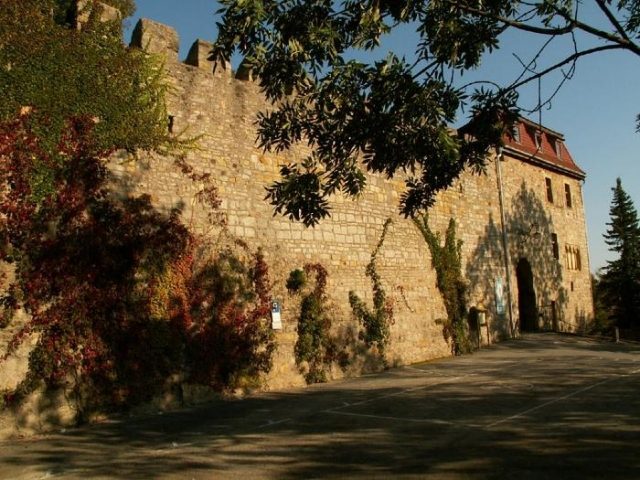
Creuzburg Castle is located northwest of Eisenach in the town of Creuzburg in the Wartburg district of Thuringia. The medieval castle complex is situated on a hill above the town in the Werra valley and is known as the "sister castle of Wartburg Castle".
Significance+
Creuzburg was one of the residences of the Ludowings and a preferred place of residence for Landgravine Elisabeth of Thuringia, who became Saint Elisabeth, the German "national saint" of the Middle Ages. She also gave birth to her son Hermann in the castle in 1222.
The castle was built between 1165 and 1170 on behalf of Landgrave Ludwig II – according to tradition, on the site of an older fortified monastery, which was replaced by the St. Jakob Monastery founded around 1173. This construction phase corresponded to the type of a Romanesque ring wall castle. From this period, the ring wall, the tower house with Elisabeth's chamber, and parts of the palas have been preserved.
The castle was intended as a fortress north of Eisenach to protect the landgravial possessions, the town of Creuzburg founded in 1213, and the Werra bridge located there. It experienced its heyday in the 12th and 13th centuries, when it was one of the secondary residences of the Landgraves of Thuringia.
During this time, it had to endure two severe sieges: in 1260, during the Thuringian War of Succession, the troops of Sophie of Brabant temporarily managed to capture the town.
In 1295, the town and castle were besieged for four weeks by King Adolf of Nassau. They could only be taken when he set the town on fire with pitch wreaths and the castle garrison, despite fierce fighting and tenacious perseverance, was finally forced to surrender due to lack of water. Johannes Rothe names these brave castle men in his chronicle: von Creuzburg, von Nesselrieden, Slune (Schlaun, i.e. v. Hayn called Schlaun), von Buttlar, von Stein, von Pferdsdorf, Strier (Strieger), Stouben (v. Steuben) and Frowen. Later, the von Harstall, von Boyneburg, Zenge and von Eschwege also belonged to the Creuzburg castle men.
Under the Wettins, Creuzburg was designated as the seat of an administrative office, which comprised a significant portion in the north of today's Wartburg district. The castle complex was expanded with a well house, a granary, and other outbuildings. Below the castle, within the city walls, were the residences of the castle men and knights.
With the advent of firearms, the military value of the fortress declined, and from the 15th century onwards, it served as a court and administrative seat; for this purpose, the Yellow House was built. During the Thirty Years' War and the Seven Years' War, the castle often served as headquarters and officers' quarters for passing armies.
In the 18th century, Creuzburg was converted into a palace complex by the state master builder Gottfried Heinrich Krohne for the Saxon Duke Johann Wilhelm; the Duke's House, the coach houses, and probably also the putti in the palace park date from this period. In 1779, Goethe was at Creuzburg for the first time on official business. In 1848, members of student fraternities were imprisoned in the residential tower. In 1879, the office was dissolved.
In 1899, a Mr. von Dreyse – a grandson of the inventor of the needle gun – acquired the castle and associated properties. In 1921, the Erfurt hotelier and patron Georg Kossenhaschen bought Creuzburg; he commissioned its renovation by castle expert Bodo Ebhardt, used Creuzburg as a private residence, furnished it artistically, and made it available as a writers' retreat. Kossenhaschen had a tall, slender Boniface cross erected in the courtyard and an Elisabeth chamber built.
Until the beginning of the Second World War, at the invitation of the Schäfermeier-Kossenhaschen owners, regular children's festivals and meetings of elderly people from the town took place at the castle. Later, refugees and wounded were accommodated. The castle suffered only minor damage during the heavy artillery shelling of the town by US troops on Easter Sunday, April 1, 1945. The next day, the Americans occupied the castle. In May, they established a special authority at Creuzburg; before that, the refugees had to leave their accommodations within hours for the destroyed town. The Schäfermeier-Kossenhaschen family was expelled after the Red Army moved in and expropriated without compensation. The valuable furnishings of the castle were largely lost. Creuzburg initially served as a barracks for the occupying power, then for border troops, and was later made available to the city administration. Until 1975, the rooms were used as a school and holiday camp, but no repairs were carried out, so it had to be closed by building authorities in 1975. In 1981, Creuzburg citizens founded the interest group "Die Creuzburg" – an association for the renovation of the dilapidated castle, which undertook the clearing and gradual renovation and made the complex and the park accessible to the public again by 1991.
The conversion work required for hotel operations was completed in 1997; today, the castle is owned by the town of Creuzburg.
The heirs of Georg Kossenhaschen had already applied for restitution in 1990. However, the responsible office for open property issues had only assigned a file number after a renewed inquiry by the heirs' lawyer. A renewed application by the heirs was rejected by the office for open property issues in Gera in January 2011.
Architecture+
The entire complex today comprises the Romanesque castle, the terraced park on the south and east slopes of the castle hill, as well as the access roads and a part of the city wall. The circumference of the castle wall is 340 meters, the inner area measures approximately 7400 square meters, making Creuzburg one of the larger preserved Romanesque stone castles in Thuringia.
Today, the premises of the restored castle house a hotel with a restaurant, the Creuzburg registry office, a private pottery, and the Creuzburg local history museum with various collection focuses in the Michael Praetorius Room, the Elisabeth Chamber, the Torture Cellar, and the so-called Local History Cabinet. The castle courtyard with a small Baroque garden, a wooden Boniface cross, a deep castle well, and the prominent summer lime tree is freely accessible.
Take Mobile History with you
You are reading this text for free. Premium adds what matters on the road: descriptions read aloud, sites found through your camera, whole regions taken offline.
- Every description, including the ~17,700 Premium sites
- Audio guide: have descriptions read to you on location
- AR finder: see sites through your camera, with distance and bearing
- Unlimited saved sites
14 days free, then from €2.99 a month. Cancel anytime.
Source: Wikipedia · Licence: CC BY-SA 4.0 · Image: http://www.wehrbauten.de/thread.php?threadid=615
This description draws on the facts documented in the linked Wikipedia article; Wikipedia content is licensed under CC BY-SA 4.0. Wording and editing: Mobile History.
Location: 51.0514, 10.2449