The remains of the ancient town can be visited
Ancient BuildingRoma
Circo Massimo (Circus Maximus)
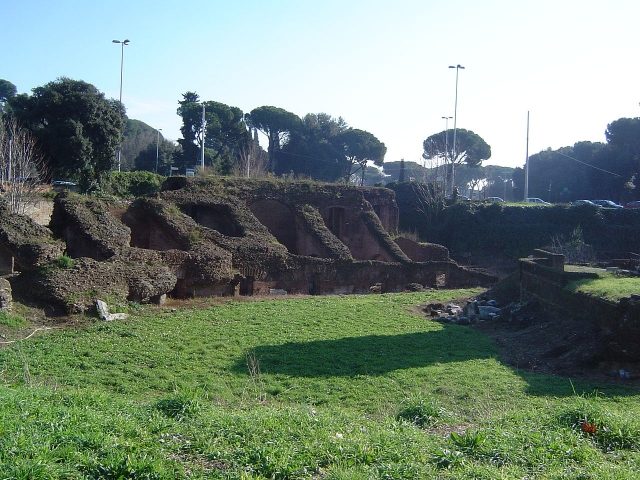
The Circo Massimo, once the largest arena in ancient Rome, was a monumental event building famous for its chariot races and other spectacles. Located in the Murcian Valley between the Palatine and Aventine hills, it still bears witness to the engineering skill and entertainment spirit of the Romans.
History+
As early as the 6th century BC, the swampy Murcian Valley was drained and used for competitions. King Lucius Tarquinius Priscus is said to have erected the first wooden grandstands, which repeatedly collapsed later. Gaius Iulius Caesar had permanent marble seating installed, and under Augustus, the Circus was further expanded, with the first obelisk placed on the spina. Constantius II added a second obelisk in the 4th century. Under Trajan, by 103 AD, the Circus was fully constructed with stone and bricks. In the early 4th century AD, the Circus reached its maximum size with a capacity of up to 385,000 spectators. The last attested races took place in the 6th century AD. After antiquity, the Circus fell into disrepair, was used for agriculture, and served as a fortress in the Middle Ages. In the 19th century, a gasometer was built, before excavations of the ancient remains began in the 1930s.
Location+
The Circo Massimo is located in Rome, in the province of Rome, in the Lazio region of Italy. It lies at an elevation of approximately 13 meters above sea level.
On site+
Today, the Circo Massimo is a vast grassy area whose original form is still clearly recognizable. Visitors can explore the remains of the ancient city. In the eastern area, excavations since 1936 have uncovered parts of the ancient seating rows and stairs, as well as the remains of a tower from the Santa Lucia in Settizodio complex. The area is now used for large events and concerts.
Nearby+
- Domus Augustana (Ancient Buildings), approx. 0.2 km away
- Domus Flavia (Ancient Buildings), approx. 0.3 km away
- Domus Augusti (Ancient Buildings), approx. 0.3 km away
- Arco di Giano (Arch of Janus) (Ancient Buildings), approx. 0.5 km away
Take Mobile History with you
You are reading this text for free. Premium adds what matters on the road: descriptions read aloud, sites found through your camera, whole regions taken offline.
- Every description, including the ~17,700 Premium sites
- Audio guide: have descriptions read to you on location
- AR finder: see sites through your camera, with distance and bearing
- Unlimited saved sites
14 days free, then from €2.99 a month. Cancel anytime.
Source: Wikipedia · Licence: CC BY-SA 4.0 · Image: http://commons.wikimedia.org/wiki/File:Circus_Maximus_Remains_South_curve.JPG?uselang=de
This description draws on the facts documented in the linked Wikipedia article; Wikipedia content is licensed under CC BY-SA 4.0. Wording and editing: Mobile History.
Location: 41.8859, 12.4858