Local government
CastleLausanne
Château Saint-Maire (Lausanne)
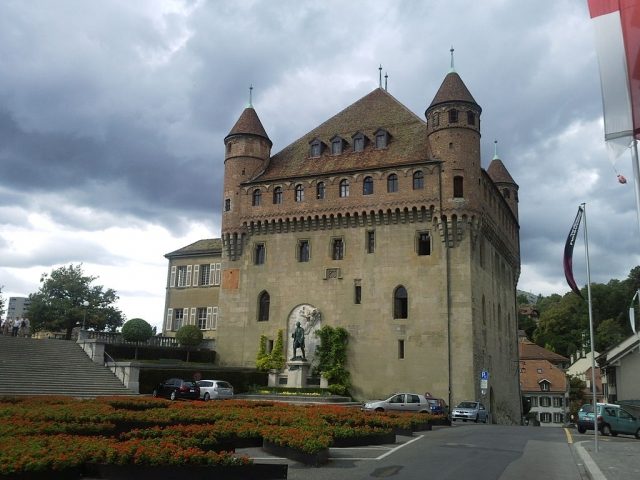
The Château Saint-Maire is a castle in the city center of Lausanne, Switzerland. It is part of the Swiss Inventory of Cultural Property of National and Regional Significance.
The Château Saint-Maire was commissioned by the Bishop of Lausanne, and the building was constructed from 1397 to 1406. Guillaume de Menthonay began the work but was murdered by his hairdresser in 1406, so the work was completed under Guillaume de Challant. During this era, it was common to build fortresses in a large cube shape, which encompassed living quarters and defense. In the canton of Vaud, the castles of Vufflens and Blonay were also built according to the same principle.
The castle's defenses held when the citizens rebelled against the bishop in 1482. They did not succeed in taking the castle.
Bern, under the leadership of Hans Franz Nägeli, conquered Vaud in March 1536. The last Bishop of Lausanne, Sébastien de Montfalcon, had to flee, and the castle passed into Bern's possession. Nothing significant was changed on the building. Only in 1789 did the bailiff add two stories adjacent to the castle to gain more space and light. Eleven years later, in 1798, Ludwig von Büren, the last bailiff, was asked to leave the castle.
From 1811, the Small Council, now the cantonal government, took up residence. To this day, Château Saint-Maire is the seat of the canton's executive authority.
Several renovations were carried out during the 19th century. A terrace was built in one corner of the castle, and the gate was destroyed to widen the access road.
In honor of Major Davel, a statue was erected on the main facade. He spent his last night near the gate that still existed at that time.
As it is the seat of the government, the castle cannot be visited.
Architecture+
The Château Saint-Maire is a large cube of gray molasse, which has red brick floors with machicolations and corner turrets. This is the typical style from the Aosta Valley – Guillaume de Challant belonged to an old and noble Valdotain family. The interior was decorated by Aymon de Montfalcon between 1498 and 1517.
Upon closer inspection of the upper part of the castle, one can see split battlements. These suggest that there were loopholes there, which allowed defenders to hide halfway. The roofs were probably lowered. The same style of battlements can be found in the castles of Locarno and Bellinzona. However, the loopholes were never needed during the Bernese period, and they were filled in, and the roof was brought back to the edge of the walls.
Take Mobile History with you
You are reading this text for free. Premium adds what matters on the road: descriptions read aloud, sites found through your camera, whole regions taken offline.
- Every description, including the ~17,700 Premium sites
- Audio guide: have descriptions read to you on location
- AR finder: see sites through your camera, with distance and bearing
- Unlimited saved sites
14 days free, then from €2.99 a month. Cancel anytime.
Source: Wikipedia · Licence: CC BY-SA 4.0
This description draws on the facts documented in the linked Wikipedia article; Wikipedia content is licensed under CC BY-SA 4.0. Wording and editing: Mobile History.
Location: 46.5247, 6.6357