To be privately owned
CastleDenens
Château Denens
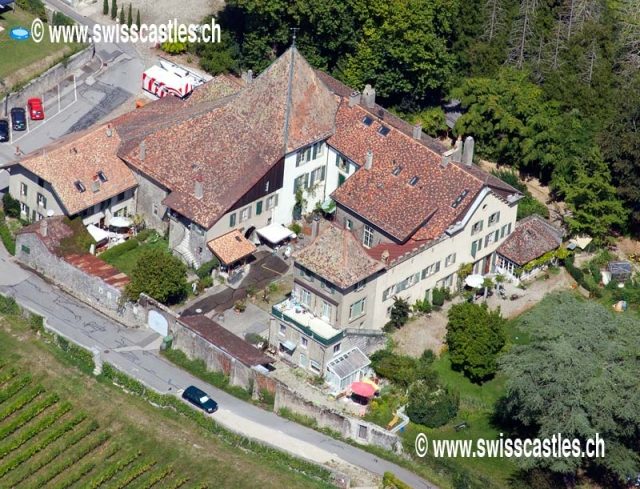
A predecessor building (fortified house) was already mentioned in 1005 in a Latin document from the Bishop of Geneva. The castle, built under Louis of Savoy in the 14th century, was converted into a chateau in the 17th century; parts of the medieval fortifications are preserved. Between the 14th and 17th centuries, the chateau often changed owners. In 1365, it passed to Marguerite d'Oron, then to the Compey family, who owned it from 1370 to 1531. The coat of arms of Denens, a crow on a mountain, is derived from that of Jeanne Curnillon, who owned the chateau in the mid-16th century. The property was transferred as an inheritance or as a dowry. Denens remained intact despite the warlike turmoil, without being besieged or attacked.
After passing into the hands of the Tavel family, the chateau was in the hands of the de Buren family, an important dynasty in the region. Ludwig de Buren was the last bailiff from Bern to Lausanne. He was an officer and propagandist in French service before settling in Switzerland. Ludwig de Buren helped a young corporal, Napoleon Bonaparte, rise in Toulon. The latter visited him in 1797 at Saint-Maire Castle in Lausanne to thank him for his gesture.
Denens Castle was attacked in 1802 by the Bourla-Papey. Patois for "burning papers," this referred to the revolting rural peasants who at that time attacked the castles of Sarraz, Bière, Mollens, Pampigny, Saint-Saphorin, Vufflens, and Denens. Under the slogan "Peace for men, war on paper!" they invested the central administrative offices of Vaud power and burned the documents that allowed the collection of taxes.
Around 1785, the chateau burned down. It was rebuilt but lost its military significance to become a noble residence. A few years later, the bailiwick of Buren reached the Bernese border. Being rather good-natured, he was allowed to return and live in his residence in Denens. Unfortunately, the man was a gambler and lost a large part of his property with bad cards. His sons and brother had to place him under protection before he squandered everything. As a result, of the old property, which represented one of the largest territories in French Switzerland, only the chateau, surrounded by some forests and arable land, remained for his descendants. Since that era, the chateau has remained the property of the de Buren family, who still inhabit it today.
Take Mobile History with you
You are reading this text for free. Premium adds what matters on the road: descriptions read aloud, sites found through your camera, whole regions taken offline.
- Every description, including the ~17,700 Premium sites
- Audio guide: have descriptions read to you on location
- AR finder: see sites through your camera, with distance and bearing
- Unlimited saved sites
14 days free, then from €2.99 a month. Cancel anytime.
Source: Wikipedia · Licence: CC BY-SA 4.0
This description draws on the facts documented in the linked Wikipedia article; Wikipedia content is licensed under CC BY-SA 4.0. Wording and editing: Mobile History.
Location: 46.5176, 6.4589