The Castle can be visited
CastleAlex
Château d'Alex
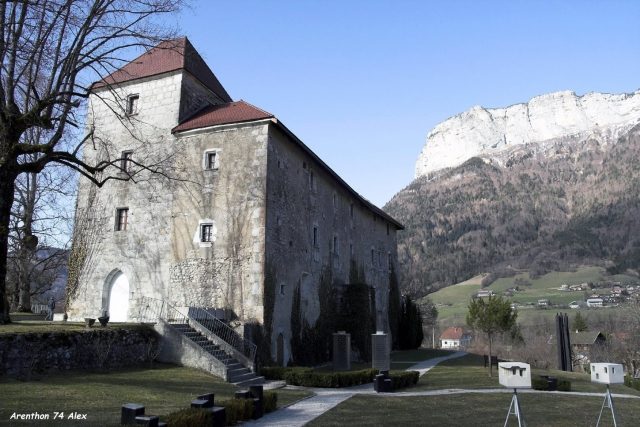
Alex Castle, also known locally as Arenthon, is a former fortified house from the 14th century, the center of the seigneury of Alex, elevated to a county in 1783, which stands in the commune of Alex in the department of Haute-Savoie, in the Auvergne-Rhône-Alpes region.
Location+
Alex Castle is located in the French department of Haute-Savoie on a hill in the commune of Alex. It monitored the outlet of the Col de Bluffy and the Fier valley on the road from Annecy to Thônes, facing Dingy Castle, which has since disappeared.
History+
In the 14th century, Alex Castle belonged to the lords of Les Clets, while neighboring lordships were the possession of the Menthon family. In 1340, the castle is mentioned as a possession of the Alex family. In 1383, Marguerite d'Alex, the last member of the family, brought the castle as a dowry to Pierre d'Arenthon, giving birth to the Arenthon d'Alex family. In 1420, François d'Arenthon, in a recognition he held from the Prince of Savoy, cited: "a fortified house behind Alex with a piece of meadow and a curtil (garden), a mill and a fulling mill on the bank of the Alex stream with sluices and appurtenances". In August 1541, Pierre Favre stayed two days at the castle. Jean d'Arenthon d'Alex was born at Alex Castle in 1620; he would become prince-bishop of Geneva in 1661 and would have the grand seminary of Annecy built in 1684. Upon the extinction of this family at the beginning of the 18th century, with Denis d'Arenthon d'Alex, captain in the Tarentaise regiment, president of the Sovereign Senate of Savoy, Alex passed to the Favier family, barons of Noyer, who in 1772 sold it to François-Marie de La Fléchère. He would see his lands of Alex elevated to a county in 1783 by the King of Sardinia. Following the insurrection in the Thônes valley in the spring of 1793, of which Alex was one of the strongholds, François-Marie de la Fléchère was placed at the head of the riots that shook Annecy in August and his massacre at Les Marquisats, the castle was confiscated and then sold as national property. The families Perravex, Laffin, Bardet, Gay, Duret then succeeded each other. Between 1884-1894, Philippe Gay, the new owner, had most of it demolished. In 1960, according to testimonies, the owners, farmers, used parchments stacked in wooden chests as toilet paper. It housed the Salomon Foundation for Contemporary Art from June 2001 to the end of 2014. Since its closure, the castle has been put up for sale. Alex Castle and its surroundings are listed as natural monuments and sites by decree of June 2, 1947.
Description+
Of the original quadrilateral castle, only part of the dwellings remains, including the square tower and a Gothic door; three-quarters having been demolished by the owner between 1884-1894. It presents itself in the form of a dwelling, oriented north-south, the lower part of which houses a vaulted oratory, framed by two quadrangular towers. A spiral staircase serves double latrines on each level. At the beginning of the 16th century, the main building underwent a major construction campaign; the great hall was fitted with new fireplaces and a ceiling, beams and joists assembled in a Jupiter's trait, the installation of which was dated 1514 by dendrochronology. A second chapel, built during the construction of a new dwelling, features a coffered ceiling and a stone stoup. The kitchen includes a fireplace with a wide flue, provided with a support for the pot hook and a fireback intended to protect the salt from humidity. Upon the death of Denis d'Arenthon d'Alex in 1706, the inventory drawn up mentions the presence next to the archives cabinet of a cabinet used to hold criminals and cites "large irons used to put on the feet of criminals".
Successive Owners+
Alex Family (1340) Arenthon Family, then Arenthon d'Alex (1383-early 18th c.) Favier du Noyer Family (1706-1772) La Fléchère Family (1772) Perravex Family (post-Revolution) Laffin Family Bardet Family Gay Family Duret Family
Notes and References+
Take Mobile History with you
You are reading this text for free. Premium adds what matters on the road: descriptions read aloud, sites found through your camera, whole regions taken offline.
- Every description, including the ~17,700 Premium sites
- Audio guide: have descriptions read to you on location
- AR finder: see sites through your camera, with distance and bearing
- Unlimited saved sites
14 days free, then from €2.99 a month. Cancel anytime.
Source: Wikipedia · Licence: CC BY-SA 4.0 · Image: Hervé Rebours
This description draws on the facts documented in the linked Wikipedia article; Wikipedia content is licensed under CC BY-SA 4.0. Wording and editing: Mobile History.
Location: 45.8897, 6.2407