To be privately owned
CastleChampvent
Château Champvent
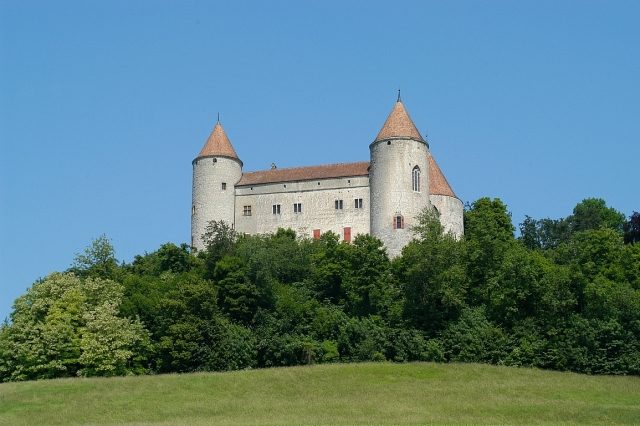
Perched on a high hill dominating the wide Thièle valley, Champvent Castle has retained its medieval character among the Vaud fortresses. Built around 1250 by Charles de Grandson, the castle has not changed much in size and form to this day. It comprises a curtain wall flanked by round towers. One of these was converted into a watchtower. Over the years, the interior of the buildings has been repeatedly redesigned to suit the taste and living style of various eras. With its rectangular enclosure wall and its four round towers, the work corresponded to a very common type of French-inspired castles, introduced in French-speaking Switzerland in the mid-13th century by the Dukes of Savoy.
The first mentions of the lordship of Champvent occurred around the year 1100. The village of Champvent, mentioned at the beginning of the 12th century, probably belonged to the Kings of Upper Burgundy. It is certain that the Lords of Grandson had settled in the Champvent region and established a considerable lordship even before the beginning of the 12th century. The lordship expanded over time far beyond the Vaud Jura zone and included the territories of Champvent, Mathod, Suscévez, Essert, Orges, Vugelles-la-Mothe, Vuiteboeuf, Sainte-Croix, and Bullet. Later, other fortified castles were built on the territory of the lordship of Champvent, such as the two castles of Mothe and Covatanne near Sainte-Croix. But the center of the lordship always remained the fortress of Champvent.
During the 13th and 14th centuries, the Lords of Champvent enjoyed high prestige in the Vaud lands. The family died out in 1336 with the death of Jean de Champvent. The property fell to Louis of Neuchâtel, who in his old age married Marguerite de Vufflens. After his death - he had no descendants - Marguerite married Jacques de Vergy in a second marriage, who became Lord of Champvent. The de Vergy, considered a wealthy and distinguished family, were among the intimate friends of the Burgundian Dukes. They inhabited Champvent for several generations, so that the lordship remained under the influence of the Duchy of Burgundy for a long time. During the Burgundian Wars, William de Vergy sided with Charles the Bold. Therefore, Champvent Castle was burned down by the troops of the Confederates after the Battle of Grandson. William rebuilt the castle. After the conquest of Vaud by the Bernese in 1536, the manorial rights reverted to the city of Bern and were administered by Yverdon. The castle then served only as a private manor house and often changed owners.
Take Mobile History with you
You are reading this text for free. Premium adds what matters on the road: descriptions read aloud, sites found through your camera, whole regions taken offline.
- Every description, including the ~17,700 Premium sites
- Audio guide: have descriptions read to you on location
- AR finder: see sites through your camera, with distance and bearing
- Unlimited saved sites
14 days free, then from €2.99 a month. Cancel anytime.
Source: Wikipedia · Licence: CC BY-SA 4.0
This description draws on the facts documented in the linked Wikipedia article; Wikipedia content is licensed under CC BY-SA 4.0. Wording and editing: Mobile History.
Location: 46.7790, 6.5715